Google is not just building the infrastructure for Agentic Commerce. It is also handing brands the tools they need to win inside it.
That distinction matters, because most merchants are watching the wrong layer. They are still optimizing for blue links and product listing ads, while the surface that actually decides visibility has moved into the AI conversation.
Two releases make this shift concrete: Google Conversational Attributes, which changed what your product feed says, and Merchant Center AI Performance Insights, which is about to change what you can measure. Together they close a loop that has been open since AI shopping began.
What Google Conversational Attributes Actually Changed
A few weeks ago I wrote about the launch of Google Conversational Attributes in Merchant Center. These are new feed fields, Product Highlights, Product Details, and a Q&A section, and they exist for one reason: to help AI understand, compare, and recommend your products inside a conversation. This is not a cosmetic addition to the feed. It is a change in what a product feed is for.
The old feed was built for a keyword match and a ranked list. Title, price, image, category, done. The new feed is built for a machine that reads, reasons, and answers a shopper's question in natural language. When someone asks an AI assistant for "a waterproof jacket that packs small for hiking in cold rain," the model does not scan ten blue links. It reads structured attributes, compares them across products, and returns a recommendation. If your feed does not describe the material, the weight, the packability, and the use case, the model cannot argue for you. It simply picks the product that gave it something to work with.
Consumers are already shopping this way, and the way products get discovered and recommended is shifting at the feed level, quietly, upstream of everything marketers usually touch. Yet most merchants have no idea it is happening. That gap between what the platform now rewards and what brands are actually doing is the whole story.

AI Performance Insights: Google's New Measurement Layer
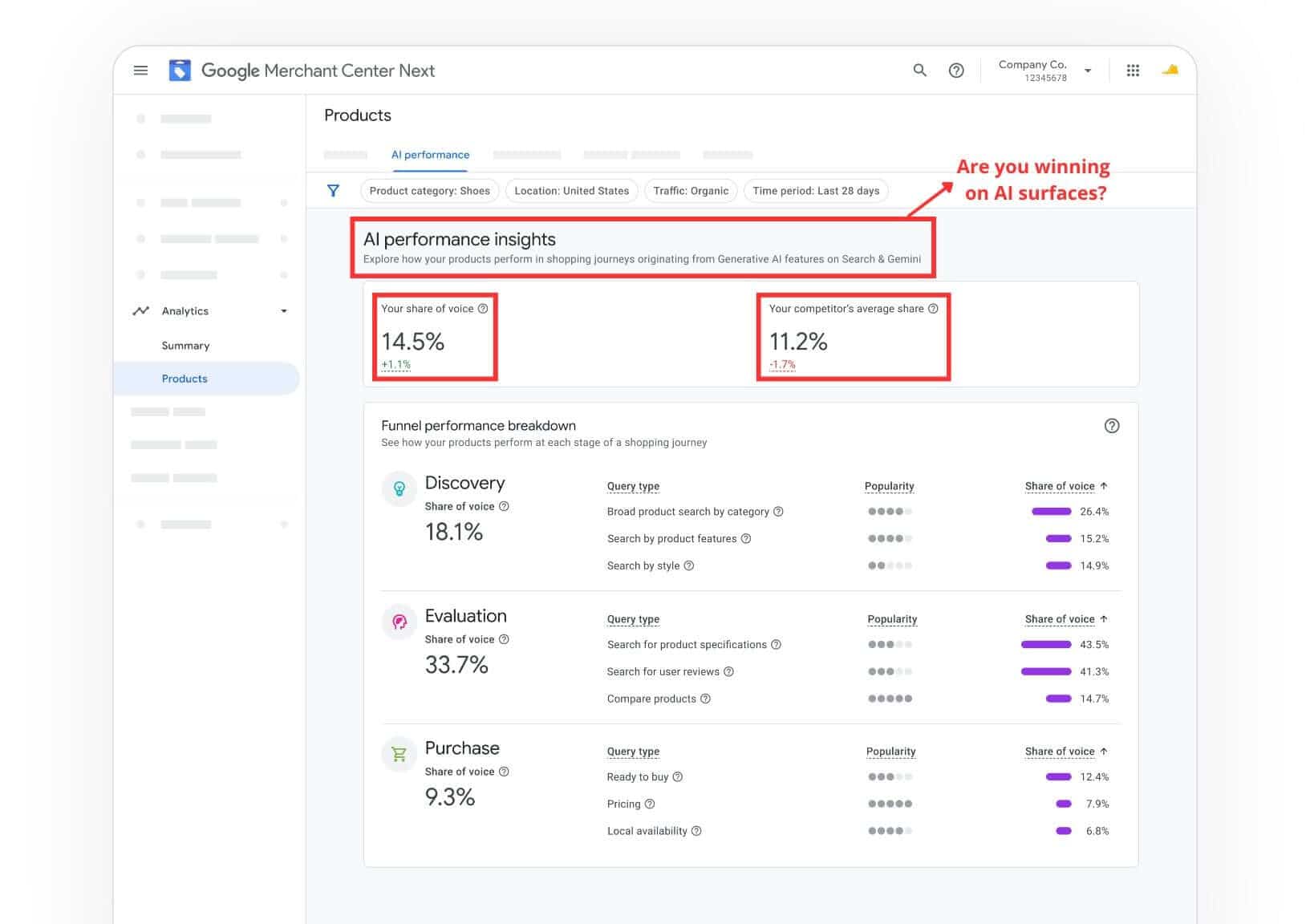
Now Google is completing the picture. AI Performance Insights is coming to Merchant Center, a native reporting layer that gives brands visibility into how their products perform across AI surfaces such as AI Mode, AI Overviews, and the Gemini app. For the first time, a brand can see itself the way the AI sees it.
Here is what AI Performance Insights tracks. It shows your share of voice against comparable brands across AI-driven shopping experiences, so you know whether the model surfaces you or a competitor. It shows shopping funnel performance across the stages that matter, discovery, evaluation, and purchase, so you can see where in the AI conversation you lose people. It surfaces the product terms buyers actually use when they ask about products like yours. And it exposes the product attributes shoppers are looking for, together with the gaps in your own data where you have nothing to say.
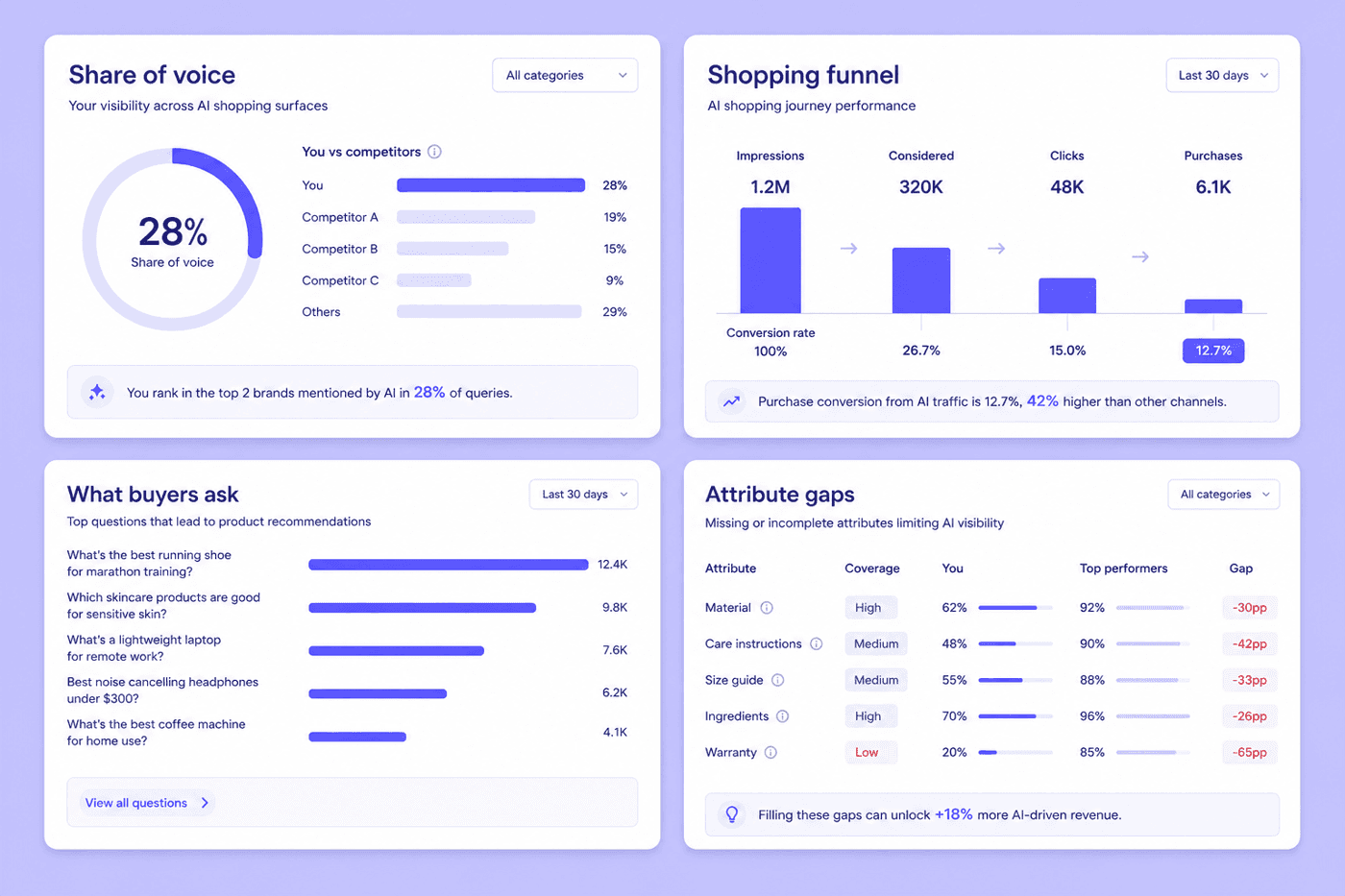
Read that last point again, because it is the one that turns Google Conversational Attributes from a nice-to-have into a scoreboard. Google is telling you exactly which attributes shoppers want and where your feed is silent. The optimization target and the measurement of it now live in the same place.
Why AI Performance Insights Is the Real Market Signal
Scale is the reason this cannot be dismissed as an experiment. AI Mode has crossed one billion monthly active users roughly a year after launch, and queries are more than doubling every quarter. That is exponential adoption, not a slow curve, and the average AI query is far longer and more specific than a classic search, which is precisely the kind of query that rewards a rich, well-described product feed.
But the deeper signal is in the sequence. There is a clear pattern in how Google moves. First it builds the surfaces. Then it builds the ad formats. Then it builds the measurement tools. It does not invest in measurement for a channel it considers marginal. Measurement is what arrives once a surface is ready to be monetized at scale, because you cannot sell performance that no one can see. AI Performance Insights just dropped. That is not a product update. That is Google telling the market that AI shopping is now a channel you are expected to manage, budget for, and be held accountable to.
My read is simple: the measurement layer is the starting gun. When a platform gives you a scoreboard, it has already decided the game is real.
The Pattern Behind Google Conversational Attributes and AI Performance Insights
Put the two releases side by side and the strategy is obvious. Google Conversational Attributes defined the inputs, the structured, machine-readable signals an AI needs to recommend a product with confidence. AI Performance Insights defines the outputs, the visibility into whether those inputs are working. Inputs and outputs, cause and effect, in one system. This is the same closed loop that made paid search a discipline rather than a guess: a lever you can pull, and a number that tells you if pulling it worked.
For years, AI shopping visibility was a black box. Brands suspected they were being left out of AI recommendations but had no way to prove it, and no clear lever to fix it. That excuse is gone. The lever is your feed and its conversational attributes. The proof is in the insights report. Anyone still treating AI shopping as unmeasurable is simply not looking at the tools already on the table.
What AI Performance Insights Will Expose in Your Product Feed
Here is the uncomfortable part for most catalogs. When AI Performance Insights lights up, it will not just show you where you rank. It will show you, attribute by attribute, everything your feed fails to say. The shopper wants "long battery life," and your data is silent. The shopper wants dimensions, materials, care instructions, compatibility, and your feed offers a title and a price. Every silence is a place where the model recommends someone else.
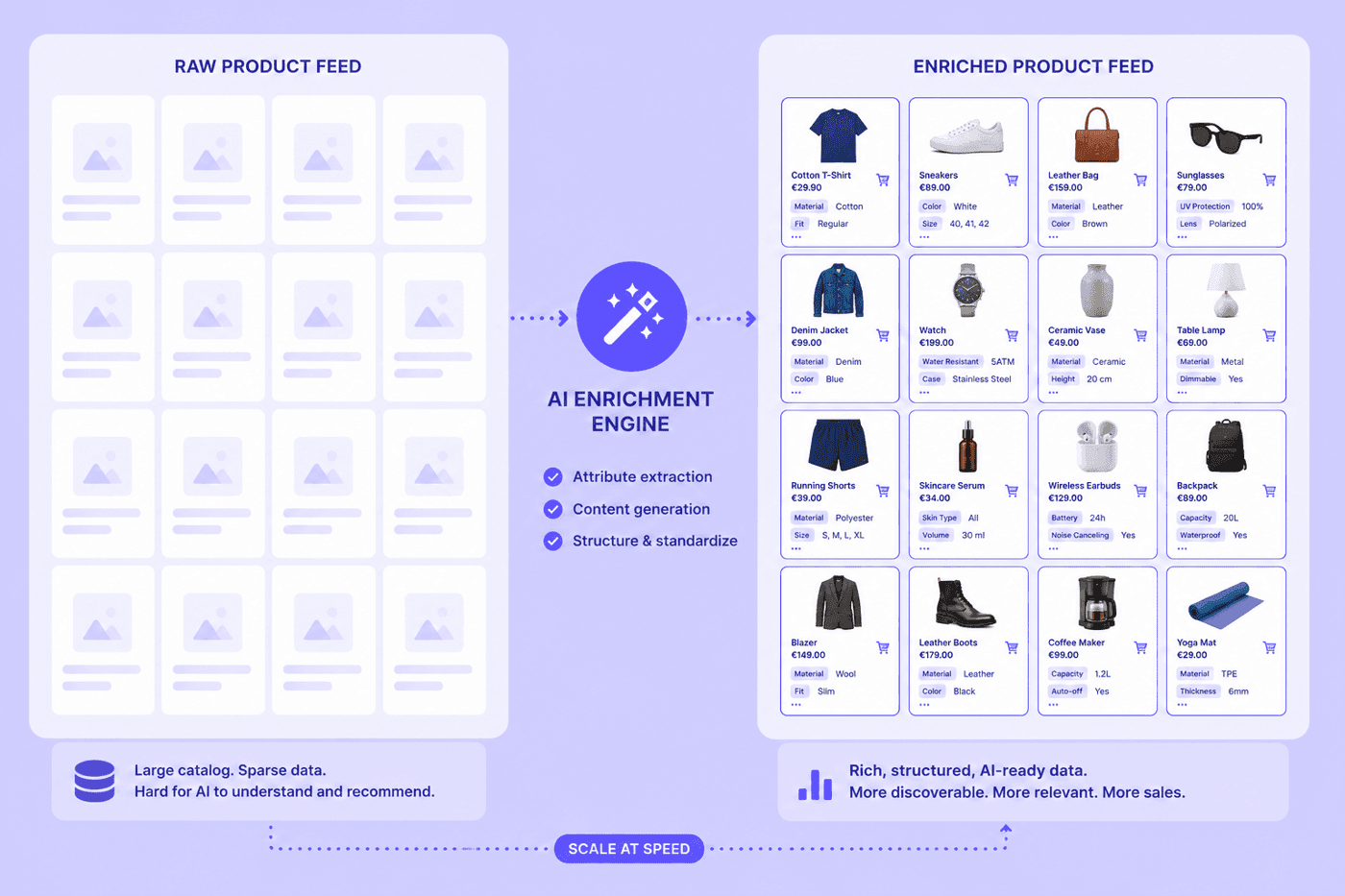
This is where the operational work lives, and it is not small. A brand with a handful of products can fill in Google Conversational Attributes by hand. A brand with tens of thousands of SKUs across multiple languages cannot, not manually, not at the speed the AI surfaces are growing. The bottleneck is no longer strategy. It is production: generating accurate, richly attributed, multilingual product data at catalog scale. This is exactly the gap AndromedAI was built to close, automatically generating and optimizing conversational attributes across an entire catalog, in any language, so the feed has something to say for every product a shopper might ask about.
How to Win With Google Conversational Attributes Before the Gap Closes
The practical move is to treat your feed as the primary asset for AI shopping, not an afterthought exported from your store. Start by populating Google Conversational Attributes for your best-selling products, then work down the tail. Write Product Highlights and Product Details the way a knowledgeable salesperson would answer a real question, in specifics, not marketing adjectives. Use the Q&A section to pre-answer the objections and comparisons that stall a purchase. Then, once AI Performance Insights is live in your market, use it as a closed feedback loop: find the attributes shoppers ask for, find where your data is silent, fill the gap, and watch your share of voice move.
The advantage here is temporary, which is what makes it worth chasing. Right now most competitors have not populated these fields and are not measuring any of this. The brands that optimize their feed while the reporting is still rolling out will have compounded a visibility lead by the time everyone else notices. Feeds that describe products in the language shoppers actually use will be recommended. Feeds that stay thin will quietly disappear from the conversation.
The Question Google Conversational Attributes and AI Performance Insights Force
Every brand should now be asking one question: is my product feed optimized for AI shopping? Not my website, not my ad copy, my feed, the structured data an AI actually reads before it recommends anything. Google has told you what to fill in with Conversational Attributes, and it is about to show you how you score with AI Performance Insights. The infrastructure is built, the surfaces are at billion-user scale, and the measurement tools have arrived.
That gap, between the brands whose feeds can be understood and recommended by AI, and the brands whose feeds cannot, is about to decide who gets recommended and who disappears. The tools to close it are already in Merchant Center. The only variable left is whether you use them before your competitors do.
Keep reading
Related articles



Free AI Readiness Audit
Find out what AI agents can't read on your product pages
Send us 3 product URLs. We score them for ChatGPT, Gemini and Google AI Mode, show what is missing and send them back fixed.
- AI Readiness Score for each page
- Missing attributes, keywords and shopper intents
- The optimized pages, ready to publish
Featured in









Google Conversational Attributes and AI Performance Insights
Google Conversational Attributes and AI Performance Insights now decide who AI recommends. Your product feed is the real battleground for Agentic Commerce.
Google Conversational Attributes and AI Performance Insights in Merchant Center
**Conversational Attributes** (Product Highlights, Product Details, Q&A) are new Merchant Center feed fields built to help AI understand, compare and recommend products. **AI Performance Insights** shows share of voice, funnel performance, buyer terms and attribute gaps across AI Mode, AI Overviews and Gemini. Google's sequence is surfaces, then ad formats, then measurement: a measurement layer means **AI shopping is now a channel you are accountable for**. The bottleneck is production: rich, multilingual attributes at catalog scale, which is the gap AndromedAI closes.
What are Google Conversational Attributes? | New Merchant Center feed fields (Product Highlights, Product Details, and a Q&A section) designed to help AI understand, compare, and recommend your products inside conversational shopping experiences. What is Google AI Performance Insights? | A native reporting layer coming to Google Merchant Center that shows how your products perform across AI Mode, AI Overviews, and the Gemini app: share of voice against competitors, funnel performance, the terms buyers ask about, and the attribute gaps in your product data. How can brands optimize their feed for AI shopping at scale? | Small catalogs can fill in Conversational Attributes manually, but large, multilingual catalogs cannot keep pace. Platforms like AndromedAI automatically generate and optimize conversational attributes across an entire catalog in any language. How do Google Conversational Attributes affect whether AI recommends my products? | AI models read structured attributes to compare products and answer shopper questions. If your feed does not describe materials, dimensions, use cases and other specifics, the model selects a competitor whose data is richer. Why do these releases matter now? | AI Mode has crossed one billion monthly active users with queries doubling every quarter, and Google follows a consistent sequence: surfaces first, ad formats next, measurement last. AI Performance Insights signals that AI shopping is now a managed, measured channel.