The Shift: From Search Engines to AI Assistants
We are on the brink of a seismic shift in how consumers discover and purchase products online. The eCommerce landscape, once defined by static web pages, keyword-driven searches, and manual comparison, is being disrupted by the arrival of AI-powered shopping assistants. From ChatGPT Shopping, officially launched in April 2025, to Google Gemini's Search Generative Experience and Perplexity, intelligent agents are now curating product recommendations through natural, conversational interfaces.
This new experience is fundamentally different from anything that came before. The user no longer needs to scroll through pages of links. Instead, they simply ask a question, "What's the best laptop for video editing under $1,000?" and the AI responds with a highly targeted selection of products, ready to explore and buy. No SEO articles, no ads, no tab juggling. Just answers.
As OpenAI explains in its official documentation, the new Shopping feature leverages multiple signals: user preferences (if available), verified product data, pricing, product reviews, safety information, and visual presentation.
The goal is not to provide a search result, but an actionable recommendation. These results are updated in real time and grounded in current web data via the Browse feature.
This transformation is not a marginal upgrade. It represents a shift in power, discovery, and ultimately conversion. Shopping is no longer about visibility in a feed, it's about becoming the product that an AI model trusts enough to recommend.
In my view, this is not just an improvement over current practices, so it's not an incremental innovation, it's a disruptive shift that fundamentally changes how eCommerce businesses operate. What's truly alarming for eCommerce players is the speed of this transformation: we're not talking about a 5- to 10-year horizon, but rather 2 years or even less.
Just as it took only two years for people to shift from relying on trusted advisors to using AI-powered search to gather information, the same rapid shift is now happening in eCommerce. Moreover consumers already know how to search with AI, which means this disruption could fully unfold in a year from launch or even sooner.

The "Innovation S-curve" describes how new tech can emerge and eventually disrupt existing ones.
From Search to Answers: What's Really Changing
The change can be summarized in one sentence: We are moving from pulling information to receiving curated suggestions.
Let's compare the two models:
Traditional Search-Based Shopping
User opens a browser
Types a keyword-rich query
Search Engine returns 10+ results per page
User clicks, compares, evaluates
Friction exists at every step
Conversational AI Shopping
User asks a question naturally
AI responds with a curated list (3-5 products)
Information is summarized in natural language
Decision-making is accelerated
This shift is especially powerful for high-intent, low-frequency purchases: electronics, fashion, furniture, sports equipment, etc. These are areas where users appreciate guidance, comparison, and confidence, all of which AI can provide more efficiently than traditional methods.
From a UX standpoint, this is a revolution. AI collapses the discovery funnel: what once took 7-10 steps can now happen in 1-2.
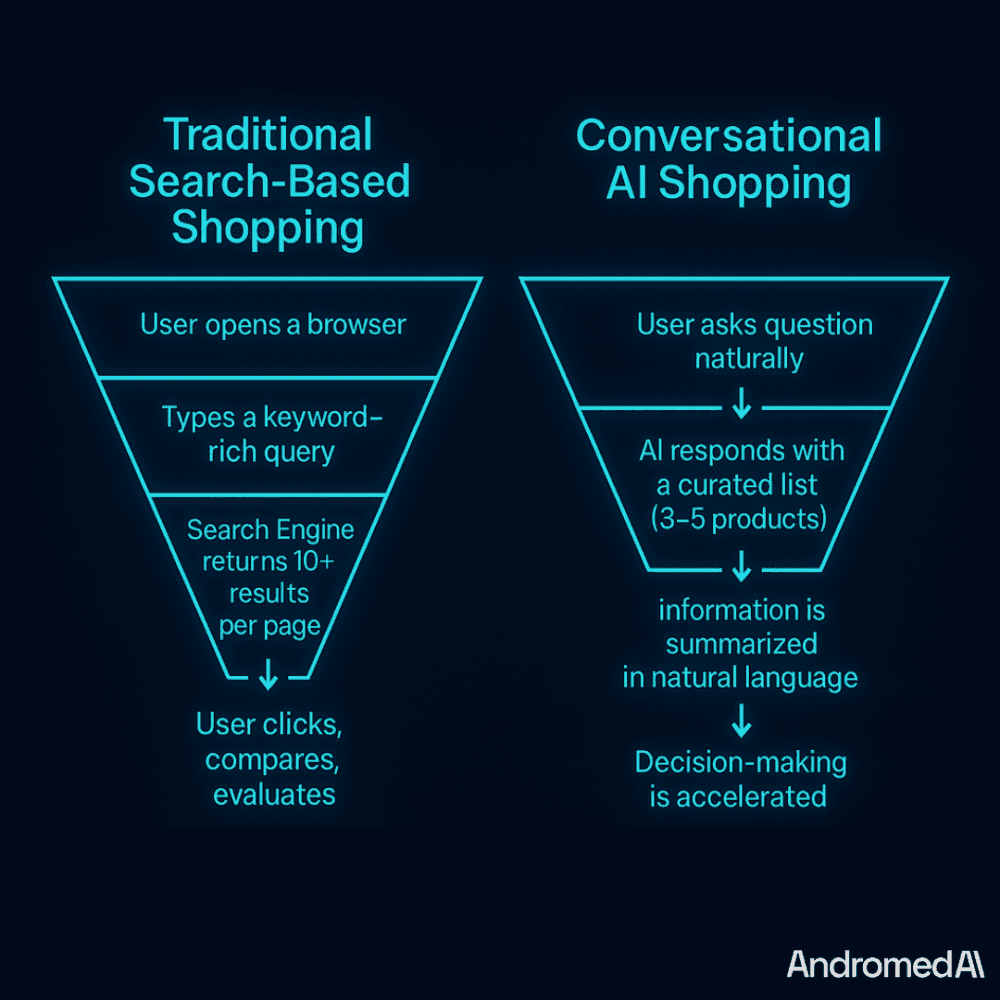
Transitioning from Traditional Search to a Conversational AI Shopping Experience.
Furthermore, trust becomes central. When a user accepts a single AI suggestion, they are placing implicit trust in the assistant's reasoning. If that product meets expectations, trust increases. If it fails, not only is the brand impacted, so is the assistant's credibility.
This creates a virtuous (or vicious) cycle of trust, making it even harder for unknown or poorly represented brands to break in.
New User Behaviors: Intent, Precision, and Trust
Three major behavioral trends are already emerging in AI shopping:
Users Ask, They Don't Search: Queries are now framed like conversations, not keyword strings. Instead of "best camera 2024," users ask: "I'm looking for a camera to shoot low-light videos for YouTube, under $800." This level of context would be nearly impossible to capture in traditional search.
Users Expect Fewer but Better Choices: Instead of 20 results, users expect 3-5 excellent matches. This means that being the 6th-best option means being invisible. Ranking is no longer a gradient, it's binary: chosen or not.
Users Trust the Model, Not the Brand: Especially for Gen Z and Gen Alpha consumers, loyalty to the interface (e.g., ChatGPT, Gemini) may surpass loyalty to individual retailers. This changes how brands need to think about top-of-funnel acquisition.
As a consequence, eCommerce strategy must adapt from SEO-driven funnel optimization to AI trust-driven engagement.
One major impact on eCommerce will be a decreased number of clicks on product pages, as users will now visit them after having already passed the consideration stage. However, this will be offset by a significant increase in conversion rates and revenue per click, as those clicks will be highly qualified and much closer to purchase intent.
The Rise of GEO (Generative Engine Optimization) and LLMO (Large Language Model Optimization)
In the past 20 years, entire industries have formed around search engine optimization. Marketers learned how to win Google's algorithm through back linking, keyword, technical performance, and content velocity. But LLMs do not rank results in the same way, they don't "index pages" or "rank by domain authority."
They select based on meaning. That's the foundation of what it could be GEO: Generative Engine Optimization.
GEO will be the art and science of making product content understandable, contextually relevant, and useful to a language model.
Key elements of GEO include:
Semantic clarity: Does the product description clearly explain who the product is for and why it's relevant?
Structured data: Is the page marked up using JSON-LD or schema.org to help models extract key attributes?
Factual density: Are the specs, features, and dimensions complete and accurate in the product page?
Use-case alignment: Does the product match the intent behind common natural-language queries?
Let's be clear: GEO is not just a repackaging of SEO. It's a fundamental shift in how content must be written and presented. A beautiful landing page might convert humans, but without proper structure, rich descriptions and semantic clarity, it will be invisible to an LLM.
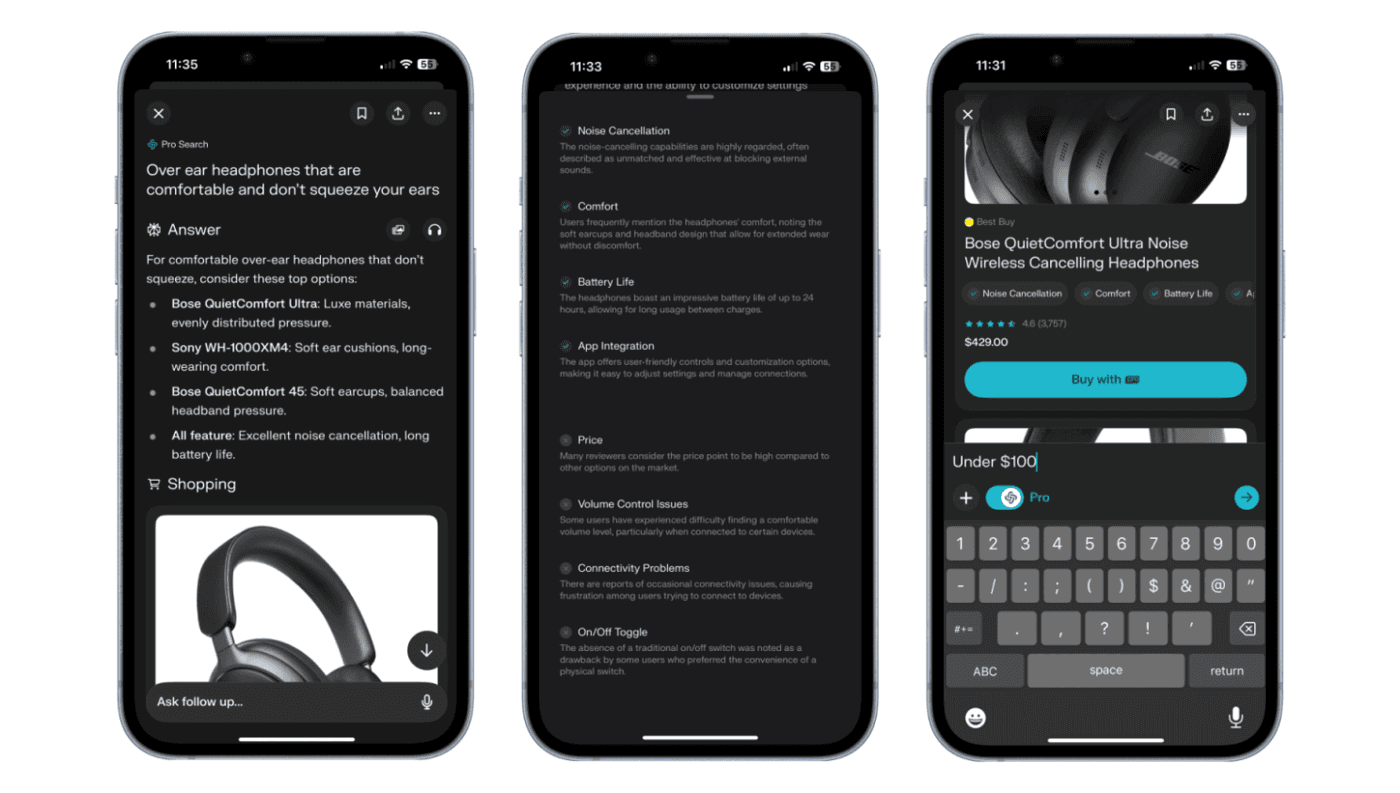
Perplexity's Mobile Shopping Experience.
From Content to Comprehension: Why Writing for AI Requires a New Mindset
One of the most important mental shifts is understanding that you are no longer writing for humans only. You are writing for a semantic interpreter, an AI model that ingests content, breaks it into meaning, and then recombines it to answer user questions.
That means:
Remove generic marketing fluff. LLMs will ignore it.
Clarify product benefits with concrete descriptors. (e.g., "fits in airline overhead bins" instead of "compact and easy to carry")
Incorporate question-answer formats. LLMs love F.A.Q. structures.
Don't forget pros and cons. These are often extracted from reviews but can also be pre-written.
A product page that performs well in this new landscape must do more than describe, it must anticipate the user's question and pre-answer it in the clearest way possible.
To ensure an LLM features your product page, simplify its task: anticipate and clearly answer common user queries directly within your product descriptions. This makes your content more appealing for AI recommendations.
The Monetization Dilemma: Trust vs Revenue
At the heart of the AI shopping revolution lies a fundamental tension: how can AI platforms monetize without breaking user trust?
For now, OpenAI's Shopping experience is entirely organic, the products recommended by ChatGPT are chosen based on relevance, quality, and match with user intent. The question isn't if monetization will come, it's how.
Monetization models may include:
Affiliate links or referral commissions
Sponsored placements embedded in AI suggestions
Tiered visibility based on merchant subscription
Native ads disguised as organic content
Each of these options introduces moral and operational complexity. The issue is not only technical but philosophical. If users suspect that the AI assistant is biased by Ads, even slightly, the entire relationship can collapse. This is not like banner ads on Google, because AI is speaking with authority.
The Possible Rise of LLM-Native Product Feeds: A New Layer for eCommerce
In eCommerce, merchants submit product feeds via Google Merchant Center or Comparison Shopping Services (CSS). The equivalent for AI does not yet exist, but may eventually arrive.
I believe the future could lie in the creation of a new standard: LLM-CSS or Large Language Model Comparison Shopping Services.
These feeds will include:
Full product metadata (price, dimensions, specs, materials)
Semantically structured descriptions (for context extraction)
Embedded pros & cons or reviews
Visual assets (clean, optimized images)
Use-case descriptors and personas
Real-time availability and price syncing
By submitting this data directly to AI platforms (e.g., via an OpenAI or Perplexity merchant API), brands can ensure their products are discoverable, interpretable, and presentable, not just crawlable.
Fragmentation Ahead: Shopping Across Multiple AI Ecosystems
The assistant space is fragmenting fast. Each platform could have its own ranking algorithms, feed formats, and optimization priorities.
Here's how the ecosystem looks today:
ChatGPT (OpenAI): Conversational product suggestions + UTM tracking
Gemini (Google): Embedded generative shopping summaries in search
Perplexity: Conversational search + Shopify checkout integration
This fragmentation mirrors the early days of mobile commerce or social commerce. Merchants will face new challenges:
Maintaining content compatibility across platforms
Adapting to multiple assistant-specific ranking logics
Monitoring traffic and attribution from opaque sources
Preventing invisibility due to unknown filters or safety heuristics
The need for multichannel LLM distribution is clear. Just like brands had to manage their presence on Google, Facebook, Instagram, and TikTok, they now need to manage how their products are read, parsed, and ranked by every assistant.
Future-Proofing Your Brand: What eCommerce Companies Must Do Now
To survive and thrive in this next era, brands must adopt GEO / LLMO principles:
Build product descriptions for LLM comprehension
Use structured data: JSON-LD, schema.org, custom product taxonomies
Enrich product content: specs, use cases, FAQs
Prepare feeds: create pipelines for OpenAI, Gemini, Perplexity, and others
Track attribution: monitor incoming traffic via UTM
Diversify presence: be visible across all assistant platforms
Avoid dependency: don't rely on any single ecosystem
The most visible product will no longer be the best optimized for Search Engines. It will be the product that an assistant decides to recommend, confidently and clearly, as the best match for a question.
How We're Preparing at AndromedAI
At AndromedAI, we've spent months building infrastructure not just for product content generation, but for AI-Powered Shopping Experience.
We believe the future lies in building:
Structured Product Pages: enriched with all metadata that LLMs need in order to extract meaning
LLM-Optimized Feeds: tailored to the input expectations of each assistant (OpenAI, Gemini, Perplexity, etc.)
Future-Proof Content: descriptions that are clear, structured, and ready for semantic parsing by any AI model
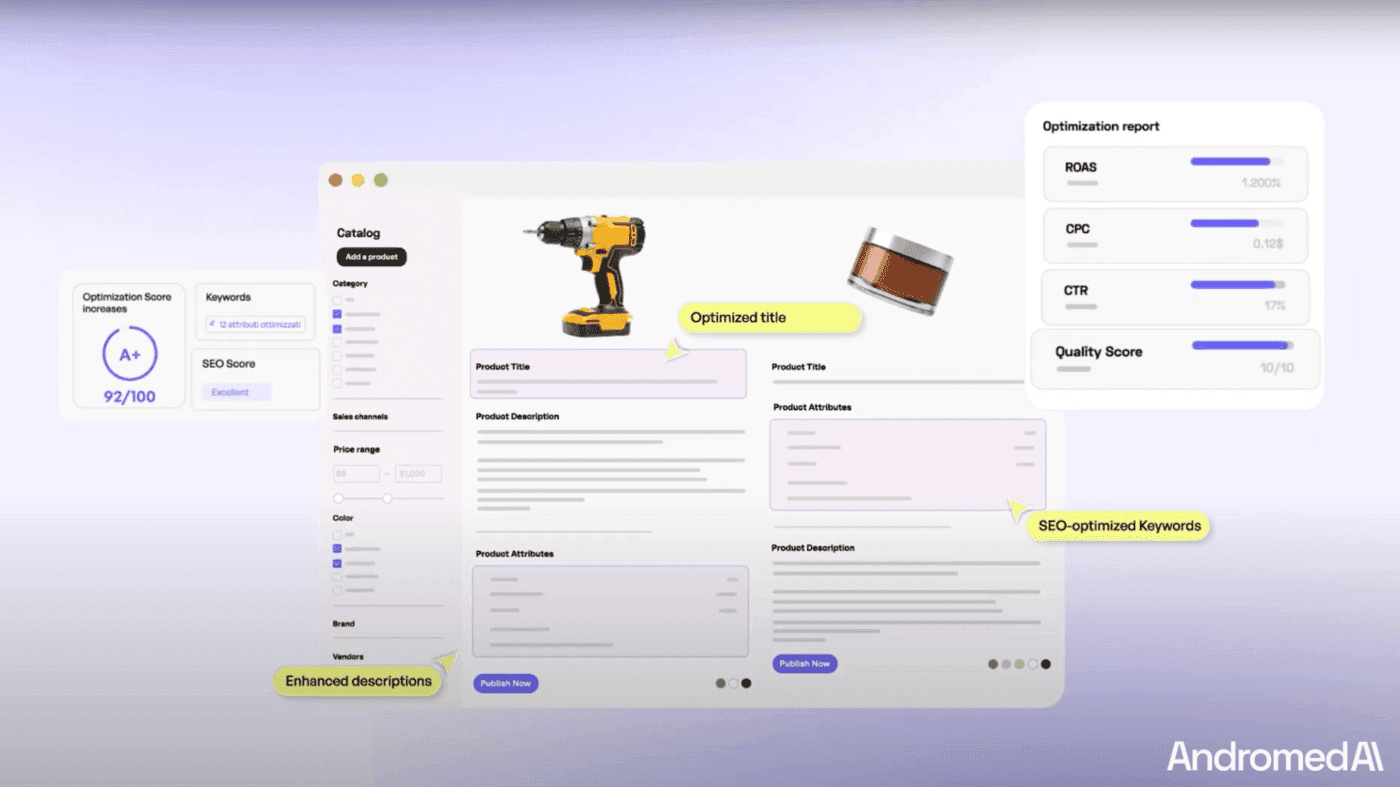
AndromedAI, the platform for Product Page Optimization
1. Product Content will be the Critical Factor for AI Discovery
When it comes to being selected by AI assistants like ChatGPT, well-structured product descriptions will be the most decisive asset. Unlike traditional SEO, where visibility could be driven by backlinks or domain authority, here the model selects products based on semantic relevance and clarity.
What this means in practice:
If your product page answers the user's question better than others, the model will likely choose you.
If your description lacks key specs, context, or clarity, it will likely be ignored, regardless of how well your brand is known.
2. Structured Data as a Foundation
It will be impossible for an LLM to recommend your product if it can't understand it. That's why structured data is no longer optional.
Add structured data to help assistants interpret not just what the product is, but how it fits into the context of a user query. We generate these schemas into every product page we generate or optimize, allowing the content to be surfaced in AI-rich results.
3. Data Enrichment: Filling in the Gaps
One of the biggest blockers for LLM inclusion will be missing information. Many merchants lack specs, materials, or sizing data, and that's where enrichment makes a difference.
AndromedAI uses a combination of:
Web RAG (Retrieval-Augmented Generation)
Computer vision
Internal databases
to extract and complete product data automatically. This ensures that when ChatGPT or Gemini try to answer a question, your product has the best chance of being chosen, because it simply contains more complete information than competitors.
Final Word: Adaptation Is Execution
Understanding the change is the first step. But staying relevant means acting now.
What I've outlined above, especially the centrality of product descriptions, are not future hypotheticals, they are current requirements.
We're entering an age where AI assistants become the interface layer between users and products. They decide what is seen. They compress the funnel. And they reshape how trust is built.
In the same way that it now feels strange to search on Wikipedia instead of asking ChatGPT, it will soon feel strange to shop without an AI assistant.
The brands that adapt early, by writing product content for machines as well as people, will win. Those that don't may become invisible.
The future is conversational.
Keep reading
Related articles



Free AI Readiness Audit
Find out what AI agents can't read on your product pages
Send us 3 product URLs. We score them for ChatGPT, Gemini and Google AI Mode, show what is missing and send them back fixed.
- AI Readiness Score for each page
- Missing attributes, keywords and shopper intents
- The optimized pages, ready to publish
Featured in








The Era of AI-Powered Shopping and Agentic Commerce has Begun
AI assistants like ChatGPT, Gemini and Perplexity are replacing search as the way people discover products. What changes for eCommerce, and how brands must write product content for machines.
The era of AI-powered shopping and agentic commerce
Shopping is moving **from pulling information to receiving curated suggestions**: AI collapses a 7 to 10 step funnel into 1 or 2. Users expect 3 to 5 excellent matches, so ranking becomes binary: **chosen or invisible**. LLMs select on meaning, not domain authority: semantic clarity, structured data, factual density and use-case alignment decide visibility. Fewer but far more qualified clicks: lower volume to product pages, higher conversion and revenue per click.
How do I optimize my product pages for AI assistants like ChatGPT? | Write for a semantic interpreter, not just a human reader. Remove generic marketing fluff, replace vague claims with concrete descriptors, add complete specs and dimensions, include FAQ-style content, pre-write pros and cons, and mark everything up with structured data so the model can match your product to natural-language queries. How fast is the shift to AI-powered shopping happening? | Much faster than most eCommerce players expect, on a horizon of roughly two years or less rather than five to ten. Consumers already know how to search with AI. How is AndromedAI helping brands prepare for Agentic Commerce? | AndromedAI builds structured product pages enriched with the metadata LLMs need, LLM-optimized feeds tailored to each assistant, and future-proof content ready for semantic parsing. It also fills data gaps automatically using Web RAG, computer vision, and internal databases.
