Amazon just dropped the most important earnings report in eCommerce this year. And the number that matters most isn't the $200.6 billion in revenue.
It's this: U.S. customers who use Alexa for Shopping spend 40% more per order than those who don't. That's conversion at scale and it changes the entire conversation about whether agentic commerce actually works.
Let's break down what happened, what it means, and what you should be doing about it right now.
From chatbot to checkout
If you've been following Amazon's AI shopping story, you probably remember Rufus. Launched in 2024, Rufus was Amazon's first shopping assistant. It answered product questions, helped compare items, and gave suggestions. Over 300 million customers used it through 2025. It was useful. But it was still a chatbot.
On May 13, 2026, Amazon quietly retired Rufus and replaced it with Alexa for Shopping.
This wasn't a rebrand. It was a category shift. Alexa for Shopping doesn't just answer questions. It recommends products based on your history, runs side-by-side comparisons inside search results, tracks price history up to a year, lets you set price alerts on any item, and can auto-buy when your conditions are met.
It also sits directly in the main Amazon search bar. No separate tab, no app to download, no Prime membership required. Every signed-in U.S. customer on the Amazon app or website now has an AI shopping agent as their default experience.
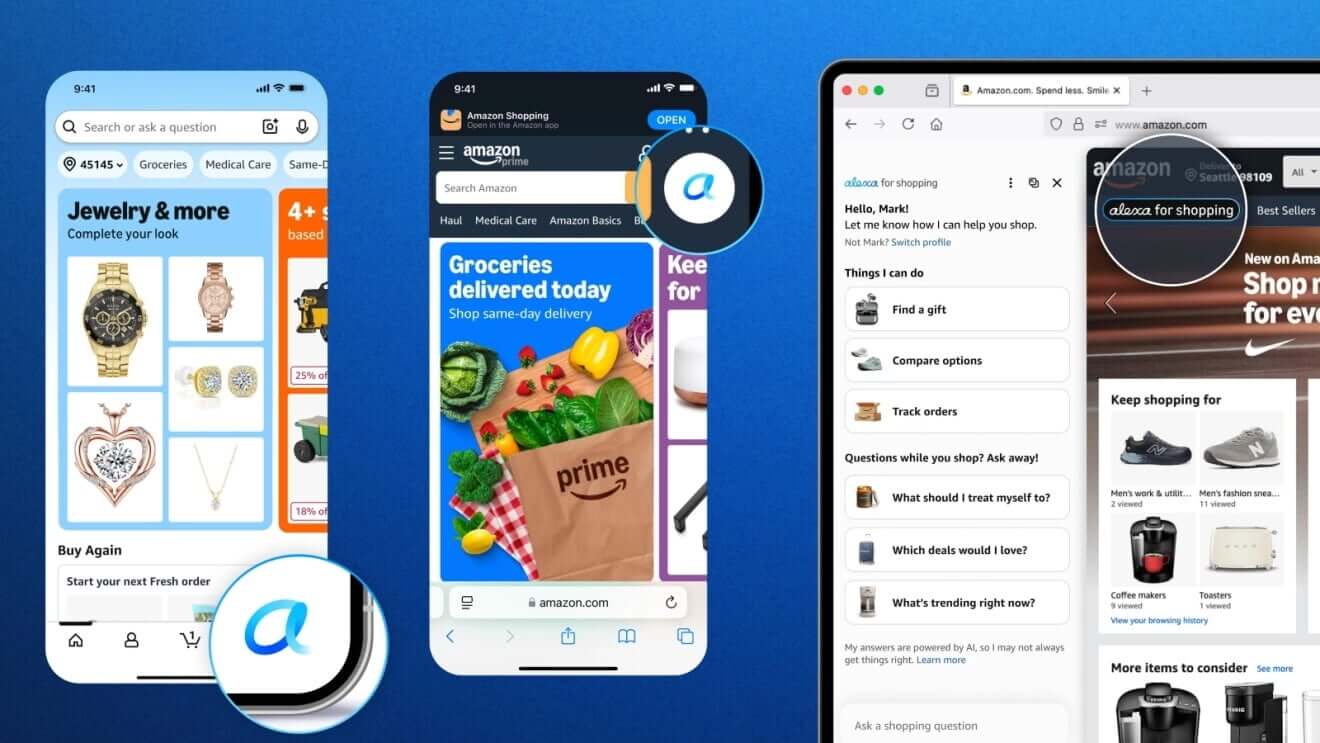
The shift from "let me help you search" to "I'll buy it for you" is exactly what agentic commerce means. And Amazon just made it the default for hundreds of millions of shoppers.
The numbers behind the shift
Amazon's Q2 2026 numbers tell a clear story. Alexa for Shopping has reached mainstream adoption.
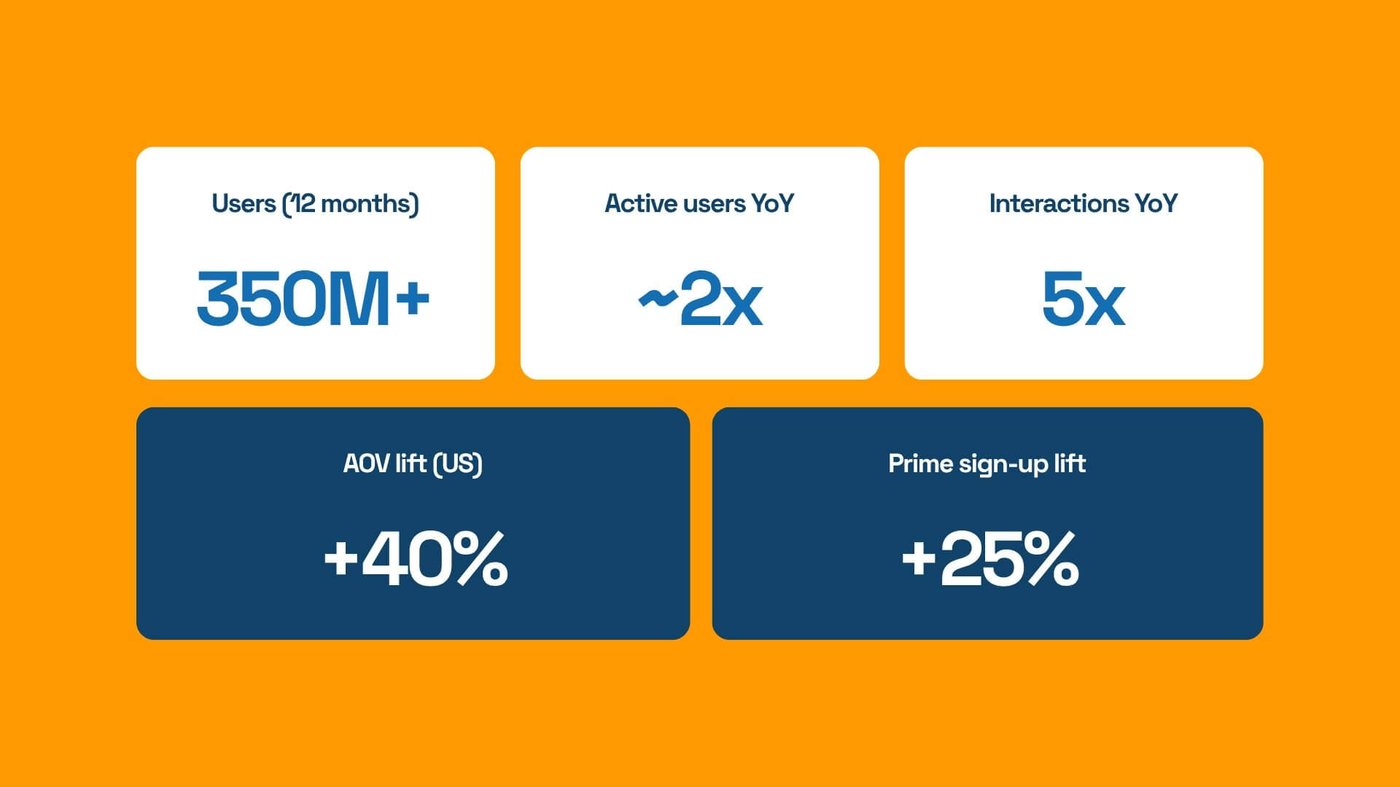
→ 350 million+ customers used Alexa for Shopping in the last 12 months
→ Active users nearly doubled year over year in Q2
→ Interactions grew more than 5x year over year
→ U.S. customers using it spend 40% more per order
→ Shoppers who try Alexa+ join Prime at nearly 25% higher rates
These are mainstream adoption numbers at a scale no other platform has come close to. And the 40% AOV lift is the data point that should make every eCommerce leader pay attention. It means the AI agent isn't just helping people browse. It's actively driving higher-value purchases.
For context, Amazon's overall Q2 was massive. $200.6 billion in net sales, up 20% year over year. Operating income hit $27.5 billion, up 43%. But it's the Alexa for Shopping metrics that signal where the growth engine is heading.
The ad format inside the conversation
Here's the part of the earnings call worth paying the most attention to.
Amazon didn't just build an AI shopping agent. They built an ad format inside it. And they just released the first performance data any platform has ever shared on advertising inside a conversational AI experience.
They're called Sponsored Prompts. They launched as a free beta at Amazon's unBoxed conference in November 2025. By March 2026, they became billable on a cost-per-click basis. And in the Q2 earnings call, CEO Andy Jassy shared the results.
→ Shoppers who click a Sponsored Prompt convert to a sale 48% more often
→ They spend 21% more on average
→ Around 20% of users who interact with a prompt continue the conversation about that brand
→ Adding prompts to a Sponsored Brands ad drives a 6% lift in conversions
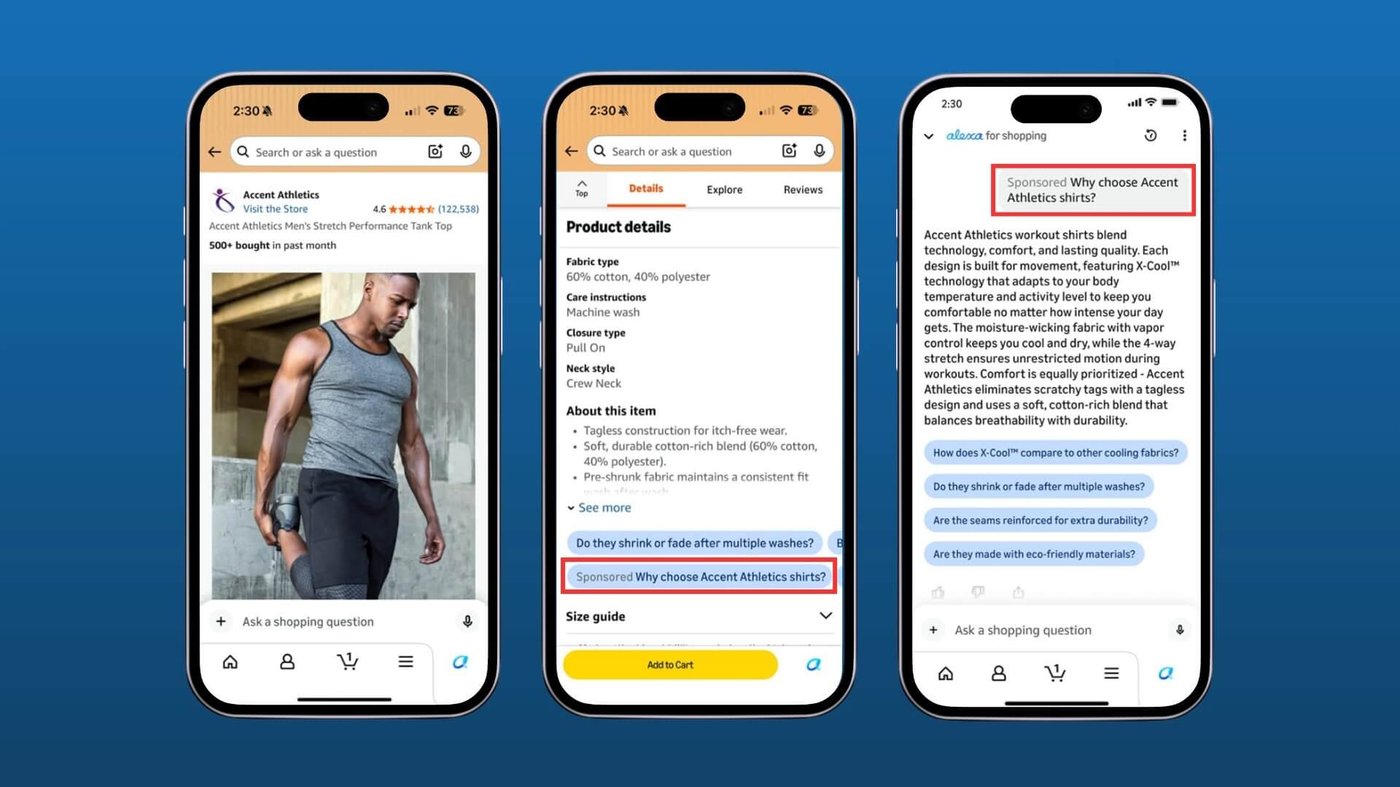
A 48% conversion lift is significant. It shows that the AI assistant now works as a blended organic-and-paid discovery layer. If that sounds familiar, it should. Google Search went through the same evolution after AdWords. The difference is that Google took over a decade to build that transition. Amazon compressed it into a single product cycle: beta in November, paid in March, performance data in July.
This is the moment where agentic commerce gets its own advertising economics. And right now, Amazon is the only platform with real numbers to show for it.
What this means if you sell online
The implications for brands and sellers are significant, and they go beyond optimizing your Amazon listings.
Your product page now serves as a data source for an AI agent. The agent reads your structured data, your bullet points, your A+ content, your reviews. It decides whether to recommend you based on attribute completeness, content quality, and pricing signals. If your product data isn't machine-readable, you're invisible in this new layer.
A few things to start thinking about now:
→ Attribute completeness matters more than ever. The agent needs structured, detailed product information to make comparisons. Incomplete listings get skipped.
→ Bullet points should lead with features and benefits, not marketing language. The AI parses information differently than a human scanning a page.
→ A+ content should be informational, not promotional. The agent treats it as a data source, not a brand experience.
→ Review quality and recency are ranking signals for the agent. A product with 50 recent, detailed reviews will outperform one with 500 old, generic ones.
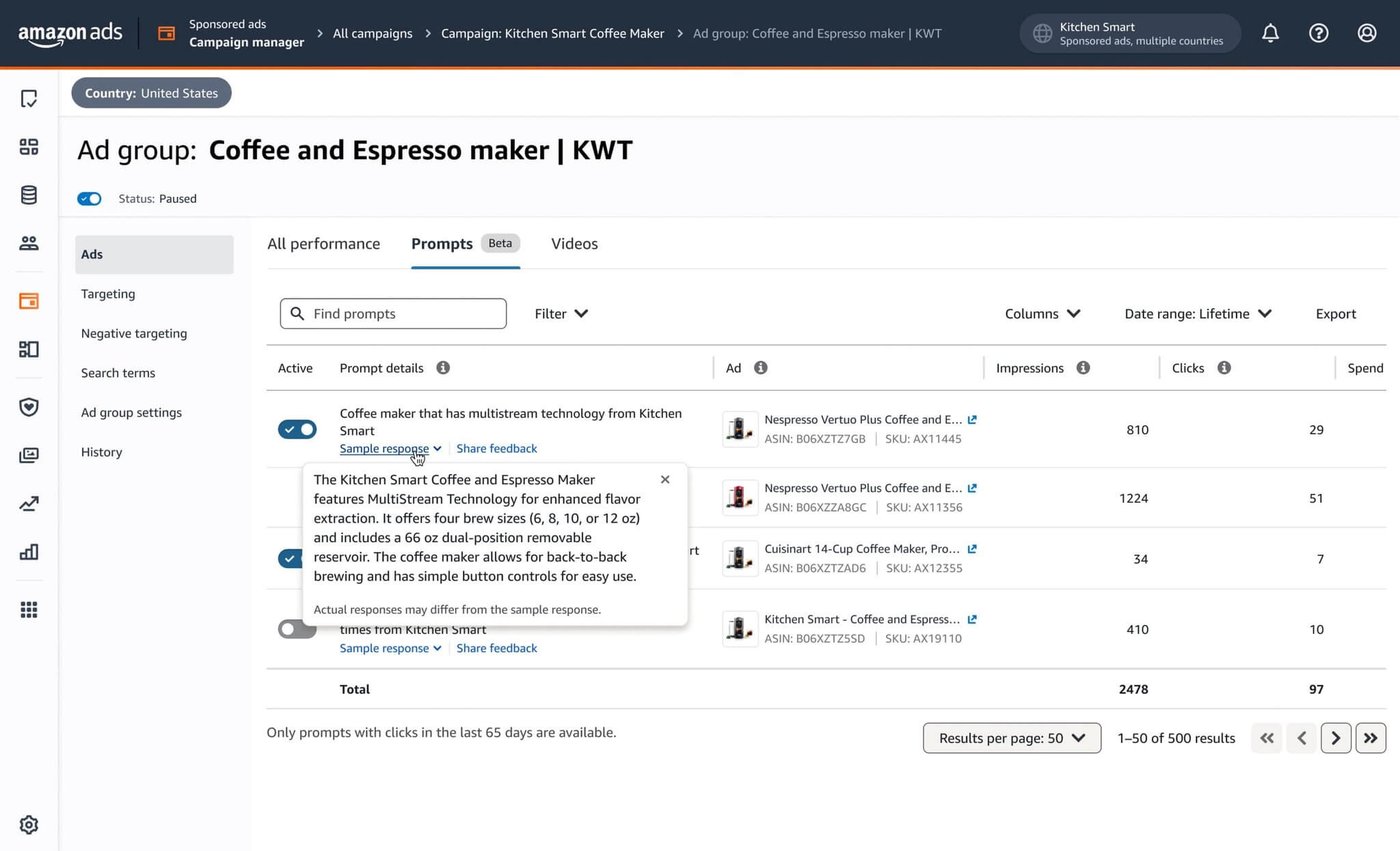
→ Sponsored Prompts are on by default for anyone running Sponsored Products or Sponsored Brands campaigns. If you're not tracking their performance separately, you're flying blind on your fastest-growing placement.
→ Expect your PPC metrics to shift. ACoS, TACoS, and new-to-brand rates will move during a 30 to 60 day stabilization window as the AI-driven discovery layer matures.
And it's already happening in the current quarter.
The window is now
The consumer readiness data backs up what Amazon's numbers are showing: according to Harris Poll, 62% of Gen Z and Millennial shoppers already prefer purchasing through AI-driven tools. ICSC and McKinsey found that 68% of consumers used at least one AI tool in the past three months as part of their shopping experience. And McKinsey projects $3 to $5 trillion in orchestrated revenue through Agentic AI in B2C retail by 2030.
We're seeing this inflection point firsthand at AndromedAI. Over the last three months we've expanded beyond Italy, signed customers in the UK, Spain and the US, and more than doubled our ARR. Every week, more companies are realizing that catalog optimization is becoming a strategic priority in the AI era.
Amazon has already moved. They've made the AI agent the default shopping experience for every U.S. customer. They've built the ad format. They've shown it converts.
Q3 is the setup quarter. By the time Q4 hits with Alexa for Shopping at full scale and holiday traffic behind it, the brands that optimized for agents will have a compounding advantage. The ones that didn't will be competing for visibility in a system they don't understand yet.
Keep reading
Related articles



Free AI Readiness Audit
Find out what AI agents can't read on your product pages
Send us 3 product URLs. We score them for ChatGPT, Gemini and Google AI Mode, show what is missing and send them back fixed.
- AI Readiness Score for each page
- Missing attributes, keywords and shopper intents
- The optimized pages, ready to publish
Featured in









Amazon's Q2 just ended the debate: Agentic Commerce converts at scale
Amazon's Q2 2026 earnings show US customers using Alexa for Shopping spend 40% more per order, and Sponsored Prompts convert 48% better. What it means for every brand selling online.
Amazon Alexa for Shopping and agentic commerce
In May 2026 Amazon replaced Rufus with **Alexa for Shopping**, an agent that recommends, compares, tracks prices and can auto-buy, now the default in Amazon search. US customers who use Alexa for Shopping **spend 40% more per order**; 350 million+ customers used it in the last 12 months. Sponsored Prompts, the first ad format inside an AI shopping assistant, convert 48% more often and lift spend by 21%. The agent reads your structured data, bullets, A+ content and reviews: **incomplete listings get skipped**.
What is Alexa for Shopping? | Amazon's AI shopping agent, launched in May 2026 to replace Rufus. It recommends products, compares them, tracks price history, sets price alerts and can buy automatically when your conditions are met. Does agentic commerce increase order value? | Yes. In Q2 2026 Amazon reported that US customers using Alexa for Shopping spend 40% more per order than those who don't. What are Amazon Sponsored Prompts? | An ad format inside Amazon's AI shopping assistant. Shoppers who click one convert 48% more often and spend 21% more on average. How should sellers optimize for Alexa for Shopping? | Complete every attribute, write factual bullet points, keep A+ content informational and collect recent, detailed reviews, because the agent treats them as data sources.
