BCG and SimilarWeb published an analysis of 20 leading European brands and retailers. The finding was striking: while total traffic and organic search were declining, traffic from LLMs was surging by thousands of percentage points. Specialty retail saw +7,465%. Mass retail +3,502%. Fashion +2,064%.
We took that as a starting point and went deeper.
We cross-referenced BCG's sector-level European data with Adobe's conversion and readiness research, SimilarWeb's AI Visibility rankings, and the most recent earnings calls from the world's largest retail platforms: Amazon, Walmart, Target, and Shopify (all Q2 2026).
The US is roughly 12 to 18 months ahead on agentic commerce adoption, and what is showing up in their earnings data today is a preview of what the rest of the market will face next.
What we found is consistent across every source. The visitors arriving through LLMs are buying. According to Adobe, by March 2026 AI-referred traffic was converting 42% better than traffic from traditional channels, with revenue per visit 37% higher.
By Q2 2026, Shopify confirmed the same pattern across its merchant base: AI-driven orders tripled year over year, AI-referred shoppers convert at twice the rate of organic visitors when product data is structured.
BCG projects AI search visits in Europe will reach 25% of organic visits by the end of 2026 and surpass organic search entirely by 2028.
What follows is the full breakdown: what is happening in each sector, which brands are already moving, and what this means for eCommerce leadership.
Fashion & Sport: +2,064% LLM Traffic Growth
While overall site visits to fashion retailers declined 1% year over year, LLM referral traffic surged +2,064%. The channel that barely existed 18 months ago is now delivering material volume.
Between June and August 2025, ChatGPT alone accounted for 16% of Zara's inbound traffic and 8% of H&M's. These are material traffic shares from a single AI platform. With AI-referred retail traffic still growing 125% year over year as of Q2 2026 (Adobe), those shares are almost certainly higher today.
The infrastructure behind this is already built. SKIMS, Glossier, Spanx, and Vuori are live on ChatGPT Shopping via Stripe's Agentic Commerce Suite. The URBN family (Anthropologie, Free People, Urban Outfitters), along with Coach, Kate Spade, and Revolve, ship through the same protocol. By April 2026, Shopify had connected 5.6 million stores to ChatGPT, Copilot, Google AI Mode, and Gemini through a single Agentic Storefronts panel.
Fashion brands that invested in structured product data and attribute completeness are now appearing in AI-powered recommendations without paying for a single click. Those that haven't are invisible to the fastest-growing acquisition channel in their industry.

Luxury: +1,190% LLM Traffic Growth
Luxury is the sector with the most to lose and the most structural resistance to this shift. LVMH reported a 3% decline in organic revenue in Q1 2025. Total site traffic across the sector dropped 12%. But the brands winning in AI visibility are not the ones most people would expect.
SimilarWeb's AI Visibility Leaderboard for August 2026 ranks luxury brands on ChatGPT in the US. Rolex leads with a 44% visibility score, followed by Cartier at 28%, Patek Philippe at 23%, Hermès at 19%, and Chanel at 15%. Louis Vuitton sits at 14%, below all five. The pattern is consistent across markets: brands with iconic, named products (Submariner, Tank, Nautilus, Birkin) and tight entity clarity dominate AI retrieval. Fashion houses with broader, more diffuse catalogs rank lower despite higher revenue.
The response from the biggest groups is accelerating. LVMH launched an "AI Factory" with Google Cloud, a central platform supporting predictive AI and generative AI across all 75 maisons, under what they internally call "quiet tech." Kering created a group-wide Client division in March 2026 with AI-driven clienteling across Gucci, Saint Laurent, and Bottega Veneta. Ralph Lauren launched Ask Ralph in September 2025, a stylist inside the app that returns shoppable looks from live inventory using Azure OpenAI.
The AI layer rewards product specificity and data depth. Brands that keep their catalogs thin and unstructured will lose visibility to competitors who make every SKU machine-readable.

Specialty Retail: +7,465% LLM Traffic Growth
Total traffic across the sector stayed flat. The LLM channel grew +7,465%, the highest in the entire dataset.
Specialty retail is built on high-intent, specific queries. "Best running shoe for flat feet." "Organic protein powder for endurance athletes." "Dermatologist-recommended moisturizer for eczema." These are exactly the queries where LLMs outperform traditional search, because they synthesize reviews, specs, and third-party recommendations into a single answer.
The readiness gap is massive. Pages with structured data are cited 3.1x more frequently in Google AI Overviews, and 71% of pages cited by ChatGPT include structured data. Yet Adobe's analysis of US retail sites found that the average product page scores just 66% on AI content readability, meaning a third of product content is invisible to LLMs. The gap between the best-performing retailers (82.5%) and the worst (54.2%) is 28 points and widening.
Brands like Decathlon and Douglas are already investing in assortment expansion specifically to increase LLM visibility. BCG has warned that retailers who fail to prepare risk being reduced to "background utilities inside agent-controlled marketplaces," a row in someone else's result, picked or skipped based on how machine-readable your catalog is.
Specialty retailers that invest in product enrichment and structured metadata now are building a moat that will compound as LLM traffic scales.

Marketplaces: +3,703% LLM Traffic Growth
The marketplace model has a structural advantage in agentic commerce. Broader assortment means more products for AI agents to surface. Richer third-party seller data means more attributes for LLMs to parse. The result: marketplaces consistently outperform first-party-only retailers on AI-driven discoverability.
Etsy was among the first marketplaces to integrate with agentic commerce protocols, going live on both ChatGPT (via ACP) and Google AI Mode (via UCP) for in-chat checkout. In Europe, Allegro has partnered with OpenAI and became one of the first companies in the ChatGPT App Store, launched an in-app AI Assistant, and is running nearly 100 AI projects with a target of 40% of its tech portfolio AI-based by end of 2026.
The clearest proof of scale is Amazon. In May 2026, Amazon retired Rufus and replaced it with Alexa for Shopping, an agent that recommends, compares, monitors prices, and can purchase autonomously. Over 350 million customers have used it in the past 12 months. Monthly active users nearly doubled year over year in Q2. US customers who use Alexa for Shopping spend 40% more per order than those who don't. Amazon also launched Sponsored Prompts, the first ad format built natively inside an AI shopping interface, delivering a 48% conversion lift over standard placements.
Amazon's "Shop Direct" and "Buy for Me" capabilities now surface products from external brand websites, over 100 million products from more than 400,000 merchants, directly inside Amazon's own search results. Merchants supporting multiple agentic protocols (ACP, UCP, AP2) see approximately 40% more agentic traffic than those on a single protocol. The competitive set for every brand just widened in both directions.
We published a full breakdown of Amazon's Q2 2026 agentic commerce data, including Alexa for Shopping and Sponsored Prompts, on our resource center.

DTC Brand Sites: +1,225% LLM Traffic Growth
DTC brands are the only segment where traditional referral traffic is also growing (+10% YoY). That reflects the structural advantage of owning your data.
Shopify's Q2 2026 earnings confirmed the acceleration. AI-driven traffic and orders to Shopify stores tripled year over year. New buyer orders from AI channels are arriving at nearly twice the rate of other channels. Half of all AI-referred sessions land directly on a product detail page, compressing the entire discovery funnel into a single step. And 75% of AI-attributed purchases came from outside the top 100 product categories, a structural advantage for specialized, independent brands over mass-market incumbents.
The data infrastructure matters more than the traffic itself. AI searches powered by Shopify Catalog, which now indexes over 1 billion products with structured attributes, convert at twice the rate of those relying on scraped data. Shopify has built live connectors to ChatGPT, Google AI Mode, Gemini, Copilot, Claude, and Perplexity, with a native dashboard tracking real-time performance by AI channel.
But the landscape is shifting underneath. Amazon's AI shopping layer now surfaces products from external DTC sites inside Amazon's own discovery surface. A DTC brand's products can appear in Amazon's results even without an Amazon listing. This widens visibility but also widens the competitive set.
Shopify's Spring '26 edition (June 2026) made AI commerce default: on Google AI Mode and Microsoft Copilot, a customer can pay for a product without leaving the conversation, via a Shopify-powered checkout. The channel is growing, but part of conversion is moving off the brand's site and outside its funnel optimization, email capture, and attribution.
DTC brands that own their data infrastructure will benefit. Those that depend on platform defaults will find themselves commoditized.

Omnichannel Retail: +2,201% LLM Traffic Growth
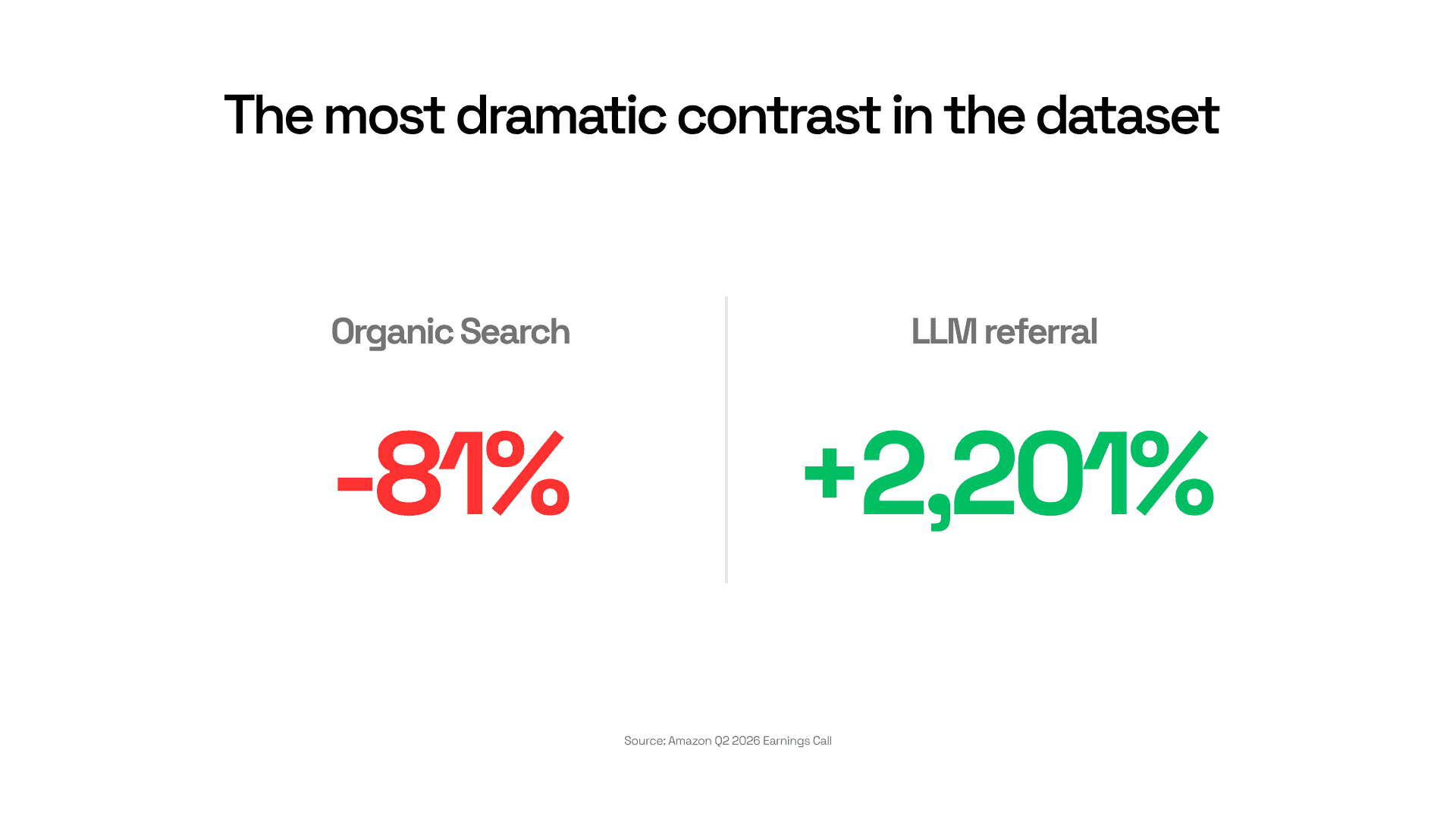
This is the most dramatic contrast in the dataset. Organic traffic collapsed 81%. Total site visits dropped 16%. LLM traffic grew +2,201%.
The organic channel is evaporating. Conversational discovery is replacing it. Omnichannel retailers that relied on search-driven traffic to their digital properties are watching that foundation dissolve.
Carrefour invested €3 billion in digital initiatives through 2026, including its "Hopla" AI assistant and a tripling of e-commerce GMV to €10 billion. Tesco, Ahold Delhaize, and Lidl are building AI-driven digital screen infrastructure that adapts in real time based on foot traffic, weather, and inventory. Walmart's retail media business hit $4.82 billion in 2025. Kingfisher scaled Google Vertex AI across its banners for front- and back-office automation.
The omnichannel model is being rebuilt from the data layer up. Retailers that treated digital as a secondary channel to physical stores are now scrambling to make their catalogs agent-readable. The ones that started two years ago (Walmart, Carrefour, Tesco) are already seeing compounding returns. The ones starting now face rising costs and shrinking organic visibility.
Mass Retail: +3,502% LLM Traffic Growth
Mass retail is the only sector where total traffic also grew (+4%), alongside an LLM surge of +3,502%.
Mass retail sits at the intersection of high purchase frequency, broad catalog depth, and price sensitivity. All three are areas where AI agents excel. Auto-replenishment, price comparison, and availability checks are the first use cases consumers are delegating to AI assistants.
The Q2 2026 earnings season turned this from a trend into a pattern. Walmart reported that customers using its AI assistant Sparky spend 40% more per order than those who don't, with total Sparky users up 70% year over year. Amazon reported the same 40% lift for Alexa for Shopping users. Target's CEO confirmed that digital traffic from external AI platforms is growing 3.5x faster than the industry average, driven by partnerships with OpenAI and Google Gemini. Three different mass retailers, three different AI implementations, the same result: AI-assisted shoppers spend more.
During Cyber Week 2025, the pattern had already emerged at scale. Salesforce reported $67 billion in global AI-influenced sales, with AI touching 20% of all orders. Retailers with their own AI agent integrations saw sales growth 7x higher than those without.
The implication for mass retail is a land grab. The brands and retailers that build their own agent layer now will own the customer relationship. Those that wait will rent it from OpenAI, Google, or Amazon at whatever terms those platforms set.

What should eCommerce Leaders do next?
BCG's analysis uncovered one more number that reframes the entire conversation. The overall impact of LLMs on site traffic, what they call the "halo effect," is up to four times higher than the direct referral traffic alone. Most brands are only measuring the tip of a shift that is already four times larger than their dashboards show.
81% of US consumers already use LLMs for product discovery. In Europe, adoption is at roughly 50% and accelerating. But the supply side is lagging far behind. Adobe found that the average product page scores just 66% on AI content readability, meaning a third of product content is invisible to LLMs. The gap between the best-performing retailers (82.5%) and the worst (54.2%) is 28 points and widening. Pages with structured data are cited 3.1x more frequently by AI systems, yet most product catalogs remain unreadable to agents. 80% of early access customers on Adobe's LLM Optimizer had critical content visibility gaps.
The gap between consumer behavior and brand readiness is enormous.
The playbook starts with data hygiene: structured metadata, accurate pricing and availability, rich product attributes, and verified reviews. Then GEO (Generative Experience Optimization), the successor to SEO, ensuring your catalog is parseable by every major LLM. Then protocol-layer readiness: connecting to ACP, UCP, and the Shopify/Stripe/PayPal rails that enable agents to transact.
The brands executing this today, across every sector we covered, are spending differently. And the channel they are building for converts better than paid search, costs nothing to acquire, and is growing faster than any other source of demand.
Keep reading
Related articles



Free AI Readiness Audit
Find out what AI agents can't read on your product pages
Send us 3 product URLs. We score them for ChatGPT, Gemini and Google AI Mode, show what is missing and send them back fixed.
- AI Readiness Score for each page
- Missing attributes, keywords and shopper intents
- The optimized pages, ready to publish
Featured in








AI Traffic: A Sector-by-Sector Breakdown of LLM Referral Growth in Retail
LLM referral traffic to European retailers grew by thousands of percent while organic search declined. A sector-by-sector breakdown, from fashion to mass retail, and what eCommerce leaders should do next.
LLM referral traffic growth by retail sector
BCG and SimilarWeb data on 20 European brands shows **LLM referral traffic up +7,465% in specialty retail**, +3,502% in mass retail and +2,064% in fashion, while organic search declined. AI-referred visitors buy: Adobe found AI traffic converting 42% better than traditional channels by March 2026, with 37% higher revenue per visit. The average product page scores only 66% on AI content readability, so **a third of product content is invisible to LLMs**. The playbook: structured product data and attributes first, then optimization for every major LLM, then connection to agentic commerce protocols (ACP, UCP).
Which retail sector has the fastest LLM traffic growth? | Specialty retail, with +7,465% LLM referral traffic growth in the BCG and SimilarWeb analysis of 20 leading European brands and retailers. Does AI-referred traffic convert? | Yes. Adobe found that by March 2026 AI-referred traffic converted 42% better than traditional channels, with revenue per visit 37% higher. Why are many products invisible to AI assistants? | The average product page scores 66% on AI content readability (Adobe), so a third of product content cannot be read by LLMs. Structured data and complete attributes close the gap. How can I check if my product pages are ready for AI agents? | AndromedAI's [free AI Readiness Audit](/catalog-audit) scores 3 of your product pages, shows what is missing and fixes them.
