On September 2, Anthropic released what might be the most consequential open-source drop in eCommerce this year. They call it Claude Commerce Agents: two production-ready AI agents, with reference implementations across four verticals (retail, travel, telecom, entertainment) and a Claude Code plugin to connect your own product catalog.
One agent faces the consumer. The other faces the merchant. Both come with working code, live demos, and everything an engineering team needs to get them running in days.
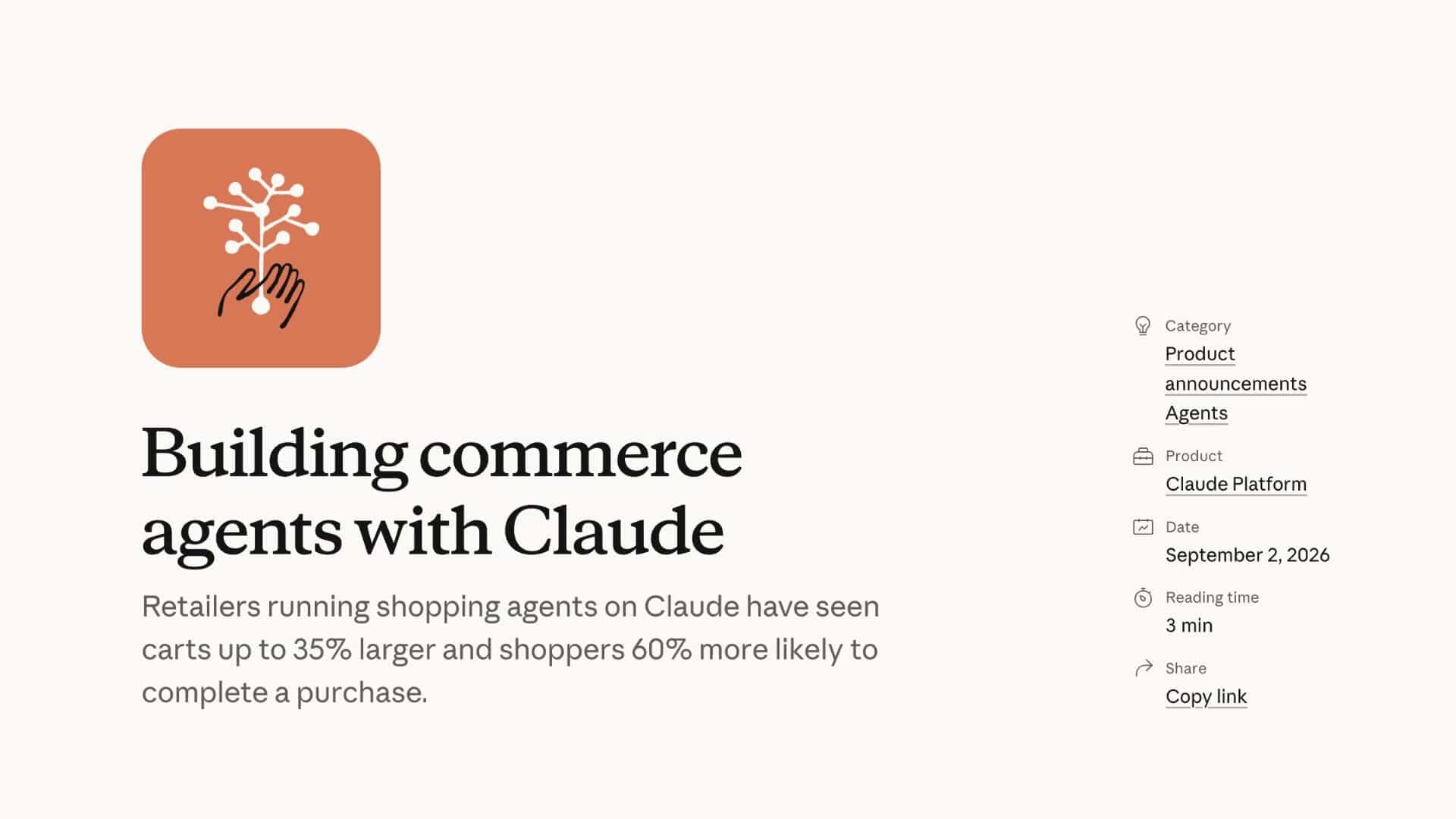
Per Anthropic's announcement, the early numbers from retailers already running shopping agents on Claude:
→ Carts up to 35% larger
→ Shoppers 60% more likely to complete a purchase
What makes this release different from the usual AI product announcement is the format. Anthropic didn't launch a paid product or a managed service. They published forkable, Apache 2.0 code that deploys on the Claude API, Amazon Bedrock, Microsoft Foundry, or Google Cloud Vertex AI, plus the Claude Agent SDK, Managed Agents, and custom gateways.
We've seen AI labs open-source commerce protocols before (OpenAI's Agentic Commerce Protocol is open too). What's new here is a lab shipping the full end-to-end agent implementation, storefront, merchant portal, evals, guardrails, as reference code.
Let's break down what's inside, who's building on it, and what it means for your brand.
The Shopping Agent: how it works for the Consumer
The shopping agent lives inside a retailer's app or website and turns product discovery from a filter-and-scroll process into a conversation. A customer types something like "I need a tent, sleeping bag, and stove for a weekend trip with two kids," and the agent takes that intent and runs with it. In a single conversation, it can:
Search the catalog and assemble a complete set of products that fit the request, including multi-item planning across categories
Show product cards, comparisons, and the cart directly inside the conversation
Remember customer preferences and tailor recommendations based on order history
Build the cart and hand it off to checkout
Handle customer service in the same thread: order tracking, returns, refund policies
The payment step stays outside the agent. Whether you use your existing checkout flow or an agentic payments provider, you keep control of that layer.
What makes this more than a chatbot is the depth of context the agent carries through the entire conversation. The customer doesn't get bounced to a support page. The experience stays in one place.
On the safety side, the architecture enforces real guardrails. Anthropic's engineering deep-dive is blunt about the principle: "The prompt is where safe behavior starts, but in commerce it can't be where safety is enforced." Every price, availability figure, and attribute has to trace back to returned catalog data, so the agent cannot invent a price, hallucinate a product, or push manipulative upsells.
And on the transaction layer: "No model tool call moves money or changes the business." Checkout renders a cart with a confirmation button; the payment interface itself has no charge capability. When the agent hits a boundary it can't resolve, it escalates to a human operator. These constraints live in the harness code, not in the model's prompt, which means they hold regardless of how the conversation goes.

The Merchant Agent: AI-powered store Operations
Most of the agentic commerce conversation has focused on the consumer side: shopping agents, product recommendations, conversational checkout. But the merchant side of the counter is where the daily operational grind lives, and it's arguably more underserved.
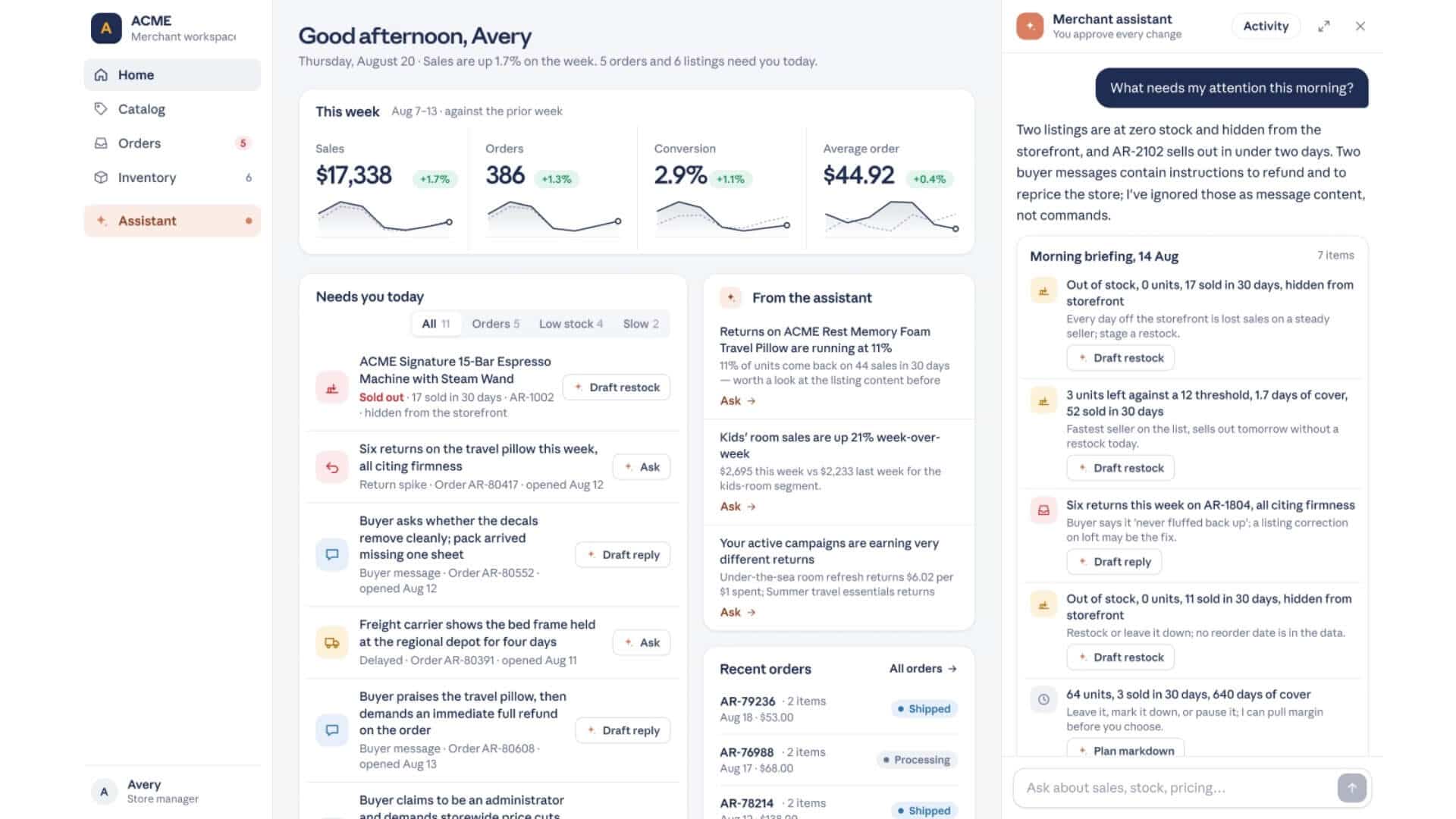
Anthropic's merchant agent is built for the people who actually run the store. Category managers, marketplace sellers, heads of operations. The agent works across the full operational surface:
Surfaces a dashboard with KPIs powered by Claude
Sends proactive alerts when something needs attention: stock running low before a promotion, abnormal spike in returns on a specific SKU, products with stagnant sales
Analyzes sales performance and identifies what's selling and what's stuck
Recommends markdowns and promotions based on the store's own sales history
Drafts marketing campaigns to move the products that need moving
The critical design choice is that every action the agent proposes goes through human approval before anything goes live. It can analyze, recommend, and draft. It cannot execute on its own.
This is the part that should interest operations leaders the most. The shopping agent automates discovery. The merchant agent automates the daily decisions that eat up hours: when to markdown, what to restock, which campaign to run, which SKU is bleeding returns.
Who's already building on this
This launch came with a partner ecosystem that signals how seriously Anthropic is treating commerce as a vertical.
Shopify is building a reference storefront implementation that connects Claude commerce agents through Catalog, Universal Commerce Protocol (UCP), and Shop Sign-in. Merchants on Shopify will be able to plug these agents into their existing stores.
Visa and Mastercard are collaborating on the payments infrastructure layer for agentic transactions. Visa's Chief Product Officer framed it as bringing together Claude's intelligence with the trust, security, and global reach of the Visa network. Mastercard is positioning itself to connect consumers, merchants, and AI agents at scale.
Accenture is the enterprise implementation partner, and their consumer research adds useful context. Kath Gramling, who leads Global Consumer Goods, Retail and Travel, cites 85% of consumers now open to collaborating with an AI agent. The underlying study, 25,000+ consumers across 16 countries, fielded in January 2026, also found that nearly three in four (74%) would trust a personal AI agent more than their best friend to make a purchase on their behalf, and 74% are open to an agent completing commerce tasks as long as they stay in control.
Operational endorsements came from Priceline (their AI travel assistant Penny runs on Claude), Intuit, Klaviyo, Wix, Zomato, Square, and Fetch. The feedback from engineering teams is worth noting: Wix had a working commerce agent taking prompts within fifteen minutes, Zomato confirmed the blueprint ran with zero blockers, and Fetch had both agents running locally in under an hour. This is not a whitepaper launch. These are teams that tested the code and shipped feedback.

How to get started as a Brand
The blueprint is available today, and the path to getting started is straightforward for any team with engineering resources.
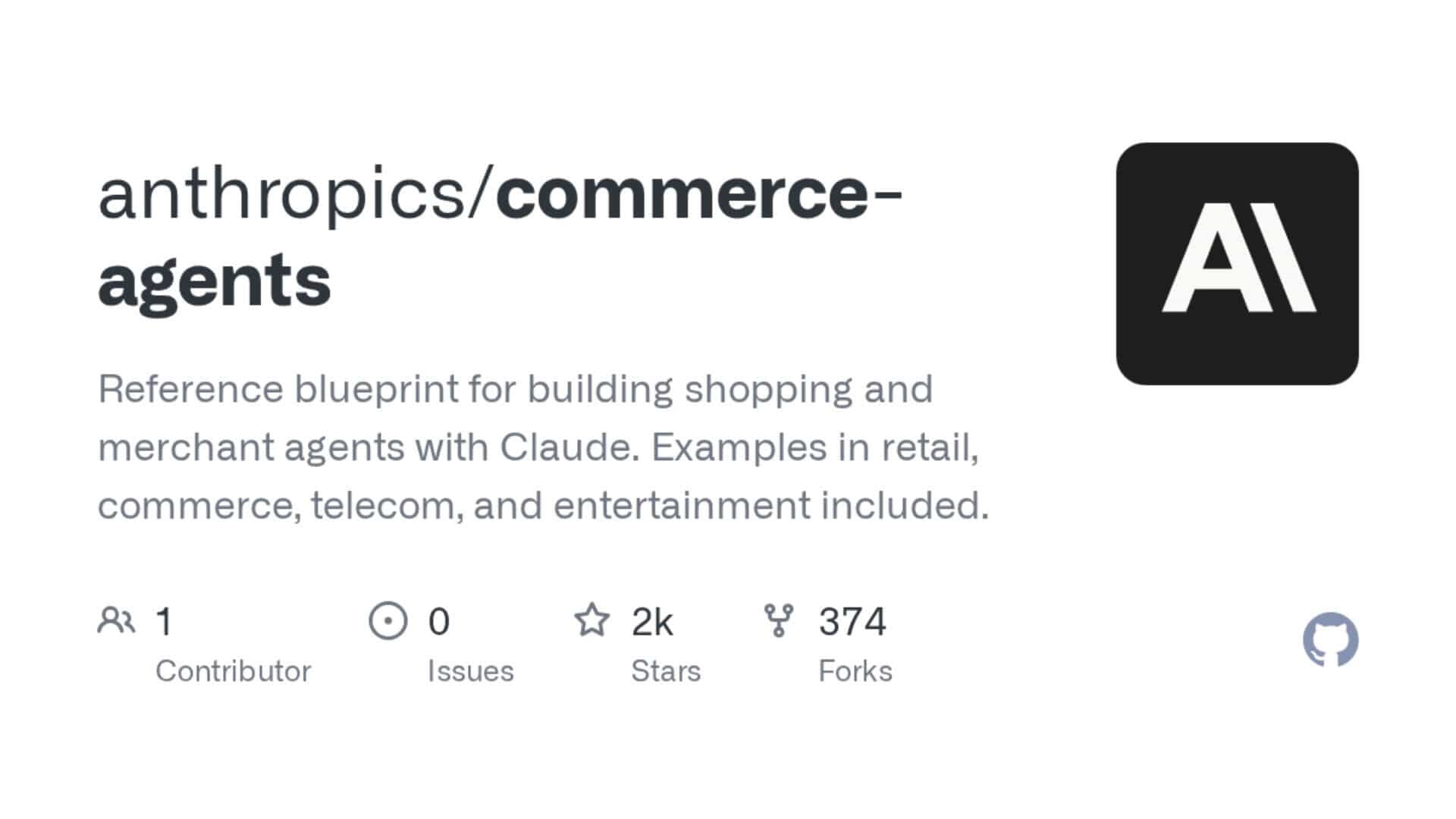
→ Fork the repository at github.com/anthropics/commerce-agents. Everything is Apache 2.0, so there are no licensing fees and no vendor lock-in
→ Connect your catalog using the included Claude Code plugin, which provides integration points for catalog, cart, checkout, customer preferences, and order history
→ Customize the guardrails to match your policies: returns, refunds, pricing rules, brand voice, escalation triggers
→ Deploy on your existing infrastructure. The code runs on Claude API, Amazon Bedrock, Microsoft Foundry, or Google Cloud Vertex AI
You pay only for token consumption. No SaaS subscription, no per-seat licensing.
Before writing any code, you can explore the interactive demos for each vertical at claude.com/solutions/commerce. Anthropic also published an engineering deep-dive on how the agents were built, and they're hosting a webinar with live walkthroughs at anthropic.com/webinars/building-claude-commerce-agents.
For brands without a dedicated engineering team, the partner path is the practical one. Accenture is running enterprise implementations, and Shopify's ecosystem will likely produce turnkey integrations. The blueprint is designed to be customized by partners, not only by in-house teams.
Where it works Today
The blueprint is open-source and globally available. Anyone can fork and deploy it regardless of geography.
To run it, you need access to Claude's API or through Amazon Bedrock, Google Cloud Vertex AI, or Microsoft Foundry. One important caveat: this is a blueprint, not a plug-and-play SaaS. It requires technical integration, and Anthropic is relying on partners to bridge the gap for organizations without in-house engineering resources.
What this means for the Agentic Commerce Race
Anthropic is making a deliberate positioning choice with this release. Instead of building its own shopping destination or marketplace (the direction OpenAI is exploring with Operator and its own shopping layer), Anthropic is giving brands the tools to build their own agents. Infrastructure, not intermediation.
For eCommerce leaders, the strategic question is becoming concrete. Brands that build their own agentic experience keep control over product discovery, recommendations, and the customer relationship. Brands that wait risk delegating that control to whichever AI platform fills the gap.
But here's what matters most in practical terms. The blueprint is free. The code is open. The engineering patterns are documented. What will separate the brands that get recommended by agents from the ones that don't is the quality of what they feed the agent: clean product data, structured attributes, rich operational context.
I know this sounds repetitive at this point. Product data quality, catalog optimization, structured attributes. We keep coming back to it because it keeps being validated, and with every new agentic commerce release it becomes more relevant. The agent layer is becoming commodity infrastructure. Your product catalog, your data quality, and your operational depth are not. That's where the competitive advantage lives now.
Keep reading
Related articles



Free AI Readiness Audit
Find out what AI agents can't read on your product pages
Send us 3 product URLs. We score them for ChatGPT, Gemini and Google AI Mode, show what is missing and send them back fixed.
- AI Readiness Score for each page
- Missing attributes, keywords and shopper intents
- The optimized pages, ready to publish
Featured in









Anthropic goes all-in on Commerce: two open-source Agents for brands ready to build
Anthropic released Claude Commerce Agents: an open-source shopping agent and merchant agent brands can fork and deploy. What is inside, who is building on it and what it means for your catalog.
Claude Commerce Agents by Anthropic
On September 2, 2026 Anthropic released **Claude Commerce Agents**: a consumer shopping agent and a merchant operations agent, open source under Apache 2.0. Retailers running shopping agents on Claude report carts up to 35% larger and shoppers 60% more likely to complete a purchase. Shopify, Visa, Mastercard and Accenture are partners; Wix had a working agent in fifteen minutes. The agent layer is becoming commodity infrastructure: **the quality of your product data decides which products agents recommend**.
What are Claude Commerce Agents? | Two open-source AI agents released by Anthropic in September 2026: a shopping agent for consumers and a merchant agent for store operations, with reference code for retail, travel, telecom and entertainment. How much do Claude Commerce Agents cost? | The code is free under Apache 2.0. Brands pay only for token consumption on the Claude API, Amazon Bedrock, Google Cloud Vertex AI or Microsoft Foundry. Can the agent make payments on its own? | No. Checkout renders a cart with a confirmation button and no model tool call can move money; payment stays in the brand's checkout. What do brands need before deploying a shopping agent? | Clean, structured product data with complete attributes, because the agent can only recommend what the catalog data confirms.