A few months ago, Anthropic published something quietly:
"We're particularly interested in agentic commerce, where Claude acts on a user's behalf to handle a purchase or booking end to end."
Most people read it as typical VC hype and scrolled past.
Last week, it happened.
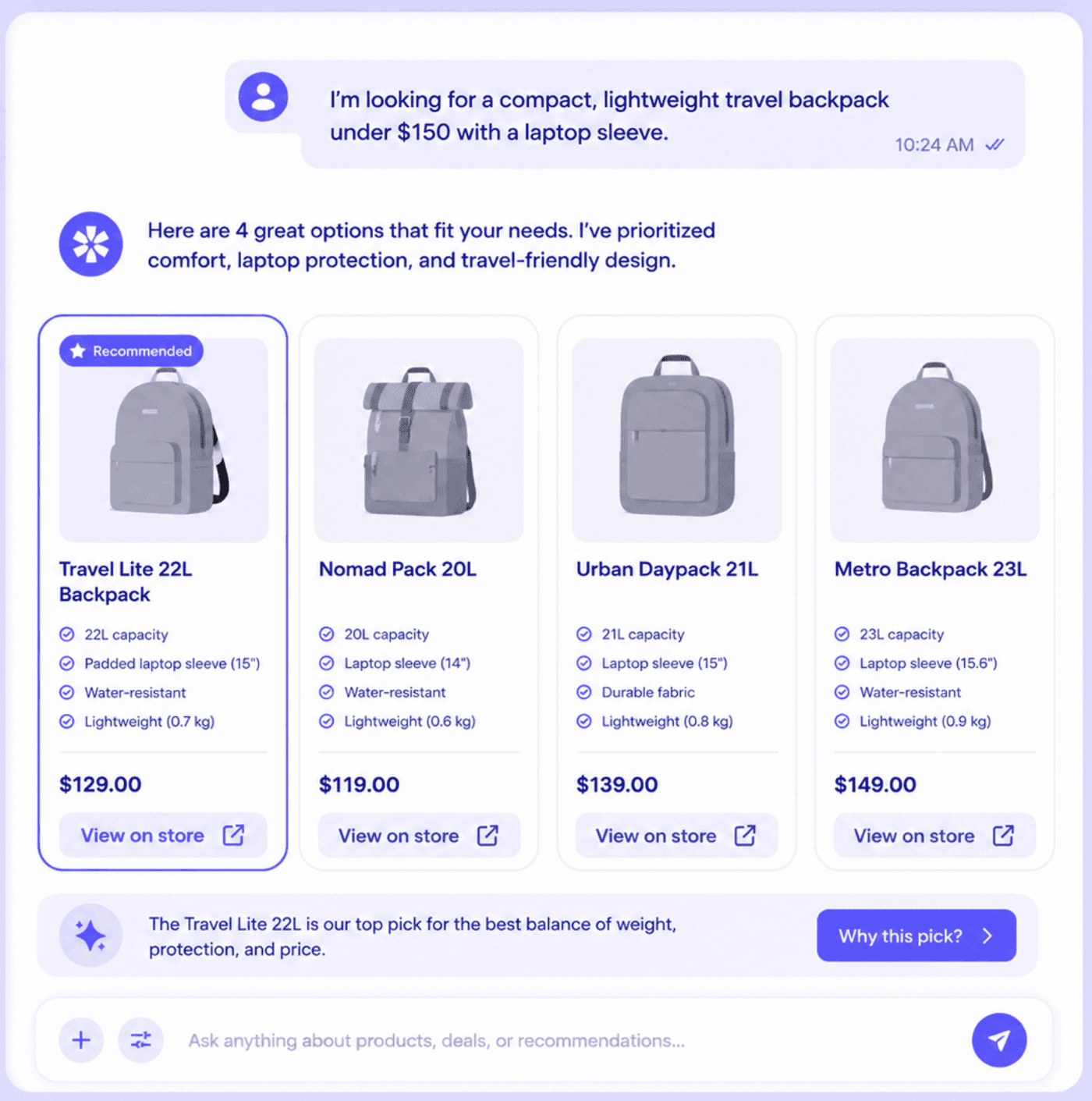
Claude started showing product cards directly inside its answers. Image, price, store link. Ask for designer bags under €500 and it returns four or five options. Not a page of blue links to go dig through. A shortlist, chosen for you.
The signal people underestimated in Claude Agentic Commerce
Here is the pattern that repeats with every platform shift: the announcement lands, it sounds like marketing, and everyone waits for proof. By the time the proof arrives, the people who moved early have already restructured for it.
Claude agentic commerce is now past the announcement stage. The product cards are live. The question is no longer whether AI assistants will sell products. It is whether your products are in the shortlist when they do.
Why the scale behind makes this serious
The reason to take this seriously is not the feature. It is the volume moving through it: Claude traffic reached 952M visits in May 2026, roughly 5× year over year.
Revenue is running at a $47B run-rate, up from around a $1B run-rate roughly 18 months earlier.
Valuation sits at $965B post-money, following a Series H that raised $65B.
And here is the number that should change how you think about the channel: shoppers arriving from AI assistants generate 53% more revenue per visit than non-AI traffic. AI-referred traffic to US retailers was up 393% year over year in Q1 2026. This is not an experimental surface with novelty clicks. It converts better than the channels you already pay for.
The structural shift
Compare the two surfaces directly.
On Google, "thermal winter coat men" returns thousands of results. You browse, filter, compare, and decide. The surface hands you the work.
On Claude, the same intent returns four or five cards. That is the final answer. There is no page two, and there is no scrolling your way back into consideration.
Like every AI surface, the logic is unforgiving. If your product data doesn't match how the model reads information, you don't rank lower. You disappear. Inclusion is decided before the shopper ever sees a result, and the decision is made by reading your data, not your website.
What every model extracts, and why product feed optimization depends on it
To decide what to surface, every model extracts three things from your catalog. The first is use case: is this coat thermal, versatile, suited to Italian winters? The second is traits: breathability, weight, insulation. The third is audience: the demographic, the context, the need it answers.
If those three signals are missing or ambiguous, the model has nothing to match against. Your feed has to speak this language, or it never surfaces. That is why product feed optimization is no longer a housekeeping task. It is the condition for being seen at all.
Product feed optimization: how to speak the model's language
Traditional feeds were built for keyword matching. A title, a few attributes, a category. That was enough when a search engine retrieved links and left the judgement to the shopper.
Agentic surfaces don't retrieve. They evaluate. So product feed optimization now means encoding use case, traits, and audience into structured attributes the model can reason over, not stuffing keywords into a title. Every attribute you leave empty is a question the model can't answer, and a reason to pick a competitor whose data does answer it.
This is the work: turn thin, human-facing product data into machine-readable, attribute-rich data that maps to how models decide. Do it once, per SKU, across every language and channel you sell in.
The Google connection: why product feed optimization now wins AI chats too
Now the part nobody is connecting. To be clear, what follows is an educated guess on my part, not an official announcement or a confirmed roadmap.
Google owns roughly 14% of Anthropic and is committing to invest up to $40B more. My read: Claude's product cards will increasingly pull from Google Merchant Center, the same feed layer Google just extended with conversational attributes for AI Mode and Gemini. If that's right, it puts even more weight behind Google's Universal Commerce Protocol (UCP).
My read on Claude agentic commerce and the Merchant Center feed
The implication is simple and it compounds. Optimizing your Merchant Center feed today doesn't just win you Google's surfaces. It increasingly wins you the AI chats too, because they may draw from the same source of truth. One feed layer, quietly becoming the control point for visibility across Google and the assistants at the same time.
The strategic implication of Claude Agentic Commerce
Here is what changes operationally. The catalog stops being a static asset you publish and forget. It becomes the interface between your products and every model that decides whether to recommend them. The brands that treat product data as infrastructure, structured, complete, continuously optimized, will be the ones in the four or five cards. Everyone else will be invisible and won't know why.
Claude agentic commerce is the clearest signal yet that this shift is no longer theoretical. The window to restructure your data ahead of the curve is open now, while most catalogs still speak the old language.
We're already helping billion-euro catalogs restructure their data for exactly this. If you want to see what it looks like on your catalog, start here.
Keep reading
Related articles



Free AI Readiness Audit
Find out what AI agents can't read on your product pages
Send us 3 product URLs. We score them for ChatGPT, Gemini and Google AI Mode, show what is missing and send them back fixed.
- AI Readiness Score for each page
- Missing attributes, keywords and shopper intents
- The optimized pages, ready to publish
Featured in




Claude Agentic Commerce Is Here: What Product Cards in AI Answers Mean for Your Catalog
Claude now shows product cards in its answers. Here's the structural shift in agentic commerce and how product feed optimization keeps your catalog visible.
Claude showing product cards inside an AI answer
Claude now shows **product cards with image, price and store link** directly inside its answers: a shortlist of four or five, not a page of links. Shoppers from AI assistants generate 53% more revenue per visit, and AI-referred traffic to US retailers grew 393% YoY in Q1 2026. Models extract **use case, traits and audience** from your catalog; if those signals are missing, your product is excluded, not ranked lower. Our read (not confirmed): Claude's cards may increasingly draw from Google Merchant Center, making **one feed layer the control point** across Google and AI chats.
What is Claude Agentic Commerce? | It's Anthropic's move to let Claude act on a user's behalf to complete purchases and bookings, and to surface product cards (image, price, store link) directly inside its answers. Instead of returning links, Claude returns a curated shortlist of products for a shopping query. How significant is AI-referred traffic for retailers right now? | Very significant. Shoppers arriving from AI assistants generate 53% more revenue per visit than non-AI traffic, and AI-referred traffic to US retailers was up 393% year over year in Q1 2026. Does optimizing my Google Merchant Center feed help me appear in Claude? | Possibly, and increasingly so. This is an educated guess, not confirmed: because Google holds a significant stake in Anthropic and has extended Merchant Center with conversational attributes for AI Mode and Gemini, Claude's product cards may increasingly pull from that same feed layer. Why does product feed optimization matter for AI shopping surfaces? | Models extract three things from your catalog: use case, traits, and audience. Product feed optimization means encoding those signals into structured, machine-readable attributes. If they're missing, the model has nothing to match against and your product never surfaces. How is buying on Claude different from searching on Google? | Google returns thousands of results and leaves the comparison to you. Claude returns four or five cards as the final answer, so if your data is thin or ambiguous, your product is excluded rather than simply ranked lower.
