Three companies are racing to sell you something inside an AI conversation. None of them are doing it the same way.
Over the last seven months, Google, OpenAI, and Microsoft have each shipped ad formats inside their conversational AI products, alongside a parallel, less-visible race: standardizing how AI agents actually complete a purchase.
Google has UCP. OpenAI has ACP. Microsoft is adopting both. None of the three uses the same names for similar things, and no independent body has standardized the terminology yet.
This piece maps what's actually live, what's still in test, and who's actually ahead in turning AI conversations into paid placements.
Google AI Mode
Google's ad formats inside AI Mode didn't emerge in isolation.
They sit on top of a broader Agentic Commerce push: at Google Marketing Live (May 2026), Google unveiled Conversational Discovery Ads and Highlighted Answers, and expanded Direct Offers, giving brands a way to surface exclusive discounts with native checkout.
That checkout runs on the Universal Commerce Protocol (UCP), an open standard Google co-developed with Shopify, Etsy, Wayfair, Target, and Walmart, and endorsed by over 20 partners including Visa, Mastercard, and Stripe.
UCP is compatible with Google's Agent Payments Protocol (AP2) and standardizes the entire commerce journey, discovery to post-purchase, so retailers don't need bespoke integrations for every AI surface. Google also introduced Business Agent, letting shoppers chat directly with a brand inside Search, and Universal Cart, a cross-retailer cart spanning Search, Gemini, and YouTube.
By July, five placement formats were live, all still US-only, with two Gemini-native formats in limited test.
7 formats:
Bottom Text-Based Ads (Stacked)
Bottom Shopping Carousel Ads (Row)
In-Line Shopping Singular Ads (Product Mixing)
In-Line Shopping Ads (Non-Rich)
Sponsored Product Grid Ads
Conversational Discovery Ads (test)
Highlighted Answers (test)
How each works
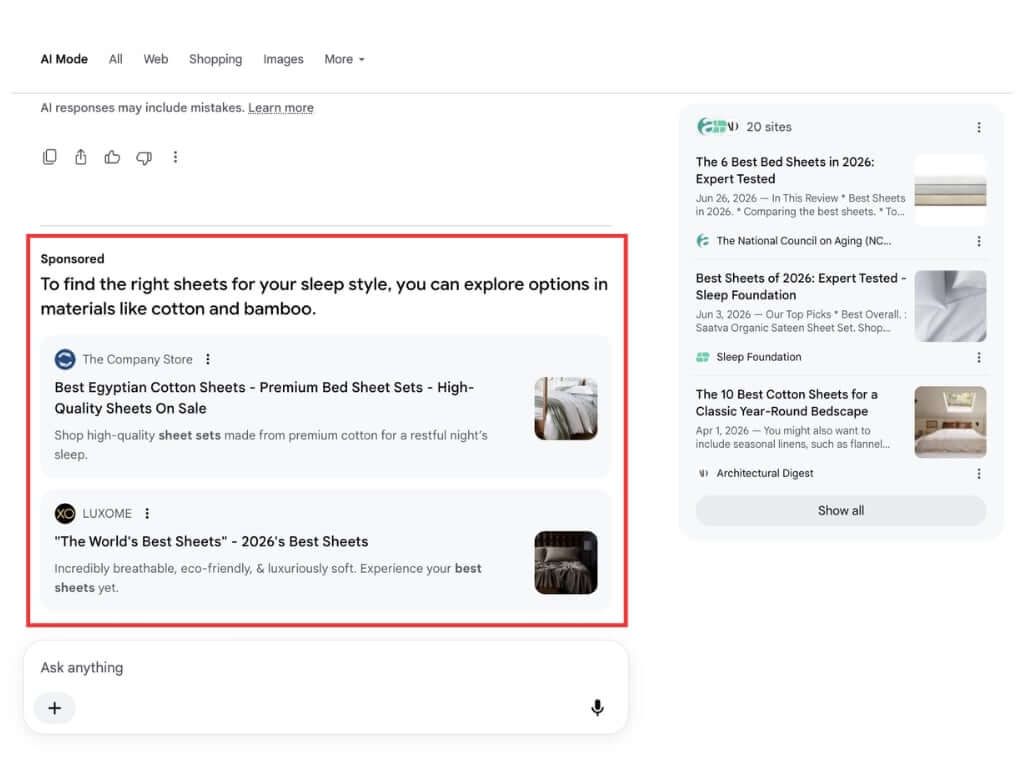
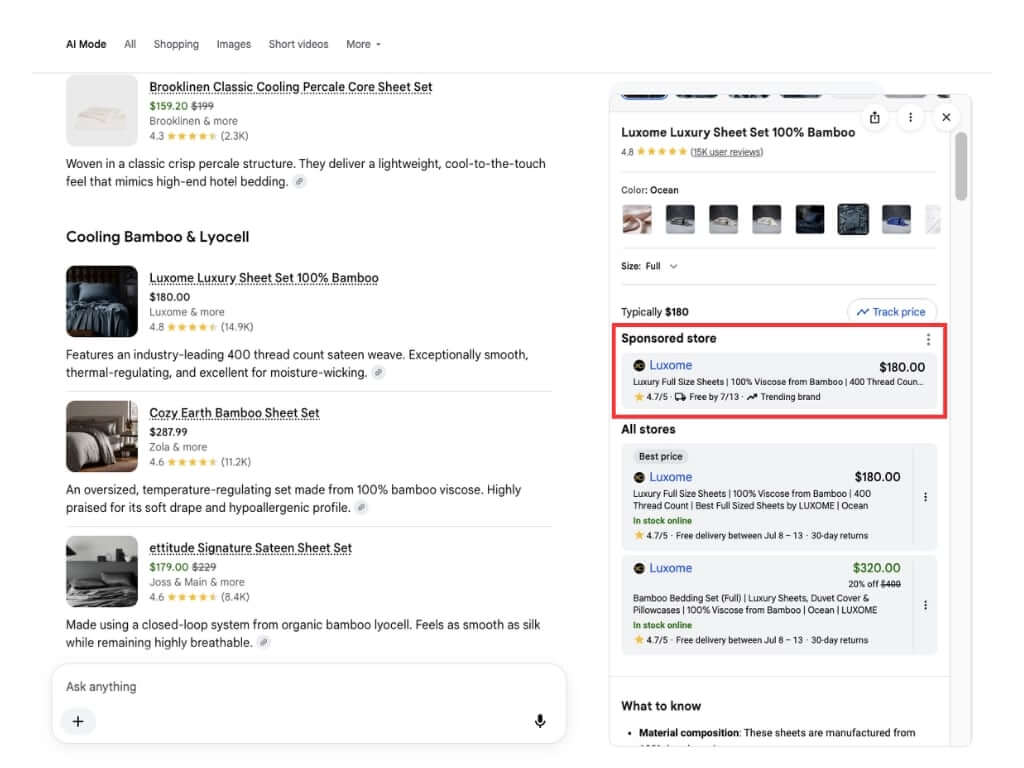
Bottom Text-Based Ads (Stacked): Sponsored links stacked vertically below the AI response, styled like organic citations, brand name, headline, short description, and a small thumbnail image. No price shown. Best for queries where multiple brands compete on trust and reputation rather than a single best price.
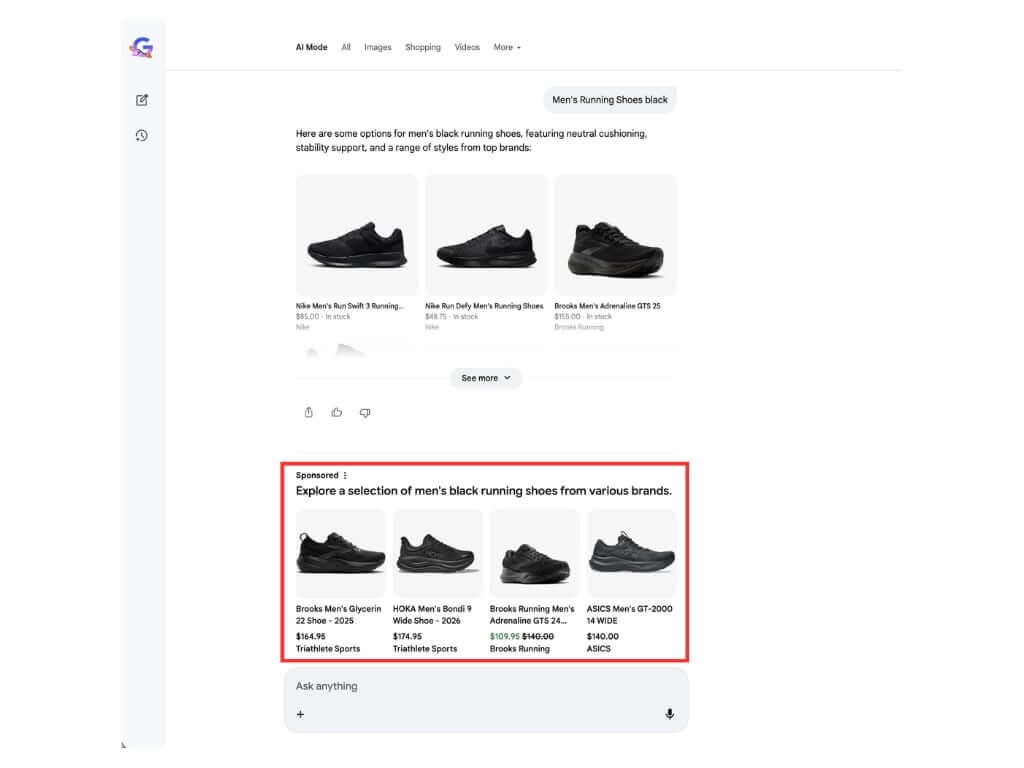
Bottom Shopping Carousel Ads: Multiple products from different retailers in a scrollable row, each with price, rating, and store name. Best for direct product comparison shopping.
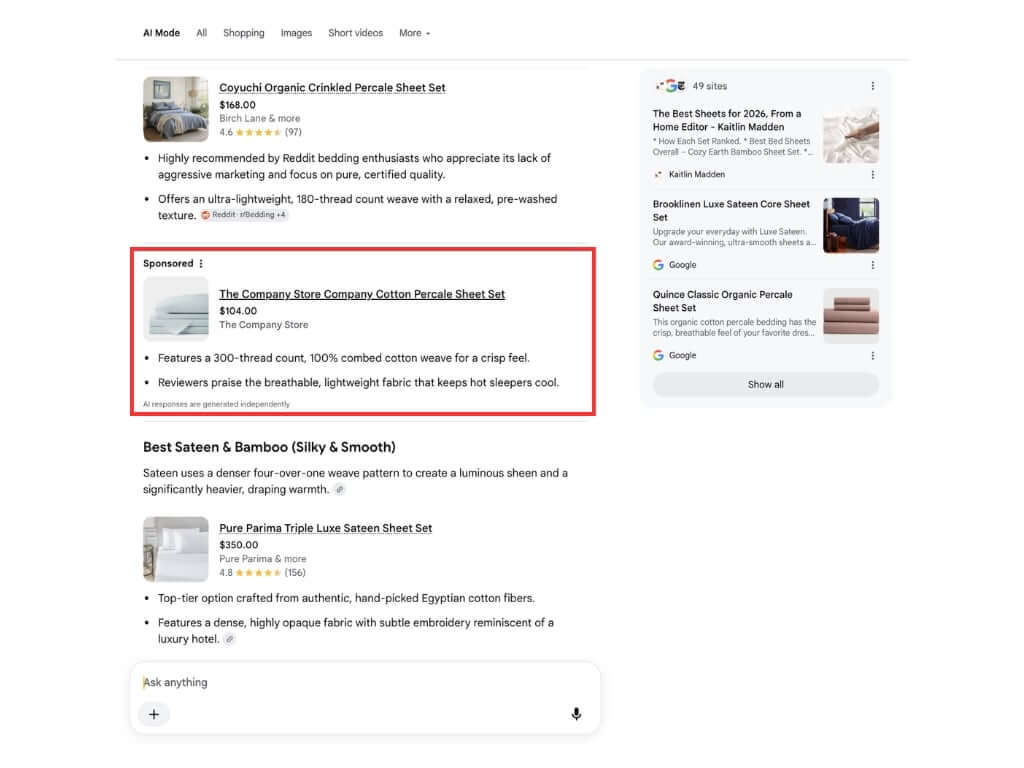
In-Line Shopping Singular Ads (Product Mixing): A single sponsored product embedded inside an organic list, visually indistinguishable except for the "Sponsored" tag. Best for intercepting users already reading comparison content.
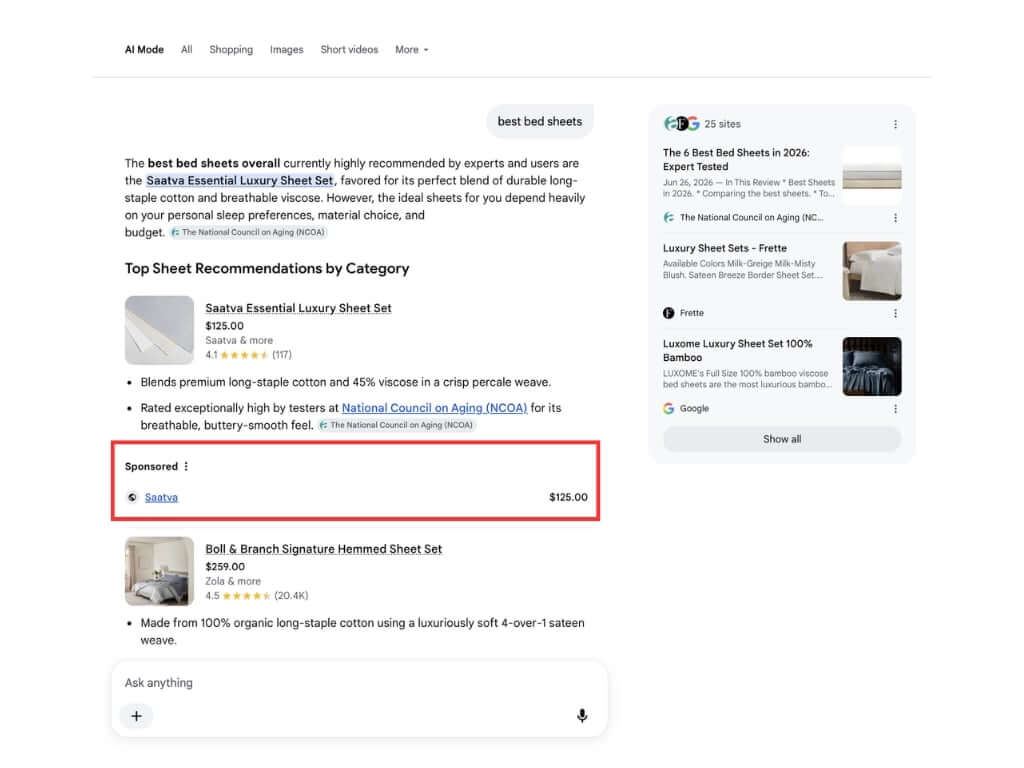
In-Line Shopping Ads (Non-Rich): A slimmer version, usually higher up, showing only favicon, name, and price. Best for low-friction, low-intrusion placements.
Sponsored Product Grid Ads: One or more sponsored slots inside a product grid, sometimes tagged "Trending brand." Best for pure shopping-intent queries with strong commercial signal.
Still in test
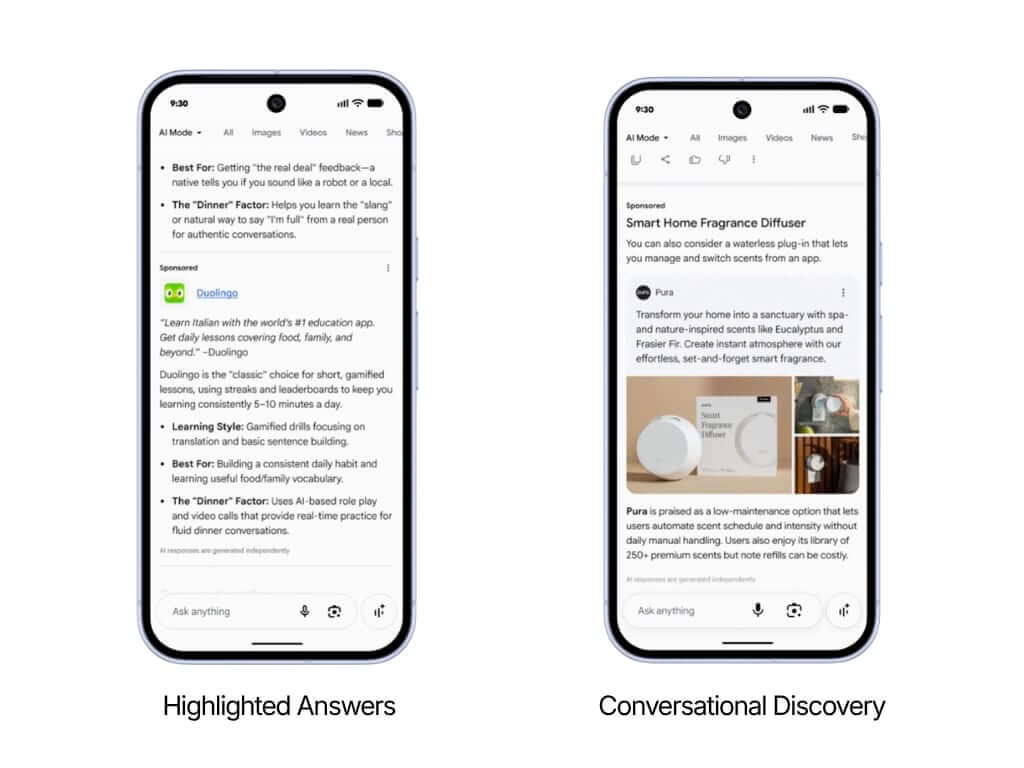
Conversational Discovery Ads: Gemini writes a custom explainer tailored to the exact question asked, appearing inside the answer flow itself rather than below it.
Highlighted Answers: A sponsored option inserted inside an AI-generated recommendation list, with the same independent AI explainer.
ChatGPT
OpenAI's approach has been the most public about its own timeline. Ad principles were announced January 16, 2026; ads launched in the US on February 9 with Target and Roundel as early partners; the rollout covered all US Free/Go users by March 21; and self-serve buying opened to every US advertiser on May 5, removing the earlier $50,000 minimum. Within six weeks of the pilot, OpenAI told Reuters the ad business had reached a $100 million annualized run rate, with more than 600 advertisers on the platform, though that figure reflects the current pace projected over a year, not revenue already collected.
On the transactional side, OpenAI took the opposite path from Google. It launched Instant Checkout in September 2025, built on the Agentic Commerce Protocol (ACP), co-developed with Stripe (later joined by Meta and PayPal). ACP is deliberately narrow, four endpoints covering checkout creation, payment, and cancellation, unlike UCP's full-lifecycle scope. But Instant Checkout itself didn't survive: OpenAI quietly retired it in March 2026 after only about a dozen Shopify merchants ever shipped against it. The protocol lives on, but OpenAI's own checkout feature is gone, a signal that OpenAI chose ad revenue over transaction fees as its near-term monetization path, while ACP continues as connective tissue other platforms, including Microsoft, are now adopting.
2 formats + 1 emerging:
Sponsored Answer Card
Product Spotlight / Shopping Carousel
Brand Chat / Conversational Messaging (bonus, not yet officially named)
How each works
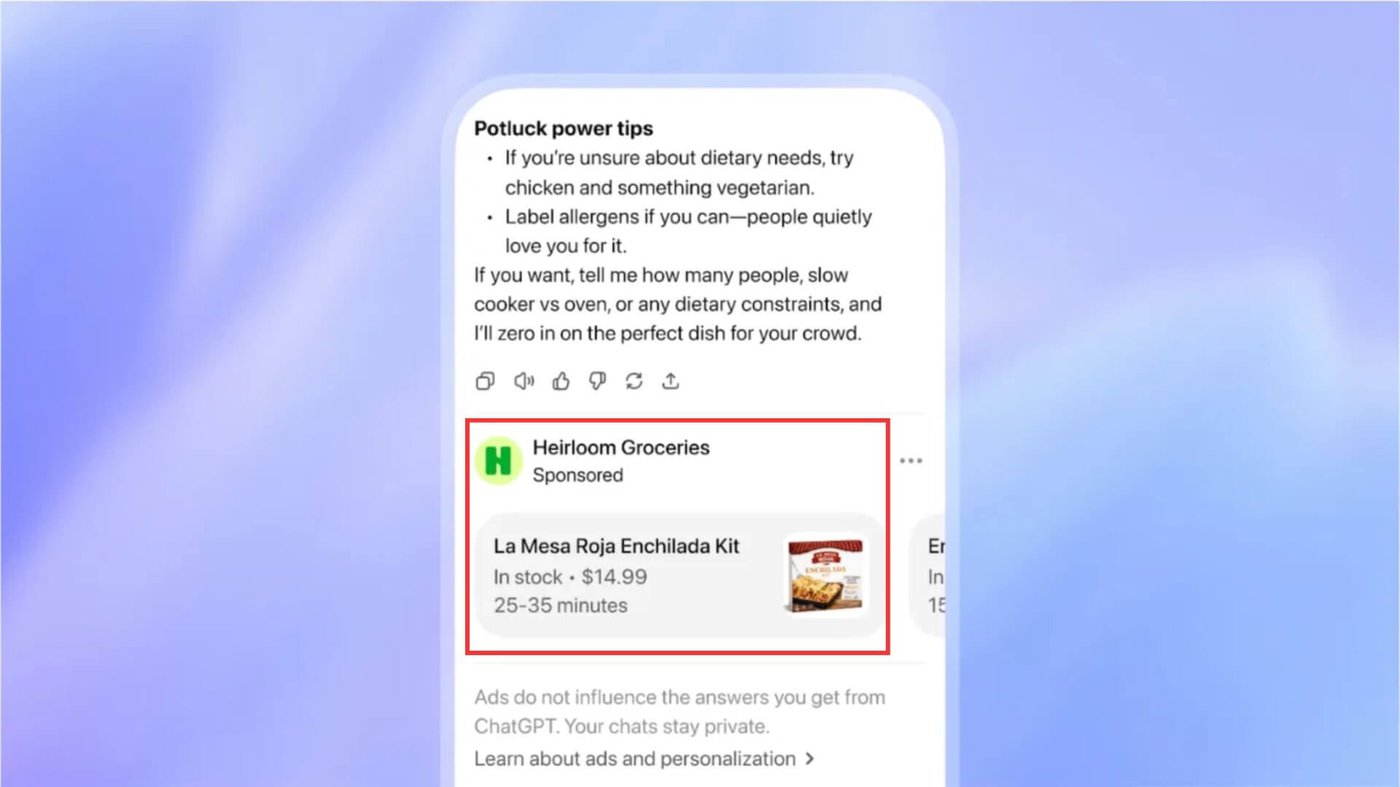
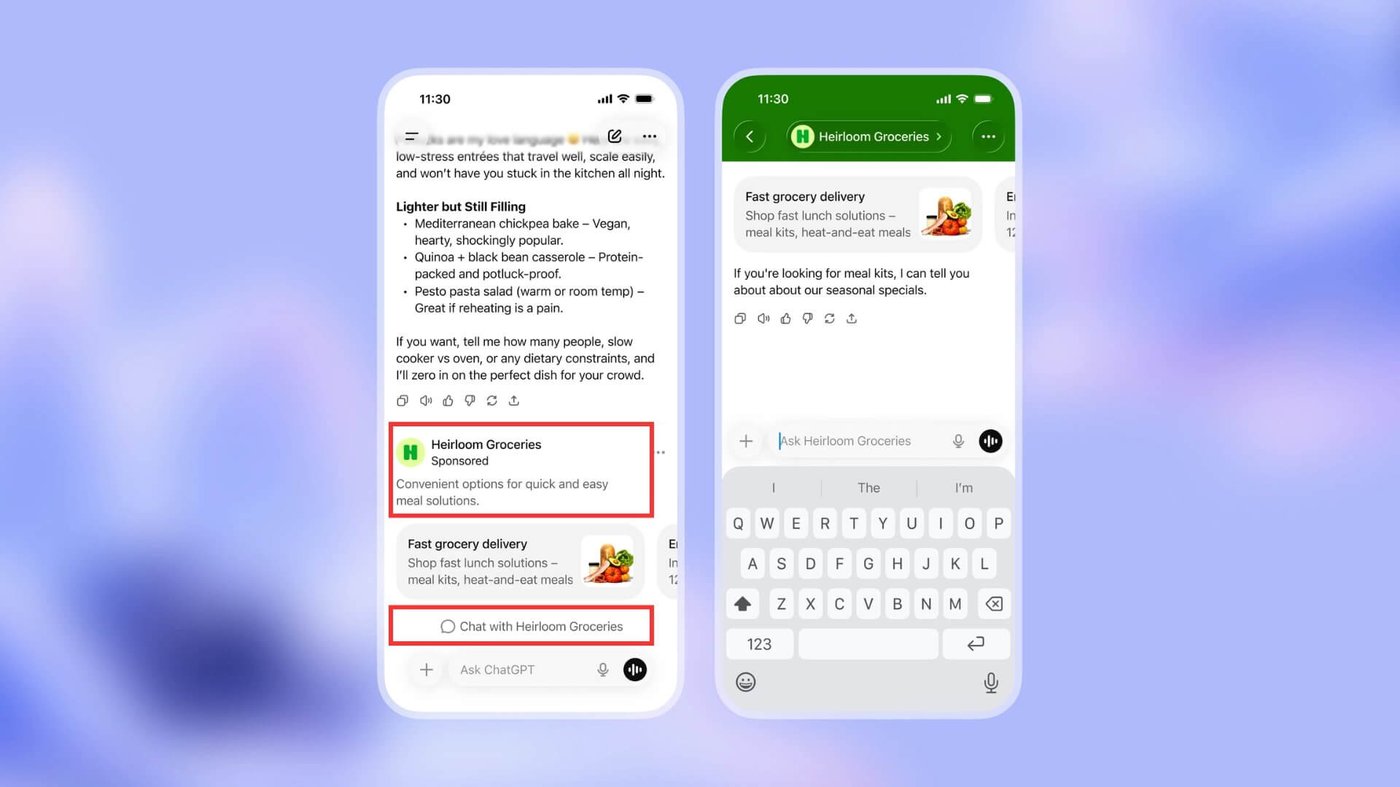
Sponsored Answer Card: A single-brand card below the response, logo, "Sponsored" label, product name, price, availability. The first live example (Heirloom Groceries, February 9) set the template still in use today.
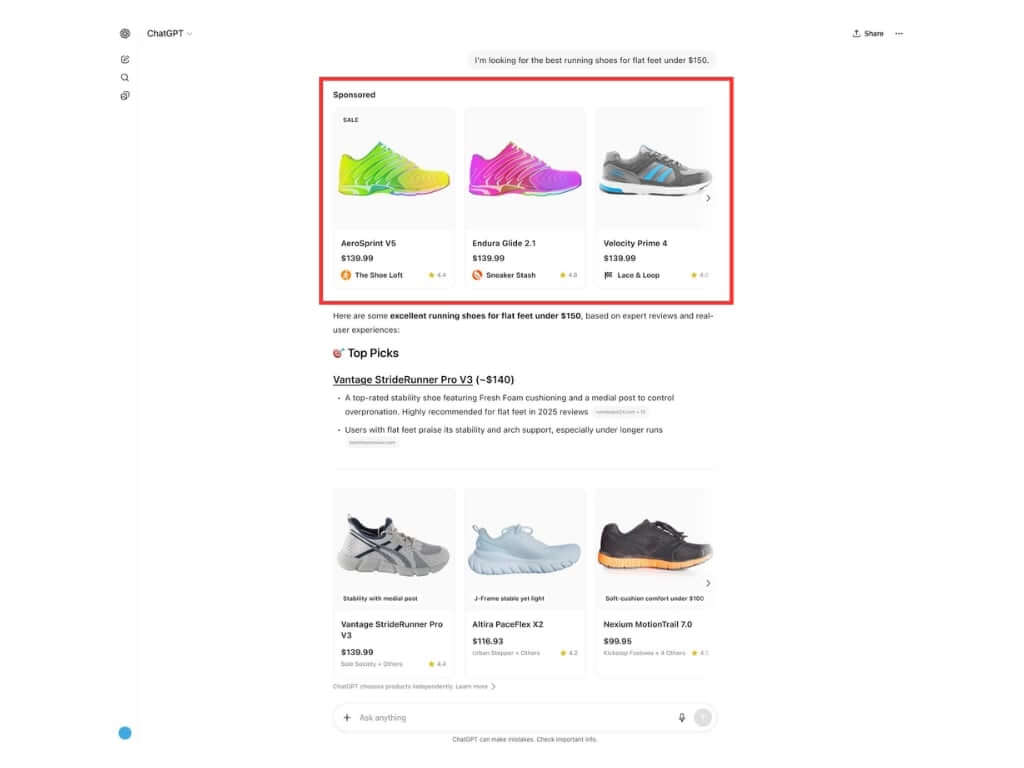
Product Spotlight / Shopping Carousel: Multiple products from different retailers in a scrollable row, near-identical in styling to organic shopping results shown just below it in the same response, which makes sponsored and organic hard to tell apart at a glance.
Brand Chat / Conversational Messaging (bonus): some sponsored cards show a "Chat with [Brand]" button, which opens a dedicated, brand-labeled conversation, seen here with Heirloom Groceries.
Microsoft Copilot
Microsoft's ad strategy looks less like a new product and more like an extension of its existing search ad business into a new surface. The most developed part of that strategy is checkout, not ads. Copilot Checkout launched in the US in January 2026 with Shopify, PayPal, Stripe, and Etsy, and Shopify merchants are automatically enrolled. Microsoft reports (its own figures, not independently verified) that shopping journeys involving Copilot are 33% shorter than traditional search paths, see 53% more purchases within 30 minutes of interaction, and are 194% more likely to convert when shopping intent is present. As of Q2 2026, Copilot Checkout had scaled past 500,000 participating merchants. Microsoft is adopting ACP for merchant onboarding on top of rolling out UCP support in its own Merchant Center, effectively supporting both Google's and OpenAI's protocols rather than building a third.
3 formats:
Search Ads
Feed-based Ads
Multimedia Ads
How each works
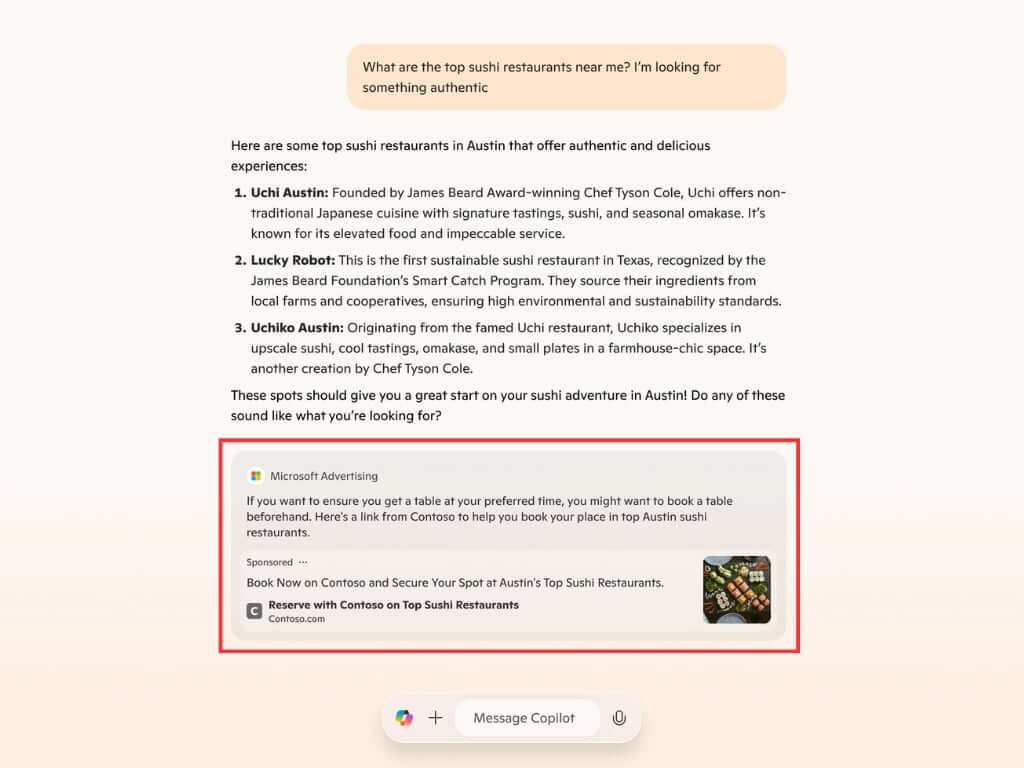
Search Ads: Existing Performance Max campaigns qualify automatically for Copilot placements, no separate setup. They appear labeled "Microsoft Advertising" and "Sponsored" beneath the conversational answer, with an "ad voice" explaining why the ad was shown. Third-party marketing sources report these placements as more effective than traditional search ads, though the exact figures aren't independently verified.
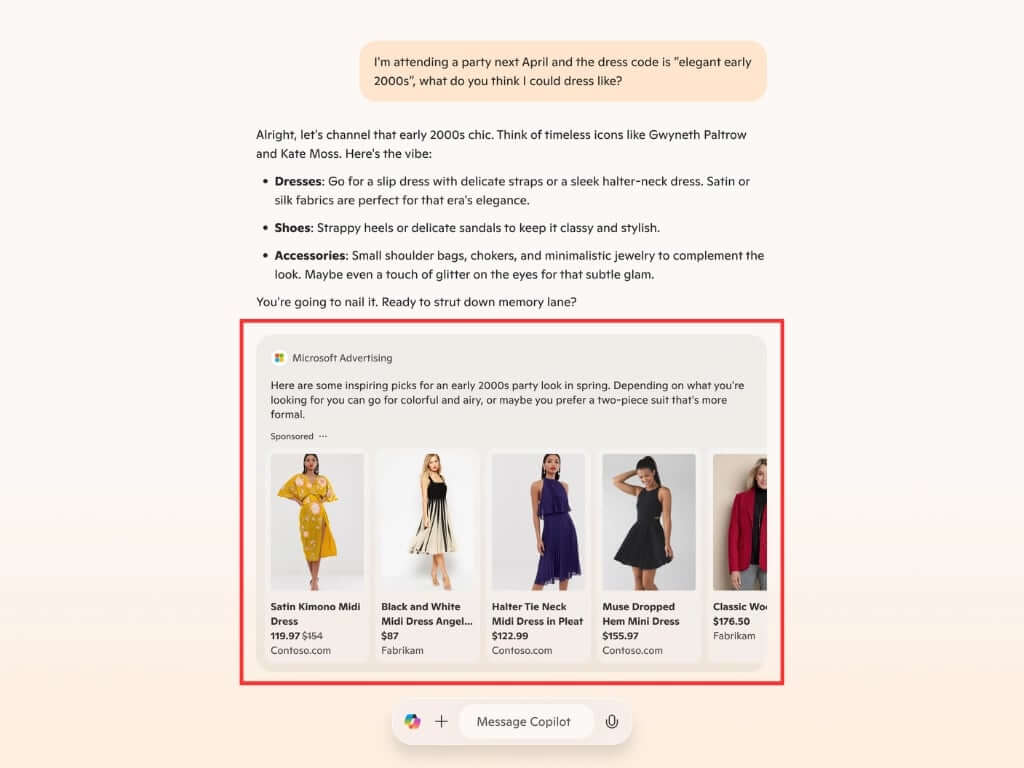
Feed-based Ads: Product ads pulled directly from Merchant Center catalog feeds, including the newer Offer Highlights format (announced April 21, 2026, piloting with Best Buy), which surfaces specific product differentiators like free shipping inside the conversation.
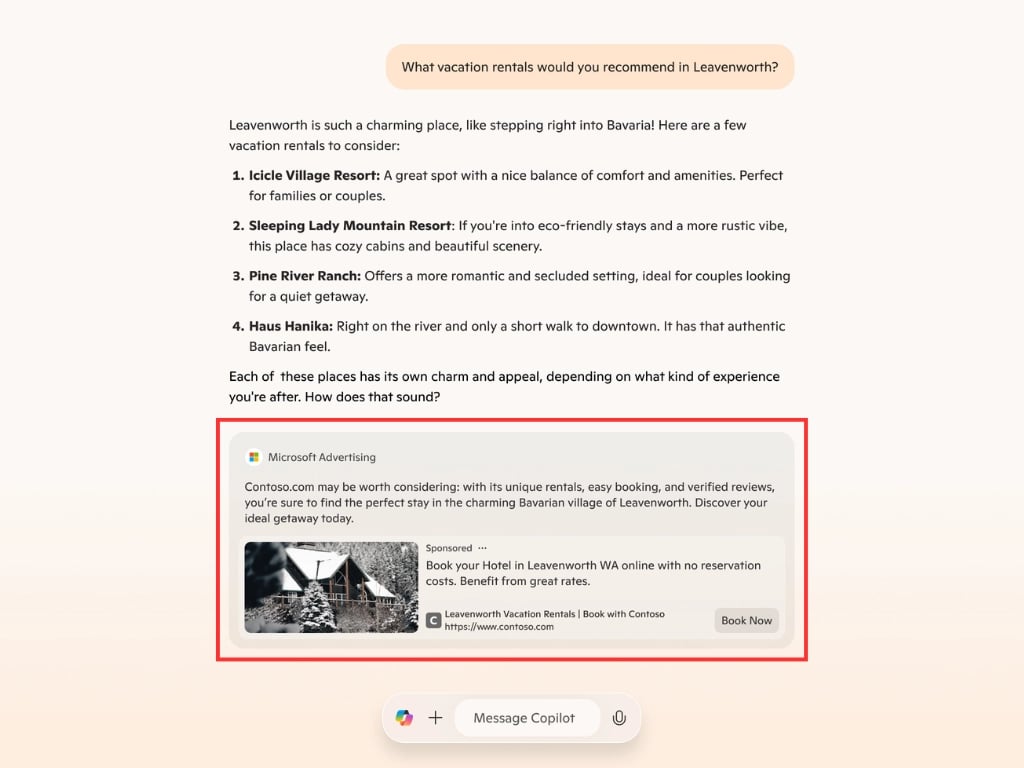
Multimedia Ads: Richer visual/video placements in the right rail of Bing/Yahoo SERPs, and the newer Showroom Ads, an interactive AI-powered showroom experience currently limited to select pilot advertisers.
Comparative table
Format | Platform | Status | Best for |
|---|---|---|---|
Bottom Text-Based Ads (Stacked) | Live | Brand trust/reputation queries | |
Bottom Shopping Carousel Ads | Live | Direct product comparison | |
In-Line Shopping Singular Ads | Live | Intercepting organic research | |
In-Line Shopping Ads (Non-Rich) | Live | Low-friction awareness | |
Sponsored Product Grid Ads | Live | High-intent shopping queries | |
Conversational Discovery Ads | Test | Answering a specific question | |
Highlighted Answers | Test | Competing inside a recommendation list | |
Sponsored Answer Card | ChatGPT | Live | Single-brand product push |
Product Spotlight/Carousel | ChatGPT | Live | Multi-retailer comparison |
Brand Chat | ChatGPT | Seen in product materials | Post-click brand engagement |
Search Ads | Copilot | Live | Existing PMax advertisers |
Feed-based Ads | Copilot | Pilot | Retail differentiators (shipping, pickup) |
Multimedia Ads | Copilot | Pilot | Brand storytelling, select advertisers |
What this means for brands
All three platforms are converging on the same underlying requirement regardless of which protocol they favor: clean, structured, real-time product feeds are now table stakes.
UCP, ACP, and Microsoft's dual-protocol approach are all solving the same integration problem from different angles. For eCommerce brands, this means feed hygiene, accurate pricing, stock, shipping data refreshed frequently, now directly determines whether you show up at all, sponsored or organic.
And for European brands specifically: every ad format across all three platforms remains US-only today. There's nothing to activate yet, only feeds and content structure to prepare.
Ads Inside AI Chat: Who's Actually Ahead?
Count formats, and Google wins clearly: 7 live/test placements versus 2-3 each for ChatGPT and Copilot, plus the most elaborate roadmap.
Count actual ad monetization at scale, and ChatGPT is ahead: a confirmed $100M annualized run rate and 600+ advertisers within six weeks of self-serve launch.
Count checkout traction, and Microsoft is quietly the furthest along, though checkout itself sits just outside the ads race: Copilot Checkout has scaled past 500,000 merchants, while OpenAI's own checkout feature didn't survive six months and Google's UCP-powered checkout is still rolling out market by market.
So the honest answer is: nobody is winning on every axis simultaneously. Google has the most ambitious ad surface. OpenAI has the most aggressive ad monetization. Microsoft has the most merchants actually transacting.
Whoever eventually pulls ahead in ads won't be decided by who has more formats, it'll be decided by whose checkout protocol brands standardize on by default, because that's the layer neither shoppers nor advertisers will ever see, and the one that will be hardest to switch away from.
Keep reading
Related articles



Free AI Readiness Audit
Find out what AI agents can't read on your product pages
Send us 3 product URLs. We score them for ChatGPT, Gemini and Google AI Mode, show what is missing and send them back fixed.
- AI Readiness Score for each page
- Missing attributes, keywords and shopper intents
- The optimized pages, ready to publish
Featured in






Ad Formats in AI Chat: A Cross-Platform Breakdown of Google, ChatGPT and Copilot
Google, OpenAI and Microsoft have each shipped ads inside their AI assistants. Every live and test format mapped, the checkout protocols behind them, and who is actually ahead.
Ad formats in Google AI Mode, ChatGPT and Microsoft Copilot
Google AI Mode has **7 ad formats** live or in test, ChatGPT has 2 plus Brand Chat, and Microsoft Copilot has 3. ChatGPT ads reached a **$100M annualized run rate** with 600+ advertisers within six weeks of self-serve launch. Copilot Checkout scaled past 500,000 merchants; OpenAI retired Instant Checkout in March 2026. Every platform depends on the same thing: **clean, structured, real-time product feeds** decide whether you appear, sponsored or organic. All formats are US-only today.
Which AI assistants show ads? | Google AI Mode, ChatGPT and Microsoft Copilot all show ads inside AI conversations as of July 2026, all in the US only. What is the difference between UCP and ACP? | UCP (Universal Commerce Protocol) is Google's open standard covering the whole commerce journey; ACP (Agentic Commerce Protocol) by OpenAI and Stripe is narrower, covering checkout creation, payment and cancellation. Who is winning ads in AI chat? | Google has the most formats, ChatGPT has the most ad revenue ($100M annualized run rate) and Microsoft has the most merchants transacting through Copilot Checkout. What should brands do before AI ads launch in Europe? | Prepare clean, structured product feeds with accurate pricing, stock and shipping data, because every format pulls from them.
