Every major shift in commerce creates a new discipline before it creates a new job title.
Search engines created SEO. Marketplaces created marketplace management. Agentic Commerce is about to do exactly the same.
Over the next few quarters, every retailer will discover that optimizing products for AI agents is no longer optional. The difficult question won't be how to optimize a catalog, that technology already exists. The difficult question will be something much simpler.
Who owns catalog optimization?
It sounds like an organizational detail. In reality, it is quickly becoming one of the biggest strategic questions in modern commerce.
Almost every company we speak with reaches the same point. Everyone agrees that product data is becoming increasingly critical as ChatGPT, Gemini, Copilot, Alexa, and other AI assistants play a growing role in influencing purchasing decisions.
Then the conversation becomes more difficult. Once everyone agrees it's important, the real question emerges: who actually owns it?
The Head of eCommerce assumes SEO owns the project. SEO believes Product Content should lead it. Product Content argues Marketing controls customer acquisition.
In the end, everyone owns a piece of the problem. Nobody owns the full outcome.
This isn't because companies are poorly organized. It's because product catalogs were never designed to have a single owner. Over the past two decades, they have evolved into a shared asset, managed by dozens of teams, each optimizing for a different objective.
That model worked well when catalog optimization was largely a nice-to-have. Even if your product data wasn't perfect, you could often compensate by spending more on advertising.
That is no longer true: customer acquisition is becoming more expensive every year, while AI-powered discovery and advertising platforms increasingly rely on context-rich, structured, high-quality product data to understand, rank, recommend, and sell products.
Catalog optimization has shifted from a nice-to-have to a must-have
Companies are now realizing they need not only better technology, but also a clear operating model for who owns, maintains, and continuously improves product data.
In practice, the Head of eCommerce or Digital already owns this outcome and its P&L, what they've lacked is the operating model and the tooling to act on it.
That's why we believe Agentic Commerce Optimization isn't simply another software category. It's the emergence of an entirely new business function, one that every serious retailer will eventually need to define.
Deloitte's 2026 executive survey illustrates this well: around 29% of retailers and 40% of consumer packaged goods companies still have no defined strategy for agentic commerce optimization.
Most organizations know change is coming, but very few have decided who should lead it. Like most organizational challenges, the companies that solve this first will gain an advantage that is difficult for competitors to replicate.
Why Agentic Commerce Optimization still lacks clear ownership
The easiest way to understand the problem is to forget AI for a moment: think about how a typical product page comes to life.
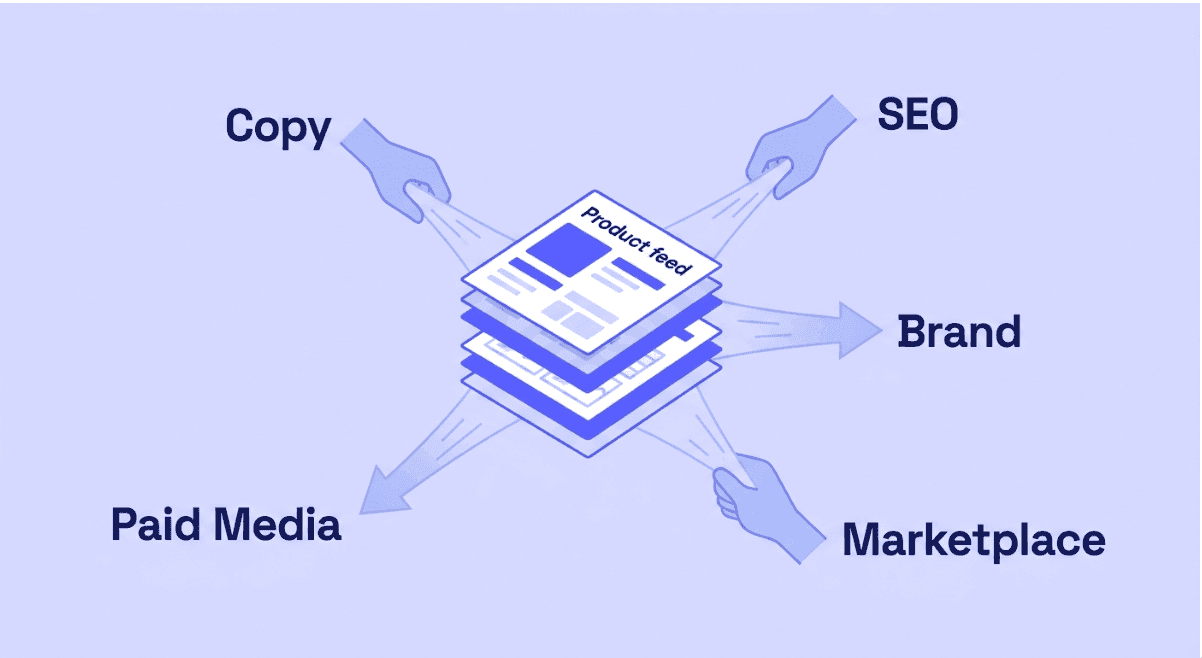
A copywriter writes the description. SEO provides keyword guidance. Brand reviews the tone of voice. Merchandising decides which products deserve visibility. Marketplace teams adapt the content for Zalando or other channels. Paid media teams optimize titles and conversational attributes for Google Merchant Center.
Each team performs its role well. The problem is that none of them are responsible for the product page as a complete information object.
For years, that wasn't an issue.
Humans naturally compensate for incomplete information. They infer meaning from images, recognize brands they already trust, compare alternatives, and fill gaps using common sense. Product pages didn't need to describe everything because people already understood far more than the page explicitly communicated.
AI doesn't work that way.
An AI agent can only reason over the information it receives. It does not fill missing attributes with assumptions, it treats them as gaps in knowledge.
Weak descriptions reduce confidence. Inconsistent specifications introduce ambiguity. Sparse product data limits the agent's ability to compare products, answer questions, or justify recommendations.
The product page has quietly changed: it is no longer just a marketing asset. It has become structured knowledge that machines use to understand your products.
No existing team was built for it, but in every organization there's already one person the catalog runs through. The role isn't missing; it's unnamed and under-resourced.
Why Agentic Commerce Optimization deserves to be its own discipline
Every important function in digital commerce started as "someone else's responsibility."
SEO was originally considered a technical task delegated to developers. Performance marketing lived inside traditional marketing. Product Information Management was treated as a back-office operational problem until brands realized structured product data had become a competitive advantage.
Agentic Commerce Optimization is following the same pattern.
What's different this time is the pace: AI assistants are fundamentally changing how purchase decisions are made.
What should concern every retailer is the speed of this transition. According to Adobe Analytics, traffic from AI assistants to retail sites is growing by more than 1,200% year over year, and shoppers arriving through these experiences convert 42% better than those from traditional acquisition channels.
And this is only the beginning. Google is still rolling out its AI-powered shopping experience gradually, giving advertisers some time to adapt. But that window won't stay open forever. As AI becomes the default interface for product discovery, retail will experience the same kind of disruption that publishers faced when AI Overviews reshaped search almost overnight.
Every team benefits from Product Catalog Optimization
Traditional search asked users to compare ten blue links. AI agents increasingly do the comparison themselves. They summarize alternatives, justify recommendations, answer objections, and, increasingly, complete purchases without requiring the customer to visit every product page individually.
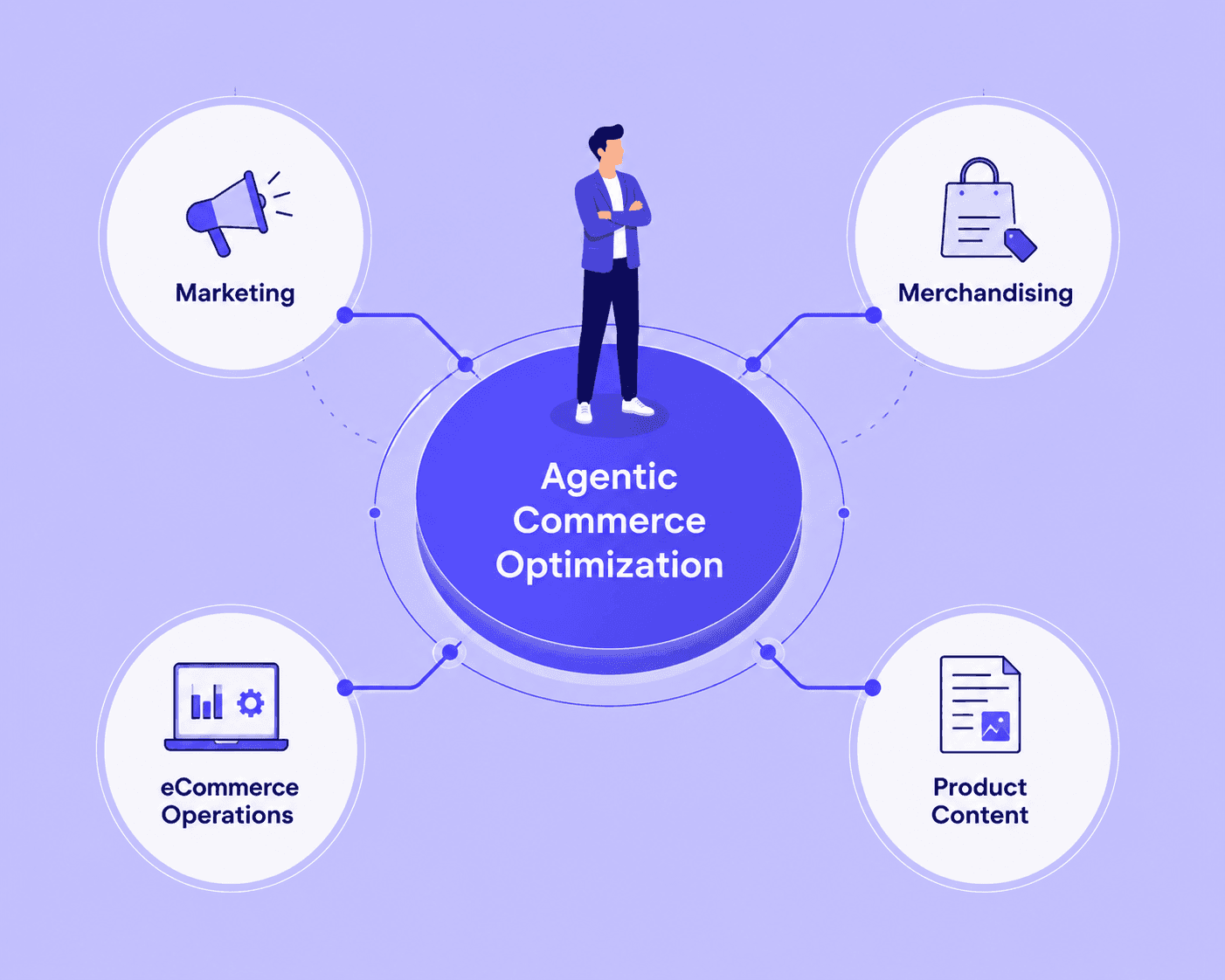
That's why Agentic Commerce Optimization naturally sits at the intersection of several existing disciplines.
Marketing cares because richer product information improves discoverability.
Merchandising cares because better structured data influences which products AI recommends.
eCommerce cares because catalog quality directly affects conversion.
Product Content teams care because they own the information every AI model ultimately consumes.
Each of these teams owns a critical piece of the puzzle, but none owns the entire system. As AI becomes a primary discovery and purchasing channel, that shared ownership increasingly becomes a liability.
Agentic Commerce Optimization is approaching an inflection point. Within a few quarters, every major retailer will need someone accountable for how products perform across AI assistants. The only real question for brands is whether they'll empower that person before their competitors do.
The catalog expert is probably already inside your organization
At this point, the obvious question is: if Agentic Commerce Optimization needs an owner, who should that person be?
Most companies assume they need to hire someone new but in many cases, they don't.
The strongest candidate is often already inside the organization and is the person who knows the catalog better than anyone else.
This person rarely has a clearly defined role and can come from almost any department. Yet in every project we've worked on, they emerge almost immediately.
They're the one who knows which attributes matter, which terms customers actually search for, which marketplaces require different product structures, and which categories become operational nightmares every season.
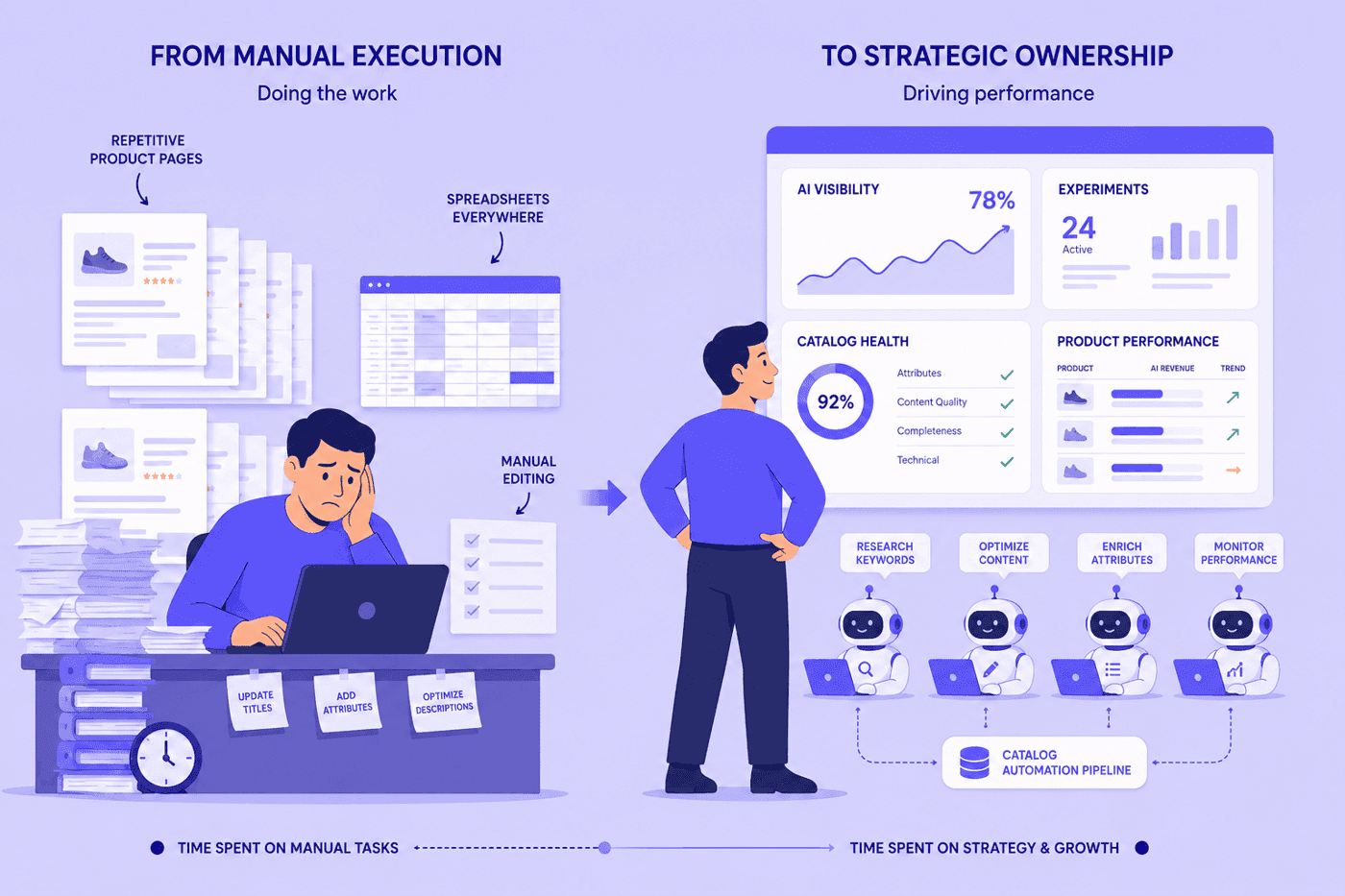
The problem is that this person has rarely been treated as strategic. Not because they lack the ability, but because they usually have spent years buried in execution: writing descriptions, enriching attributes, fixing spreadsheets, reviewing translations, adapting marketplace feeds, and managing the repetitive work required to keep the catalog alive.
Their expertise has never been the bottleneck. Their time has.
This is where AI changes the equation. The first generation of AI tools promised to help teams write product descriptions faster. That was useful, but it only solved a small part of the problem.
The real opportunity isn't producing product pages faster, it's eliminating the need for experts to spend most of their time creating them, and instead equipping them with the insights they need to continuously improve the catalog by knowing exactly what to optimize, why it matters, and how to do it.
Now that AI can reliably generate descriptions, titles, structured attributes, metadata, translations, product highlights, and conversational attributes, the role of the catalog expert changes. You do not replace them, you finally free them to act like the strategic owner the business always needed.
From Catalog Manager to Catalog Strategist
Accounting software didn't eliminate accountants, CRM platforms didn't eliminate salespeople, and marketing automation didn't eliminate marketers. Each technology allowed specialists to spend less time on execution and more time creating business value.
Agentic Commerce Optimization is driving the same transformation. The person who once spent their days producing product pages manually becomes the person responsible for how the entire catalog performs across AI-powered commerce.
Instead of measuring success by the number of descriptions published, they begin asking strategic questions:
Which products have the greatest untapped AI visibility?
Which categories should be re-optimized first?
Where is product information preventing AI assistants from recommending our products?
Which attributes most influence recommendation quality across different markets?
This is no longer a production role. It is a performance role, focused on continuously improving how products are understood, evaluated, and recommended by intelligent systems.
We call this role the Catalog Strategist. Unlike a copywriter or SEO specialist, the Catalog Strategist combines product expertise, AI, experimentation, and performance data to continuously optimize the catalog as a strategic business asset.
Few organizations formally have this role today, but that is unlikely to last.
Just as retailers eventually created dedicated teams for SEO, marketplaces, CRM, and marketing automation, they will soon designate someone responsible for how products perform across AI assistants and intelligent commerce platforms.
Success isn't measured by content. It's measured by business impact
Defining the role of the Catalog Strategist is relatively straightforward. Defining how to measure its success is more important. Their job isn't to publish more product pages, in fact, if AI is doing its job well, content production becomes almost invisible.
Their responsibility is to maximize the performance of the catalog as a business asset.
That means using data, not intuition, to identify where optimization will create the greatest commercial impact. Rather than treating every SKU equally, the Catalog Strategist prioritizes the products with the highest unrealized potential, deciding which pages deserve attention, which attributes are limiting performance, and which opportunities will generate the highest return.
The role becomes one of continuous optimization. They analyze where AI assistants struggle to understand products, identify missing or weak product information, compare performance across markets, and experiment with richer attributes, better product structures, and new ways of describing products.
Every optimization is a hypothesis, every product an experiment, and every result another data point that improves future decisions.
This represents a fundamental shift in how retailers think about product catalogs.
Historically, a product page was considered finished once it was published because improving it required significant manual effort.
AI changes that assumption: when product content can be regenerated, tested, and deployed continuously, the catalog evolves from a static database into a living system that constantly learns and improves.
The best catalogs will be the ones that never stop improving, and the Catalog Strategist will be responsible for making that happen, not by writing faster, but by making smarter decisions.
This is exactly what we built AndromedAI to enable: an AI layer that eliminates manual catalog work while providing actionable insights into which product pages need optimization and exactly how to optimize them.
The result is that the people who already own your catalog can operate as Catalog Strategists from day one, instead of spending their time on repetitive execution.
Keep reading
Related articles



Free AI Readiness Audit
Find out what AI agents can't read on your product pages
Send us 3 product URLs. We score them for ChatGPT, Gemini and Google AI Mode, show what is missing and send them back fixed.
- AI Readiness Score for each page
- Missing attributes, keywords and shopper intents
- The optimized pages, ready to publish
Featured in






Who owns Agentic Commerce Optimization? Nobody yet. That's the real bottleneck for brands.
Five teams touch your catalog but none own agentic commerce optimization. Why the role is missing, and why the Catalog Strategist who should own it is probably already inside your company.
Who owns agentic commerce optimization inside a brand
Copywriting, SEO, brand, merchandising and paid media each touch the product page, but **nobody owns the product page as a complete information object**. Around 29% of retailers and 40% of CPG companies still have no defined strategy for agentic commerce optimization (Deloitte, 2026). AI agents cannot fill gaps the way humans do: missing attributes become missing knowledge, and the product is not recommended. The owner is usually already inside: the catalog expert, freed by AI to become a **Catalog Strategist** measured on business impact, not content volume.
Who should own agentic commerce optimization? | The Head of eCommerce or Digital owns the outcome and its P&L; day to day, the catalog expert already inside the company is the best candidate to become the Catalog Strategist. What is a Catalog Strategist? | A performance role that combines product expertise, AI, experimentation and data to continuously optimize how products are understood and recommended by AI assistants, instead of producing pages manually. Why can't existing teams own it? | Each team optimizes one piece of the product page, but AI agents read the page as a single body of structured knowledge, so shared ownership leaves gaps. How is success measured? | By business impact: AI visibility, recommendations, traffic and revenue from the products optimized, not by the number of descriptions published.
