The first AI-powered holiday season
Every Q4 feels urgent. Every year, someone tells you this is the one that matters most.
But this year that claim actually holds up, and not for the reason most brands assume.
At a recent Google retail readiness briefing, called Leaders' Brief, Sarah Byrne, Executive Director of Agencies at Google, put it plainly: this year, shoppers won't just be trying AI, they'll be relying on it.
Not experimenting with a new feature out of curiosity, but genuinely leaning on it to make purchase decisions.
That distinction matters more than it sounds. Trying something means you fall back to your old habits when it's inconvenient. Relying on it means it becomes the default path, and the brands that show up well inside that path win, while the ones that don't simply stop getting considered.
This changes how people search, how they compare products, and how they ultimately decide what to buy. And it means Q4 preparation needs to start somewhere most brands aren't currently looking.
Shoppers aren't trying AI anymore. They're relying on it.
Google's own consumer research team, led by Jonny Protheroe and Tamara Bos, the researchers behind the well-known "Messy Middle" framework, ran one of the largest studies of its kind to understand exactly how AI is reshaping purchase decisions.
The scale is worth pausing on: 17,000 interviews across seven countries and languages, combined with an observational study run with the UK's Shopping Research Panel that analyzed more than 38,000 real online purchase journeys, tracking every touchpoint that led to a decision.
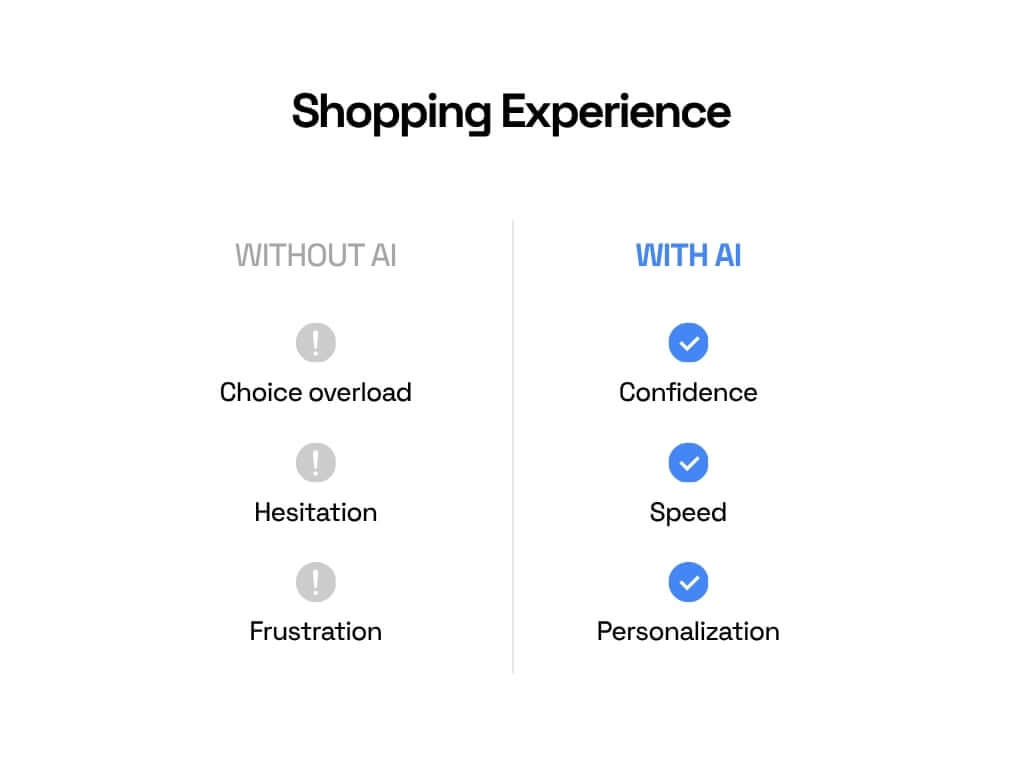
The headline finding is simple. People who are not using AI in their purchase journey still describe the messy middle exactly as it's always been described: choice overload, difficulty finding the right information, and hesitation before committing.
But people who have used AI recently in a purchase journey describe something close to the opposite. Google calls them super empowered consumers, and they report three consistent benefits.
→ Savings. For complex decisions that used to stretch across multiple days or weeks, journeys that involved AI were, on average, noticeably shorter. People spent less time, less effort, and in some cases less money, while still feeling confident in the outcome.
→ Assistance. Shoppers are asking AI far more complex questions than a typical search box would ever have invited, comparing pros and cons across products and categories in a single conversation. This isn't just about speed. Google's research ties it directly to confidence: people make decisions faster because they understand the category better, not because they're cutting corners.
→ Suggestions. AI is recommending products and brands people hadn't necessarily heard of before, often with a striking level of personalization to their stated needs. When something unfamiliar gets suggested, people don't blindly trust it. They go back to Google Search to verify it, which is part of why Google describes this as an expansionary moment for search rather than a threat to it.
Underneath all of this is a genuinely new kind of search behavior.
People are having back-and-forth conversations with AI that asks them clarifying questions in return, not just returning a static list of links. And search itself has become multimodal: people are searching with their voice, with their camera through Google Lens, and with whatever happens to be visible on their screen at that moment, to identify, verify, or find out where to buy something they've just seen in the real world.
The practical implication for brands is direct. If you want to be part of that conversation, you need to be the most authoritative, most human, most helpful source of information in your category, because the best ads today are simply answers that show up at the exact moment someone needs them.
The numbers behind the shift
If all of this still feels a little abstract, the scale behind it isn't.
Google shared a set of figures at the briefing that are worth sitting with, because they explain why so many brands are suddenly scrambling to catch up.
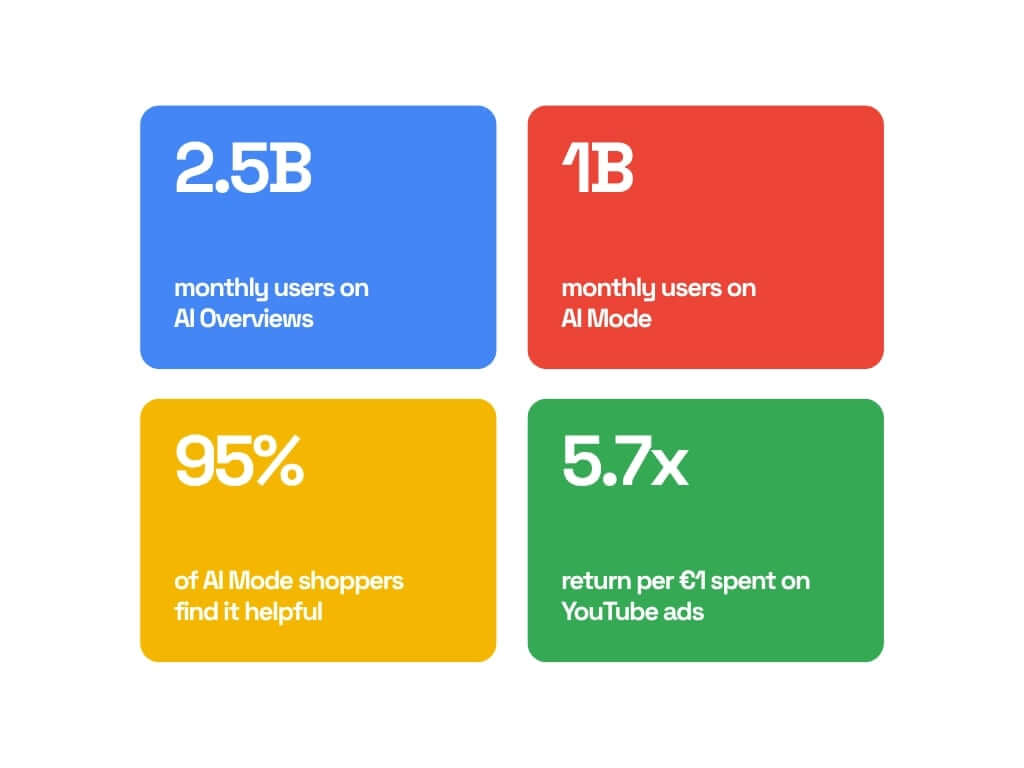
→ 2.5 billion monthly users are already engaging with AI Overviews inside Google Search.
→ 1 billion monthly users are actively using AI Mode, Google's more conversational search experience.
→ 95% of consumers who use AI Mode specifically for shopping say they find it genuinely helpful, not just novel.
→ 77% of users say AI Mode and AI Overviews help them make faster purchase decisions, and shoppers who use AI platforms have 2.8 times more touchpoints across their journey than those who don't.
YouTube adds another layer to this picture that's easy to underestimate if you still think of it purely as an awareness channel. In a study Google ran with Kantar, every €1 spent on YouTube ads returned €5.70, a figure that is 15% higher than the equivalent return on TV.
And 78% of US viewers say YouTube creators are the most trusted source for product recommendations, compared with an average of around 60% across Meta, TikTok, and Snapchat. YouTube ads on connected TV alone drove over a billion conversions last year, which is a very different story from the platform's old reputation as a pure brand-building channel.
Put together, this isn't a niche behavior confined to early adopters anymore. For a large and fast-growing share of shoppers, AI is becoming the default way they start their research, and increasingly the way they finish it too.
Google's Commerce 4: what's actually "agentic" and what isn't
This is where most of the current conversation gets muddled, and where we think it's worth being precise. "Agentic commerce" has become a catch-all label for anything AI-related happening in retail right now. Google's own framework, shared at the briefing, actually draws a much sharper line than the industry chatter suggests.
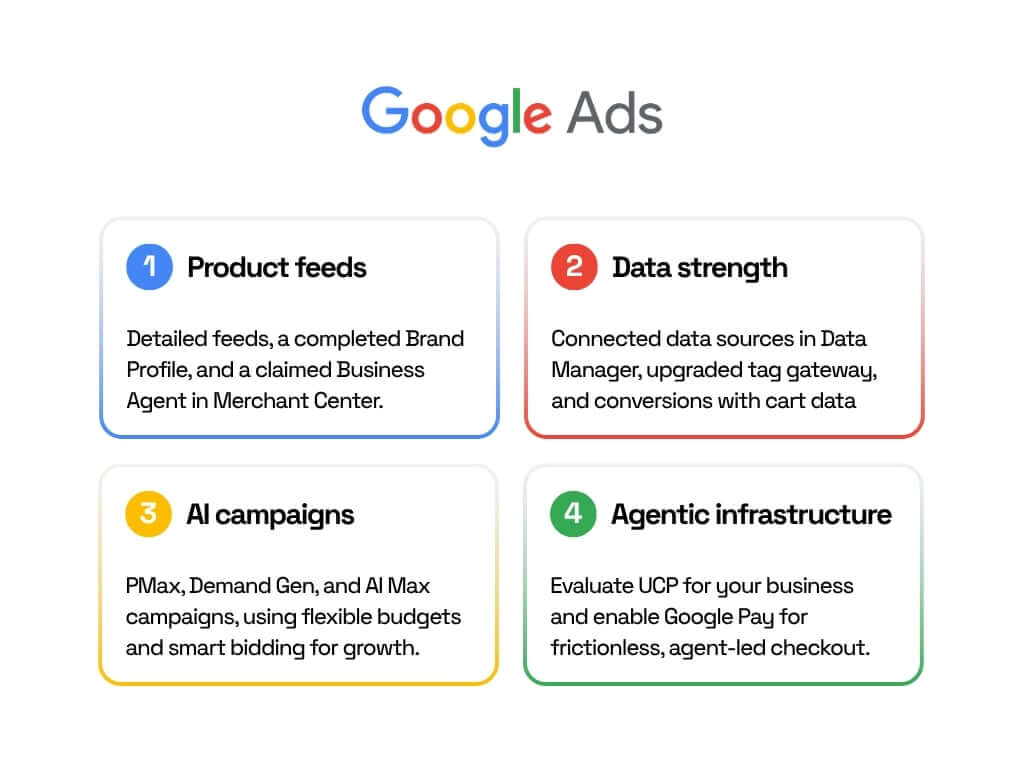
Google laid out four pillars for Q4 readiness, and the order they chose is deliberate:
1. Product feeds: detailed product data, a completed Brand Profile, and a claimed Business Agent, all set up inside Merchant Center. This is the unglamorous foundation: accurate colors, sizes, images, and resolution, so that AI systems can actually read and trust what you're selling.
2. Data strength: connecting your data sources inside Data Manager, upgrading to Google tag gateway, and implementing conversions with cart data so Google understands not just what was clicked, but what was actually bought alongside it.
3. AI campaigns: adopting AI Max, Performance Max, and Demand Gen campaigns, setting flexible budgets, and using smart bidding for profitable growth, rather than manually micromanaging every lever.
4. Agentic infrastructure: evaluating UCP, the emerging protocol for AI agents to complete purchases, for your business, and enabling Google Pay to remove friction from checkout.
Only that fourth pillar is agentic commerce in the strict, technical sense: the actual protocols and checkout infrastructure that let an AI agent complete a transaction on a shopper's behalf.
The first three pillars are what makes AI search and AI-powered campaigns work well in the first place, and they're squarely feed and data problems, not agentic ones.
There's a second layer to this worth flagging, which came up directly when a viewer asked Sébastien Pichon how to keep control over performance marketing as it moves toward black-box automation.
Sarah Byrne's response was pointed: she said the real direction of travel isn't toward black box, it's toward glass box, meaning more transparency, not less, and that the outdated instinct is to treat budget as your main control lever in an AI campaign.
Algorithms are designed to go find sales you wouldn't have found yourself by reaching into territory you're not familiar with, so capping budget like a closing-time shop door is the wrong mental model. The real control now sits in the guardrails you set around data, goals, and exclusions, not in a spending ceiling.
Put simply: brands rushing to bolt on agentic checkout infrastructure while their product feed is still thin, outdated, or missing key attributes are optimizing the wrong layer first. Feed health and data strength are the prerequisites. Agentic commerce is the payoff, not the starting point.
What the people running these campaigns are actually saying
Theory is easy to nod along to. The panel that followed made it concrete, with three people who are actually accountable for these numbers day to day.
Mike Ryan, Head of Ecommerce Insights at Smec, described what he calls the October blues: four to six weeks out from key dates like Black Friday, consumers instinctively start holding back, and same-day conversion rates that might normally sit around 85% begin to dip.
His point was blunt: that dip doesn't mean your campaigns have stopped working, it means they haven't converted yet, and panicking or pulling back at that point is exactly the wrong move.
What actually brings the sale home is layering in first-party data: new-customer-only bidding, exclusion lists inside PMax so you're not just re-targeting your existing base, high-value-customer bidding modes, and merchant center promotions like loyalty offers, timed so that when the key date finally lands, the shopper lands on your site and not a competitor's.
He was equally candid about the reason this matters more this year specifically: search behavior has shifted from a search bar to what he called a search box, with people typing long, detailed, conversational queries that classic keyword campaigns and fixed ROAS targets simply aren't built to catch.
And Lauren McSherry, Head of Shopping Partners EMEA at Google, kept circling back to a single idea whenever the conversation drifted toward more exciting-sounding topics. Comparison shopping services, she explained, are effectively a supercharged team of experts helping retailers grow through Google, and every customer in the region works with one.
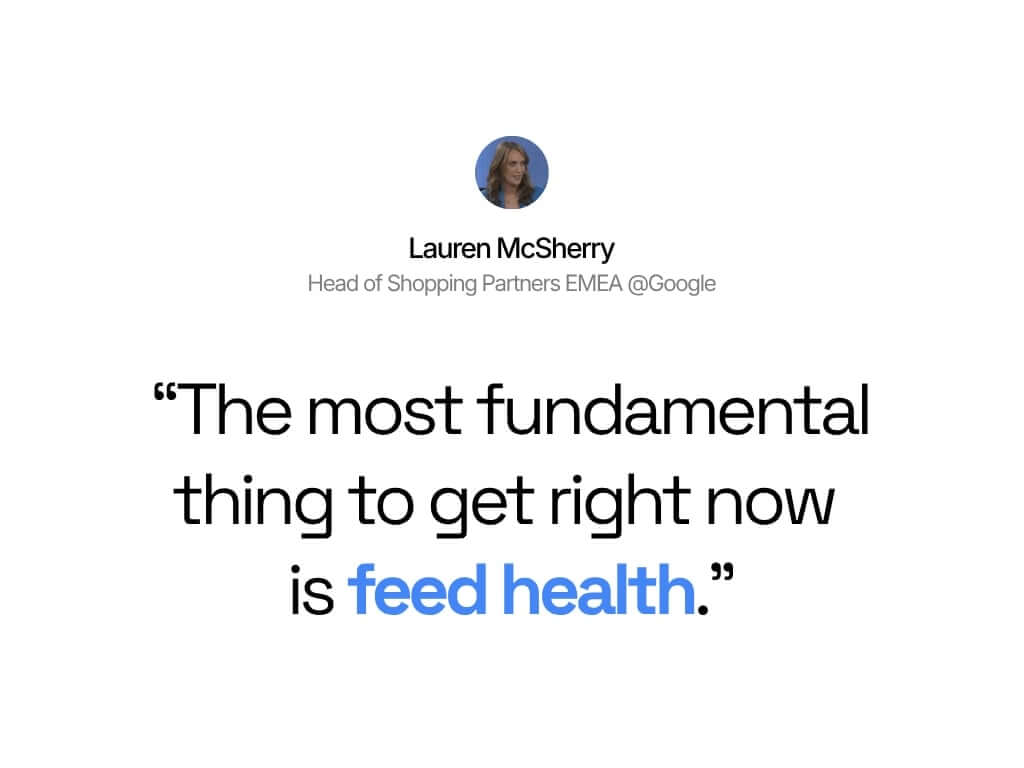
But her repeated point, delivered with more conviction each time, was that the most fundamental thing any brand can get right for this specific Q4 is feed health: not a technical data upload, but the actual quality of content, colors, sizes, image resolution, and completeness that determines whether the right ad reaches the right person at the right time.
"The most fundamental thing to get right now is feed health." Lauren McSherry, Head of Shopping Partners EMEA, Google
It's worth noting that this wasn't just her personal opinion. When Google polled the live audience on what excited them most about peak preparation, out of options including festive creator campaigns and promoting a physical store on Google Maps, 53% of respondents picked the same thing: nailing feed health with their comparison shopping service.
Your pre-Q4 checklist, in order
Pulling everything above into something you can actually act on this week, here is the sequence Google itself is recommending, translated into concrete steps rather than abstract pillars.
→ Start with your product feed. Go through content, title, colors, sizes, image quality, and resolution line by line rather than assuming last year's upload still holds up. Claim your Business Agent and complete your Brand Profile inside Merchant Center, since these are increasingly what AI systems read before they decide whether to show you at all.
→ Strengthen your data foundations next. Connect every relevant data source inside Data Manager, upgrade to Google tag gateway to patch signal loss, and implement conversions with cart data so you can see full basket composition, not just the single product that got clicked, which also feeds new AI-ready attributes like related and substitute products back into your feed.
→ Layer in AI-powered campaigns once the first two are solid. Adopt PMax, Demand Gen, and AI Max, and treat budget as a flexible input rather than a rigid ceiling, since Google's own framing is that capping spend like a closing-time shop door works against algorithms designed to find sales you wouldn't have reached yourself.
→ Only after that, evaluate agentic infrastructure on its own merits. Look at UCP for your business specifically, and enable Google Pay if frictionless checkout genuinely matters for how your customers behave, rather than adopting it because it's the newest headline.
Skipping ahead to step four while steps one through three are still shaky is, by Google's own account and by the panel's own experience, the wrong place to put your energy this quarter.
Q4 doesn't wait
One of the more telling moments in the briefing wasn't a statistic, it was a scheduling detail. Asked what her team does once peak season is actually over, Lauren McSherry's honest answer was that it never really is. Google's own retail leadership team starts planning the following February, meets weekly through most of the year, and shifts to daily check-ins as peak approaches, and her own reflection was that even that timeline is arguably getting later every year rather than earlier.
Her advice for anyone starting this process condensed into three ideas: treat last year's peak data as a learning lab rather than a folder to archive, keep feeding the AI with genuinely rich product data since good AI still depends entirely on good data, and lean on your comparison shopping service as a competitive advantage rather than a commodity vendor, since the right partner brings language coverage, category expertise, and a working relationship that's hard to replicate internally.
Budget can be adjusted mid-flight, almost in real time. A product feed that hasn't been touched since last year cannot be fixed overnight, no matter how much budget you throw at the problem in November. That asymmetry is really the entire argument of this newsletter: the first AI-powered holiday season will reward the brands that treated the unglamorous basics as the priority, weeks before the obvious, more exciting parts of the plan ever came into play.
Keep reading
Related articles



Free AI Readiness Audit
Find out what AI agents can't read on your product pages
Send us 3 product URLs. We score them for ChatGPT, Gemini and Google AI Mode, show what is missing and send them back fixed.
- AI Readiness Score for each page
- Missing attributes, keywords and shopper intents
- The optimized pages, ready to publish
Featured in






The First Agentic Commerce Q4 is here. This is what Google says you need to Win
Google's retail readiness briefing for the first AI-powered holiday season: the Commerce 4 framework, the numbers behind AI shopping, and a pre-Q4 checklist that starts with your product feed.
Google guidance for the first agentic commerce Q4
Google says that in Q4 2026 **shoppers won't just try AI, they'll rely on it** to make purchase decisions. 2.5 billion monthly users engage with AI Overviews and 1 billion use AI Mode; 77% say AI helps them decide faster. Google's Commerce 4 framework, in order: product feeds, data strength, AI campaigns, and only then agentic infrastructure (UCP, Google Pay). **Feed health is the most fundamental thing to get right**: a feed untouched since last year cannot be fixed overnight in November.
What are Google's four pillars for Q4 readiness? | Product feeds (Merchant Center, Brand Profile, Business Agent), data strength (Data Manager, tag gateway, conversions with cart data), AI campaigns (AI Max, Performance Max, Demand Gen) and agentic infrastructure (UCP, Google Pay). How many people use Google AI Mode? | Google reported 1 billion monthly users of AI Mode and 2.5 billion monthly users engaging with AI Overviews. Should brands start with agentic checkout? | No. Google recommends fixing feed health and data first; agentic infrastructure is the payoff, not the starting point. What does feed health mean? | Complete, accurate product data in your feed: titles, colors, sizes, attributes and high-resolution images that AI systems can read and trust.
