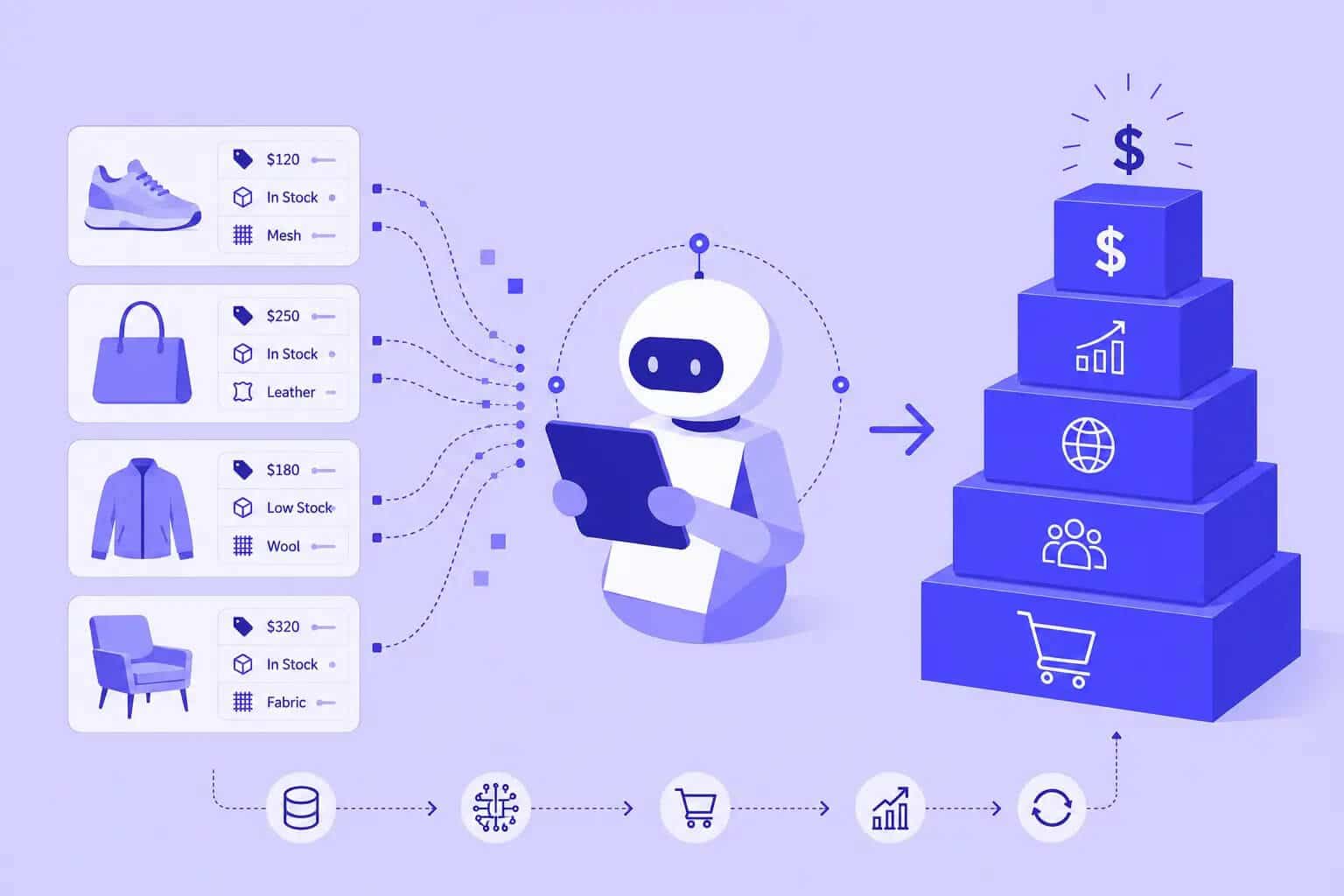
McKinsey just put a number on agentic commerce, and it is bigger than most people expect. By 2030, the firm estimates $3 trillion to $5 trillion in orchestrated revenue could flow through agentic commerce models. That is not a hype cycle forecast. It is a base rate for a shift already underway, and it changes what retailers need to optimize for. The report frames three signals that are easy to read and hard to act on: 38 percent of European consumers already use generative AI to research products and decide what to buy, agents are starting to compare prices, reorder staples, and assemble full baskets on the consumer's behalf, and the winning condition is that product data, pricing, and availability become machine readable in real time.
What the McKinsey Agentic Commerce Report Actually Says
Strip the report to its spine and the argument is structural, not tactical. McKinsey's view is that what distinguishes this cycle of eCommerce growth from earlier waves is not demand, it is capability. Agentic AI, systems that reason, plan, and act, is moving from the back office into the buying process itself. The report is explicit that the interface between consumers and retailers is changing, the economics of growth are changing, and the basis of competitive advantage is changing with them. The $3 to $5 trillion figure is the headline, but the more useful sentence in the McKinsey Agentic Commerce report is the one about competition: retailers increasingly compete to be selected by algorithms acting on behalf of consumers, not to win clicks or attention.
That reframing is the whole game. When a person shops, they browse, scroll, and get influenced. When an agent shops, it evaluates inputs. Product data, pricing logic, availability signals, and fulfillment reliability all become inputs to an automated decision. McKinsey's own words: platforms and brands that are legible, trusted, and consistently performant gain visibility, and those that are not risk being bypassed. Bypassed is the operative word. There is no second page of results in an agent conversation. There is the product the agent picks, and everything it did not.
Why Most Retail Leaders Underestimate the Agentic Commerce Shift
Here is where I think the report will be misread. Most leaders will file the $3 to $5 trillion number under "future," something to revisit in a planning cycle two years out. That is the mistake. The demand signal is already here. 38 percent of European consumers using generative AI to research and decide is not a forecast, it is current behavior, and research behavior is the leading indicator of transaction behavior. When OTTO's CEO Dr. Boris Ewenstein calls AI "the next paradigm shift in ecommerce," and puts it in the same sentence as the moves from catalogs to online, online to mobile, mobile to platforms, he is not describing a feature. He is describing a change in the substrate.
The second reason for underestimation is that the shift hides inside familiar words. "Headless commerce" already means something to engineers. But when Allegro's chief technology and product officer David Roberts describes a new headless commerce model where AI assistants shop seamlessly across multiple platforms, he is pointing at something more consequential than a decoupled front end. He is describing a world where the shopping surface is no longer your site, your app, or even a specific marketplace. It is an assistant that moves across all of them, and your catalog is either readable to that assistant or it is not. Retail leaders who hear "headless" and think "architecture" miss that this is a distribution change.
The Structural Change Behind the Agentic Commerce Retail Story
Underneath the McKinsey framing is a shift in where competitive advantage is decided. For twenty years, eCommerce optimization meant the front end: better pages, faster checkout, sharper merchandising, more persuasive creative. The McKinsey Agentic Commerce report says that era is not over, but it is no longer sufficient. The firm is direct about it: leaders must shift from optimizing front end experience alone to ensuring back end systems, product data, pricing logic, and fulfillment reliability, are machine readable, trusted, and consistently performant. The optimization surface moved from the page a human sees to the data an agent reads.
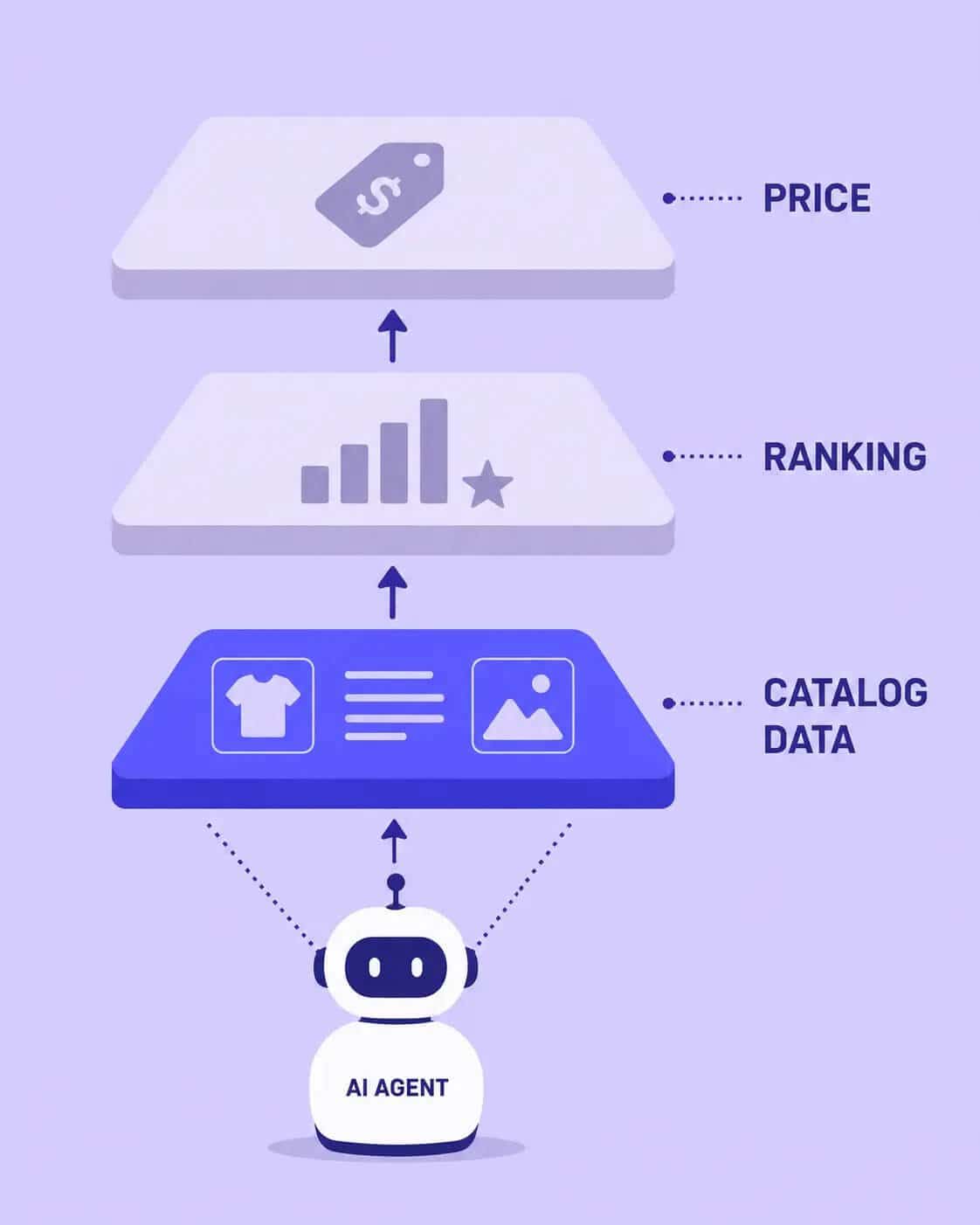
This is a layer most retail teams do not own cleanly today. Search engine optimization decided how your pages ranked. Generative engine optimization decides whether your content gets cited in AI answers. But agentic commerce introduces a layer upstream of both, whether an agentic shopping engine includes your product at all. We call this Agentic Commerce Optimization, and it operates at the product and catalog level, before ranking and before price ever enter the picture. An agent cannot rank what it cannot parse. The McKinsey number is large precisely because this layer is being built now, across marketplaces and open web assistants at the same time.
What Changes Operationally for Agentic Commerce Retail Teams
After years working with eCommerce catalogs, the pattern I keep seeing is the same everywhere. Product titles are built for internal SKU logic, not for how people, or agents, actually search. Descriptions repeat the same three adjectives across thousands of products. Attributes are missing entirely. That was survivable when a human shopper filled the gaps with judgment and a product photo. It is not survivable when an agent is the reader. An agent will not guess what your product does. It reads what is there, or it moves to the competitor whose data it can parse.
So the operational to do list that follows from the McKinsey Agentic Commerce report is concrete. Structure your attributes, color, size, material, fit, use case, so an agent can match a product to a constraint. Make pricing consistent across every channel, because agents compare ruthlessly and a conflicting price reads as a trust problem. Keep availability accurate in real time, because nothing burns agent trust faster than recommending something that is out of stock. And write product content that describes what the product is and does in plain, machine legible language, not marketing filler that a model discounts. McKinsey lists "make your business agent ready" as the first action in its leadership agenda. That is what agent ready actually means: not a chatbot on your site, but a catalog an agent can read, trust, and transact against.
The Strategic Implication of the McKinsey Agentic Commerce Report
The strategic read is that catalog quality has quietly become a distribution decision. In the old model, you could buy your way to visibility. In an agentic commerce retail model, no amount of advertising fixes incomplete product data, because the agent is not looking at your ad, it is reading your feed. That inverts a twenty year assumption. Spend used to compensate for weak fundamentals. Now the fundamentals, structured data, price consistency, trustworthy signals, are the fundamentals of getting recommended at all.
My read is that the $3 to $5 trillion figure will look conservative in hindsight, not because agents will grow faster than McKinsey models, but because the value concentrates. In a world of clicks, demand spread across a long tail of pages. In a world of agent selection, demand concentrates on the products the agent can confidently choose. The brands that make their catalogs machine readable first will absorb a disproportionate share of that orchestrated revenue, and the ones still optimizing the front end alone will wonder why their traffic converted into someone else's sale. The McKinsey Agentic Commerce report did not hand retail a trend to watch. It handed retail a reason to fix its data before the agents finish learning to read.
Keep reading
Related articles



Free AI Readiness Audit
Find out what AI agents can't read on your product pages
Send us 3 product URLs. We score them for ChatGPT, Gemini and Google AI Mode, show what is missing and send them back fixed.
- AI Readiness Score for each page
- Missing attributes, keywords and shopper intents
- The optimized pages, ready to publish
Parlano di noi









The McKinsey Agentic Commerce Report: A $3 to $5 Trillion Signal Retail Cannot Ignore
The McKinsey Agentic Commerce report sees $3 to $5T orchestrated revenue by 2030. Here is why agentic commerce retail hinges on machine readable catalog data.
McKinsey agentic commerce report
McKinsey estimates **$3 trillion to $5 trillion in orchestrated revenue** could flow through agentic commerce models by 2030. 38% of European consumers already use generative AI to research products and decide what to buy. Retailers now compete **to be selected by algorithms acting for consumers**, not to win clicks: there is no second page in an agent conversation. Being agent ready means structured attributes, consistent pricing, real-time availability and plain, machine-legible product content.
What is the McKinsey Agentic Commerce report and what does it forecast? | It is McKinsey's June 2026 analysis of how AI is resetting eCommerce growth and competition in Europe. Its headline forecast is that by 2030, global B2C retail could see $3 trillion to $5 trillion in orchestrated revenue flowing through agentic commerce models, where AI agents research, compare, and buy on the consumer's behalf. Why does the McKinsey Agentic Commerce report matter for retail now? | Because the demand signal is already present: 38 percent of European consumers already use generative AI to research products and decide what to buy. Research behavior leads transaction behavior. What does agent ready mean in agentic commerce retail? | It does not mean adding a chatbot to your site. It means making back end systems, product data, pricing, and availability structured, accurate in real time, and machine readable, so AI agents can reliably select and transact against your assortment. How does agentic commerce change competition compared with traditional eCommerce? | Traditional eCommerce competed for clicks and attention on human facing pages. Agentic commerce competes to be selected by algorithms acting for consumers, so legible and trusted catalogs gain visibility while the rest get bypassed. What should retailers do first in response to the McKinsey Agentic Commerce report? | Fix the catalog: structure product attributes, make pricing consistent across channels, keep availability accurate, and write plain, machine legible product content. This is the Agentic Commerce Optimization layer, which AndromedAI automates at catalog scale across languages.
