A case study on what happens when an eCommerce catalog is optimized for both search engines and AI, and why the underlying work matters more than ever.
Every eCommerce team knows the quiet tax that a large catalog charges: thousands of product pages that need to be accurate, complete, and genuinely findable, not just published. For an online pharmacy like Semprefarmacia, that tax is even higher.
Product data has to be precise, compliant, and clear, across categories that range from OTC to supplements to personal care, all competing for the same limited attention on Google's search results.
Over a six-month engagement, AndromedAI worked with Semprefarmacia to optimize product listing pages using AI, rewriting and structuring content at scale so that it performed better for both traditional organic search and the newer AI-driven discovery surfaces on Google.
The project ran across three batches of products, comparing performance in the month before optimization (PRE) against the month after (POST).
The results turned out to be a clean illustration of something a lot of teams suspect but rarely get to prove: catalog quality is not a cosmetic exercise. It is a direct lever on revenue.
The results, in three numbers

Comparing the pre and post-optimization periods across the three batches of optimized products:
Organic and AI visibility on Google (impressions): +163.7%
Organic clicks: +158.7%
Units sold on the website: +46.9%
The headline here isn't just that visibility improved. Plenty of SEO work does that without ever touching the bottom line. It's that sales moved almost in lockstep with visibility, which is the part that's genuinely hard to engineer.
Why the correlation matters more than the percentages
Across all three batches, the growth in impressions and the growth in sales tracked each other closely, with a correlation coefficient of 0.94 between impressions and site sales. Visually, the bars for impressions, clicks, and sales rise together batch after batch, not perfectly proportional, but moving in the same direction with the same intensity.
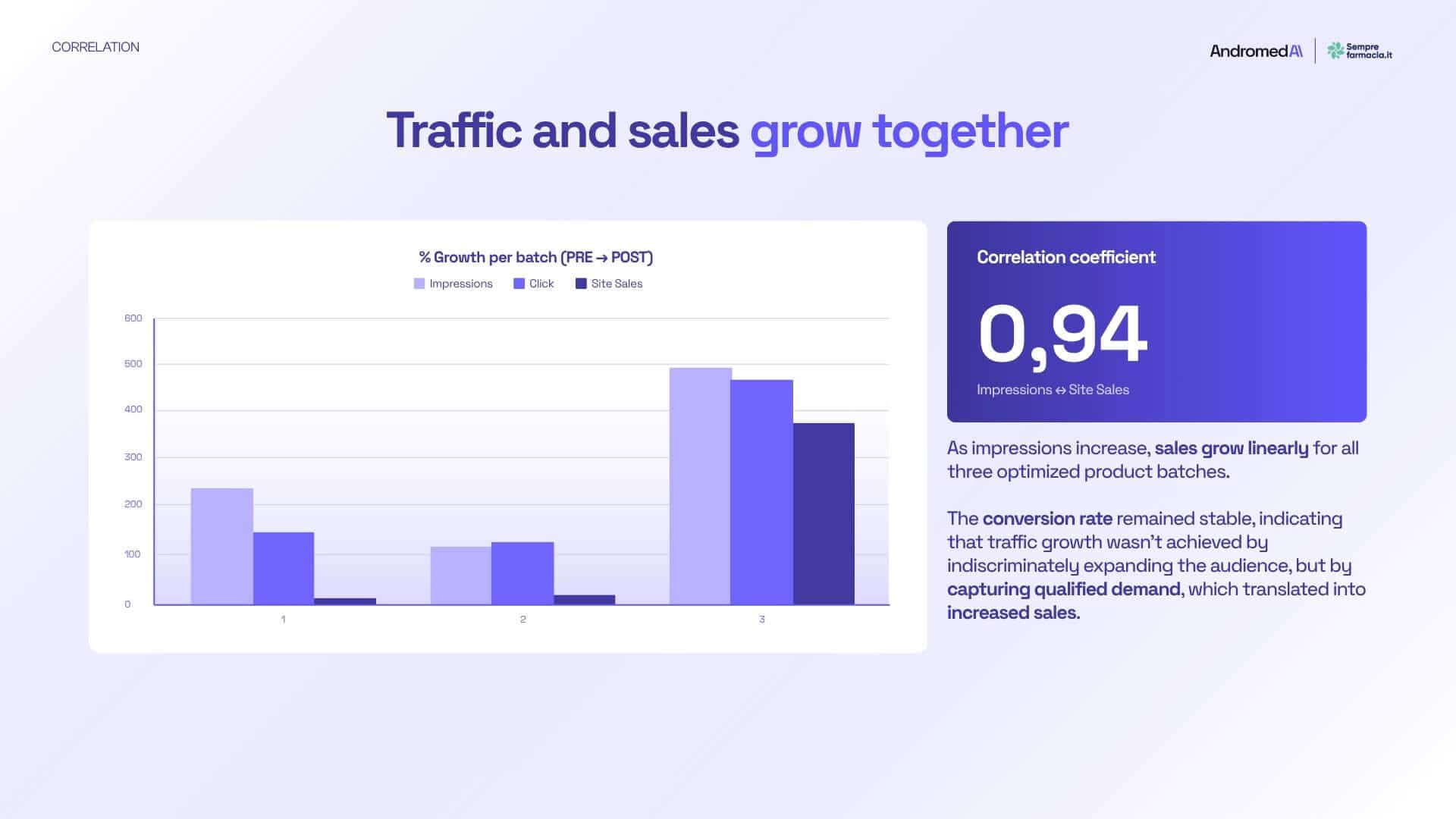
What makes this meaningful is what stayed flat: the conversion rate. If optimized pages had simply pulled in more traffic (more impressions, more clicks, from a broader but less relevant audience), you'd expect the conversion rate to drop, diluted by visitors who were never going to buy. That's not what happened.
The conversion rate held steady, which means the additional visibility wasn't generic; it was intercepting real, qualified demand that the catalog simply hadn't been surfacing before. The optimization didn't just make products more visible, it made them visible to the right searches.
That distinction is the difference between a vanity metric and a business result.
The operational side: speed without cutting corners
The performance gains would mean less if they came at the cost of a slower, more painful production process, but the opposite happened. Manually producing a complete product page took 17 minutes before AI support. With AndromedAI in the workflow, that dropped to 2.5 minutes per page, an 85% reduction in processing time, roughly 483 hours saved across 2,000 product pages.
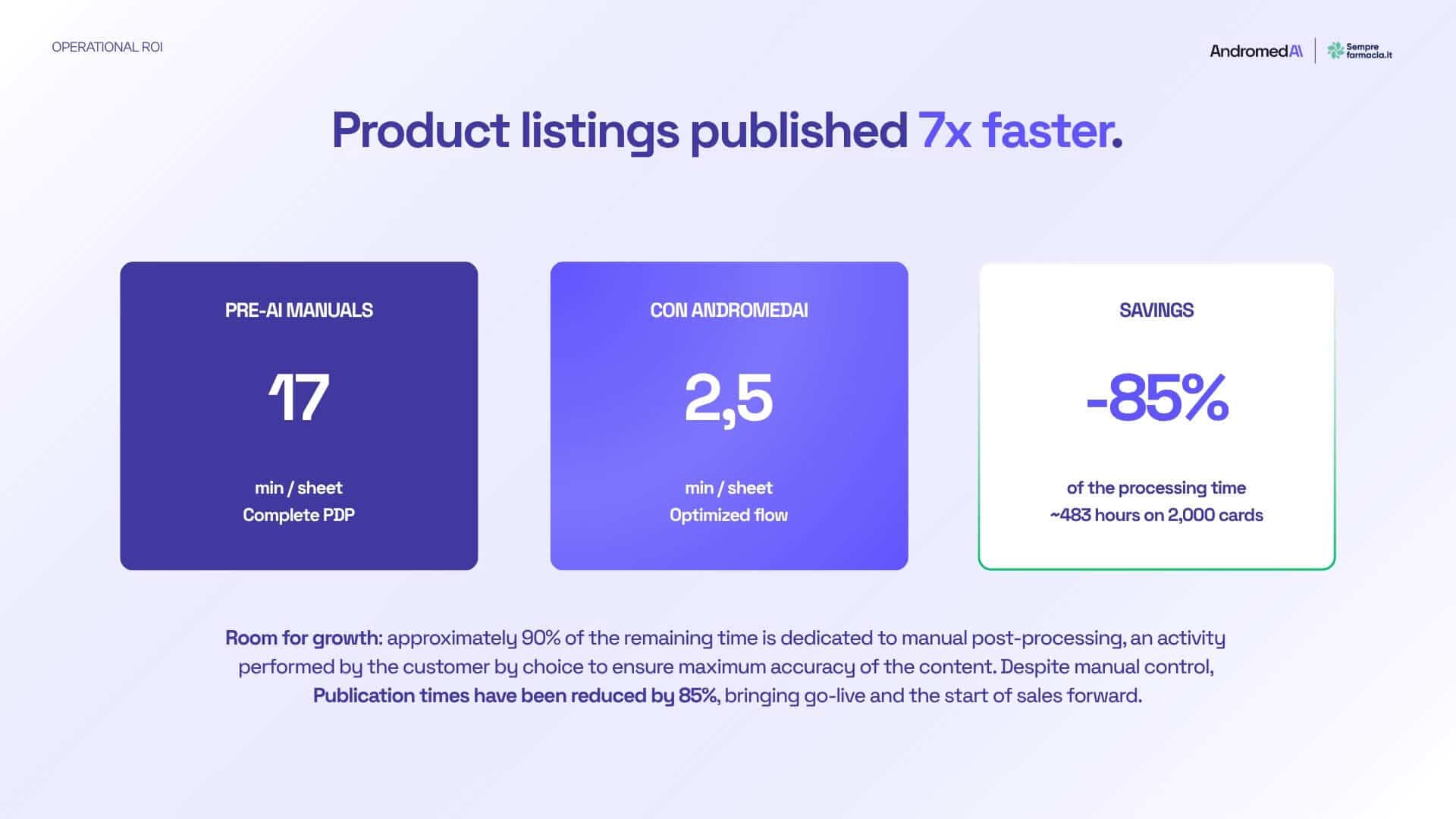
Importantly: this wasn't achieved by removing human oversight. Semprefarmacia chose to keep a manual review pass on top of the AI-generated content, and that review still accounts for a meaningful share of the remaining time per page.
The 85% time saving happened around that quality check, not instead of it, meaning the catalog got faster to publish and stayed accurate, which is the combination that's usually hardest to achieve.
Faster publishing also means new products start selling sooner, rather than sitting unindexed while a team works through a backlog.
The deeper point: why catalog quality is the foundation, not a detail
It's tempting to file this under "SEO win" and move on, but the underlying lesson is broader. A product catalog is, functionally, the interface between what a business actually sells and what the outside world (shoppers, search engines, and increasingly AI systems) can understand about it.
When that interface is thin (missing attributes, generic descriptions, inconsistent structure), it doesn't just rank poorly. It becomes invisible to AI systems that depend on structured, specific information to make a match between a query and a product.
That's precisely why the results above are correlated rather than coincidental: the optimization didn't add noise to the catalog, it added legible signal, the kind that search algorithms, and AI models, can actually use to understand what a product is, who it's for, and why it answers a given query.
Looking ahead: catalog quality as the entry ticket to Agentic Commerce
There's a second reason this work matters, one that's about the future, not just the results we've achieved today.
The way people discover products is fundamentally changing. We're moving from a world where consumers type keywords into a search box to one where AI agents research, compare, and increasingly make purchasing decisions on their behalf.
Google AI Mode, ChatGPT Shopping, and Claude Shopping are early examples of this shift. Today, these AI assistants help consumers discover and evaluate products. Tomorrow, they'll increasingly complete purchases directly through agentic checkout.
In that world, product catalogs won't just need to persuade people. They'll need to communicate effectively with AI systems. And businesses that optimize their product data today will be better positioned for how commerce works tomorrow.
None of that works on a thin catalog.
An AI agent can't recommend, compare, or transact on a product it can't clearly parse.
It needs the same things a well-optimized page already provides for organic search: precise attributes, unambiguous descriptions, clear differentiation between similar SKUs, and structure that maps cleanly to what a shopper (or their agent) is actually asking for.
In that sense, the SEO gains in this case study and readiness for Agentic Commerce are the same underlying work, viewed from two different angles.
A catalog that's legible to Google's ranking systems today is, by construction, closer to being legible to a shopping agent tomorrow.
The takeaway
Optimizing a product catalog is often treated as maintenance: necessary, unglamorous, easy to deprioritize. This case study suggests the opposite framing is more accurate.
Done well, with the right structure and without sacrificing accuracy, catalog optimization is one of the few levers that visibly moves impressions, clicks, and sales together, while cutting production time by 85%.
And it happens to be the same groundwork that determines whether a catalog will be findable at all in a future where AI agents, not just search bars, stand between a product and a customer.
Case study data: AndromedAI x Semprefarmacia, Batches 1-3, PRE period 10/02/2026-10/03/2026 vs. POST period 10/04/2026-10/05/2026.
Keep reading
More customer results


Free AI Readiness Audit
Find out what AI agents can't read on your product pages
Send us 3 product URLs. We score them for ChatGPT, Gemini and Google AI Mode, show what is missing and send them back fixed.
- AI Readiness Score for each page
- Missing attributes, keywords and shopper intents
- The optimized pages, ready to publish
Featured in






Semprefarmacia: 46.9% More Sales, 483 hours saved: The Math Behind AI Catalog Optimization
How AndromedAI optimized Semprefarmacia's product pages for search and AI: +163.7% impressions, +158.7% clicks, +46.9% units sold and 85% less time per page.
Semprefarmacia case study results with AndromedAI
After AI catalog optimization with AndromedAI, Semprefarmacia saw **+163.7% Google impressions, +158.7% organic clicks and +46.9% units sold**. Impressions and sales moved together, with a **0.94 correlation**, while the conversion rate held steady: the new visibility reached qualified demand. Time to produce a complete product page fell from 17 to 2.5 minutes, an **85% reduction** and about 483 hours saved across 2,000 pages, with human review kept in place. The same work that lifts SEO makes the catalog readable to AI shopping agents.
What results did Semprefarmacia get from AI catalog optimization? | Comparing the month before and after optimization, Semprefarmacia saw +163.7% impressions on Google, +158.7% organic clicks and +46.9% units sold on its website. How much time did AI save per product page? | Producing a complete product page dropped from 17 minutes to 2.5 minutes, an 85% reduction, saving about 483 hours across 2,000 product pages. Did the conversion rate drop with more traffic? | No. The conversion rate held steady, which shows the extra visibility reached qualified shoppers rather than generic traffic. Is catalog optimization relevant for AI shopping agents? | Yes. Precise attributes, clear descriptions and good structure are what both search engines and AI agents need to match a product to a query.
