Discover how we increased clicks from AI by 1,800% using our proprietary framework and AndromedAI technology.
Below is a high-level overview of the theory and the framework. Want the full guide applied to your catalog? Request a free catalog audit.
Drawing on our experience managing over €100M in eCommerce marketing investments and working at Google, we've created a practical guide that explains how to optimize your product catalog for AI-powered shopping.
Let's get started! But before applying the framework, it's essential to understand what AI Shopping and Agentic Commerce are and how they work.
What is AI Shopping
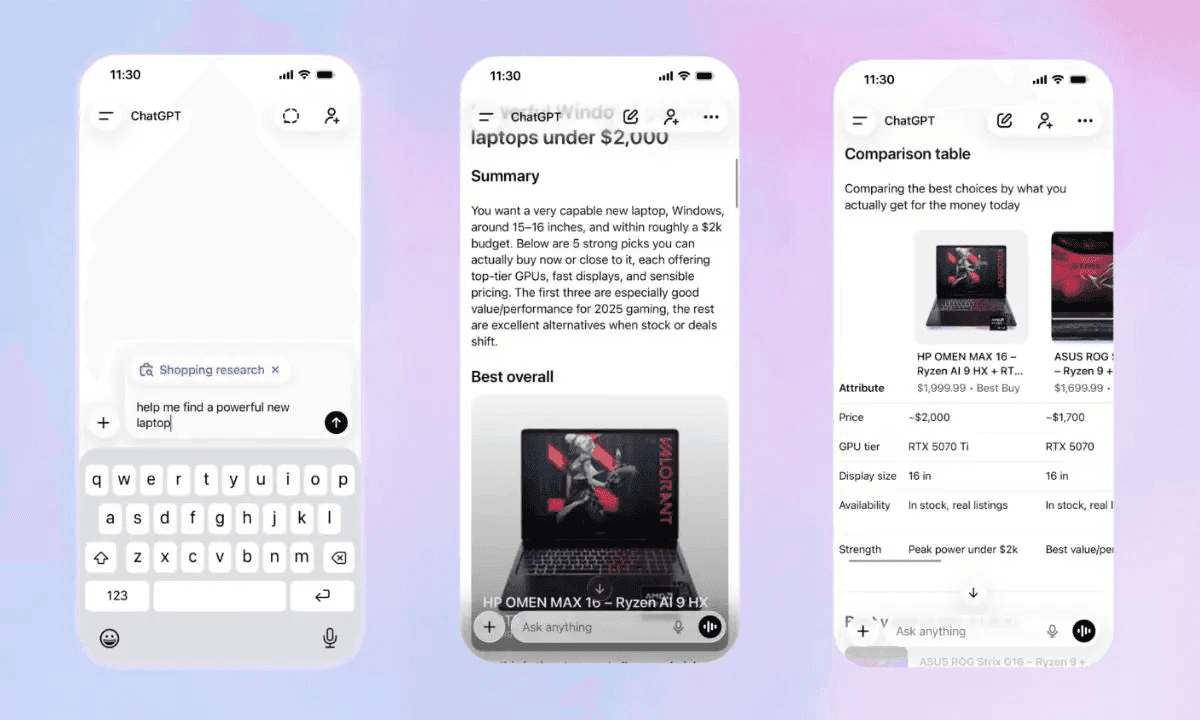
AI-powered shopping is a way of discovering and purchasing products in which the user no longer needs to manually carry out the process of searching products online step by step, typing queries in a search engine, comparing dozens of product pages, and refining searches to find the product he wants to buy.
Instead, an AI agent understands what the user wants to buy and combines it with his personal preferences (remembered from previous conversations). It then searches, compares, and synthesizes options across multiple eCommerce catalogs, comparing the available options, and summarizing the best ones, saving the user time and effort and helping him make a better purchasing decision faster.
The result is a curated shortlist of the most suitable products for the user, often accompanied by clear reasoning explaining why those options were selected.
What is Agentic Commerce
In simple terms, Agentic Commerce is shopping powered by AI agents that can plan and carry out multiple steps of the buying journey on a user's behalf, while staying aligned with the user's intent and constraints.
Instead of the shoppers manually searching, filtering, and comparing products across sites, an AI agent can do much of that work for them. In practice, an AI Shopping Agent can:
clarify requirements (e.g., budget, size, brand, materials, delivery date) as needed
retrieve and merge product information from different sources
compare options across criteria such as price, availability, reviews, specifications, and compatibility
summarize and recommend the best-fit choices for that specific user based on his preferences
Agentic Commerce is a shift toward a shopping experience where the user expresses what they want, and the system orchestrates discovery and evaluation across channels. In its most futuristic form, agentic commerce goes beyond recommending products and can reach end-to-end purchasing, potentially including payment and shipping steps.
A key point to remember
An AI agent like ChatGPT Shopping Research is not a search engine. A search engine returns results and links; an agent uses tools (including search, product feeds, merchant catalogs, and other services) to accomplish a goal, such as helping a user decide what to buy, by interpreting user intent, comparing options, and producing a tailored shortlist of products.
How does AI Shopping work?
When users ask an AI shopping assistant a question, they typically provide much more context than they would in a traditional search engine. That's the key shift: instead of typing a short keyword query, they describe a real need in depth.
Traditional search query (Google)
Men white running shoes cheap
AI shopping query (ChatGPT)
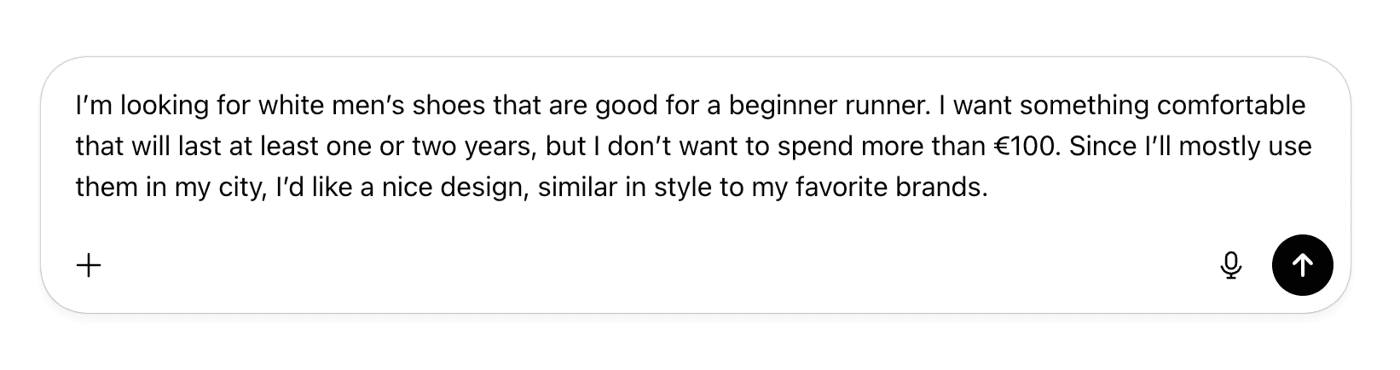
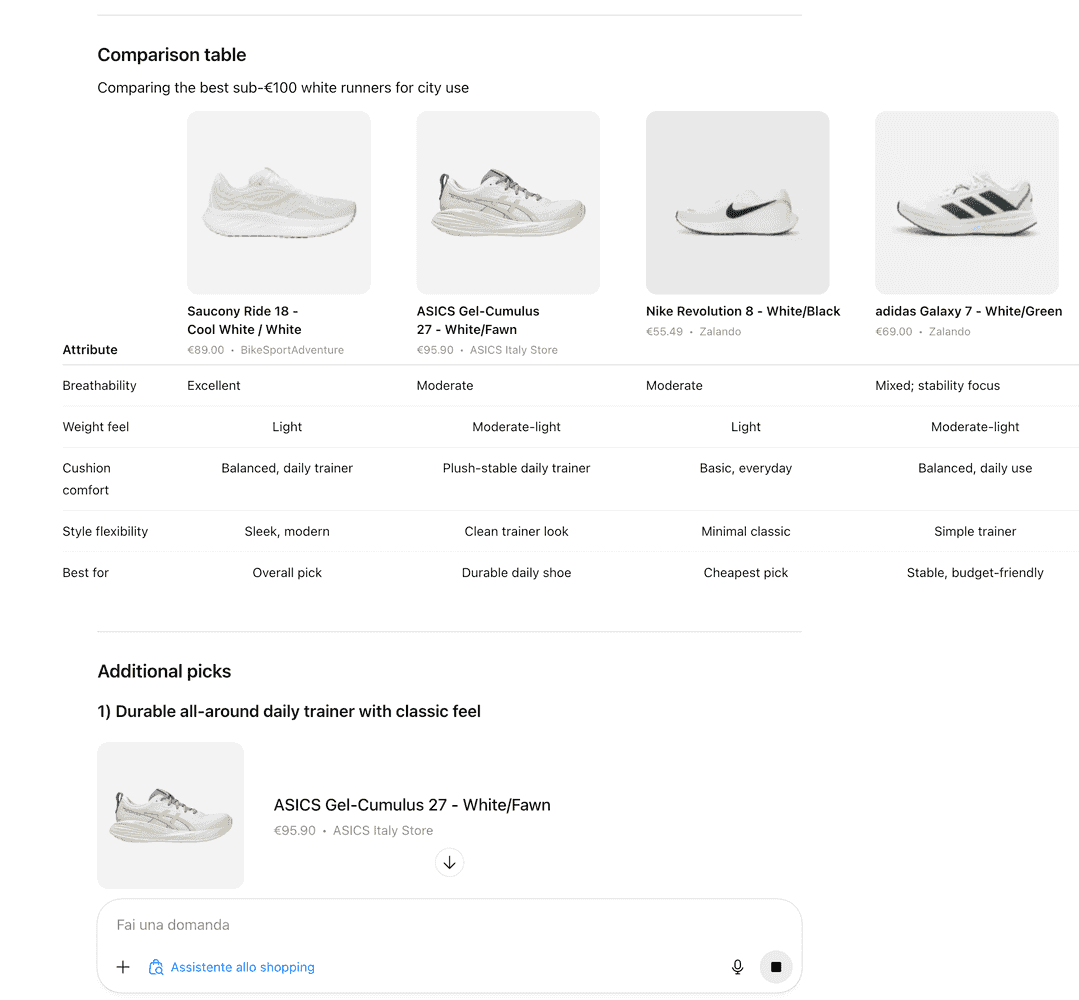
I'm looking for white men's shoes that are good for a beginner runner. I want something comfortable that will last at least one or two years, but I don't want to spend more than €100. Since I'll mostly use them in my city, I'd like a nice design, similar in style to my favorite brands.
That AI query contains constraints (price, use case, durability), preferences (design/style), and context (beginner runner, city use). An assistant can use all of this to produce a more targeted recommendation.
Here, the AI's memory of the user also comes into play. For example, if the AI knows that the person lives in Miami, it may suggest lightweight, breathable shoes suited to a warm climate. If it knows that the user is spending time abroad in Stockholm, it will instead prioritize warmer, more insulated footwear. This contextual memory allows the AI to tailor product recommendations to the user's real-life situation, not just to a generic search query.
The typical AI Shopping flow
1) Users make a product-related request
They describe what they want, often in a long, natural-language prompt, like the one in the example (a shopping-intent query to ChatGPT).
2) AI turns the user request into multiple "sub-queries" (query fan-out)
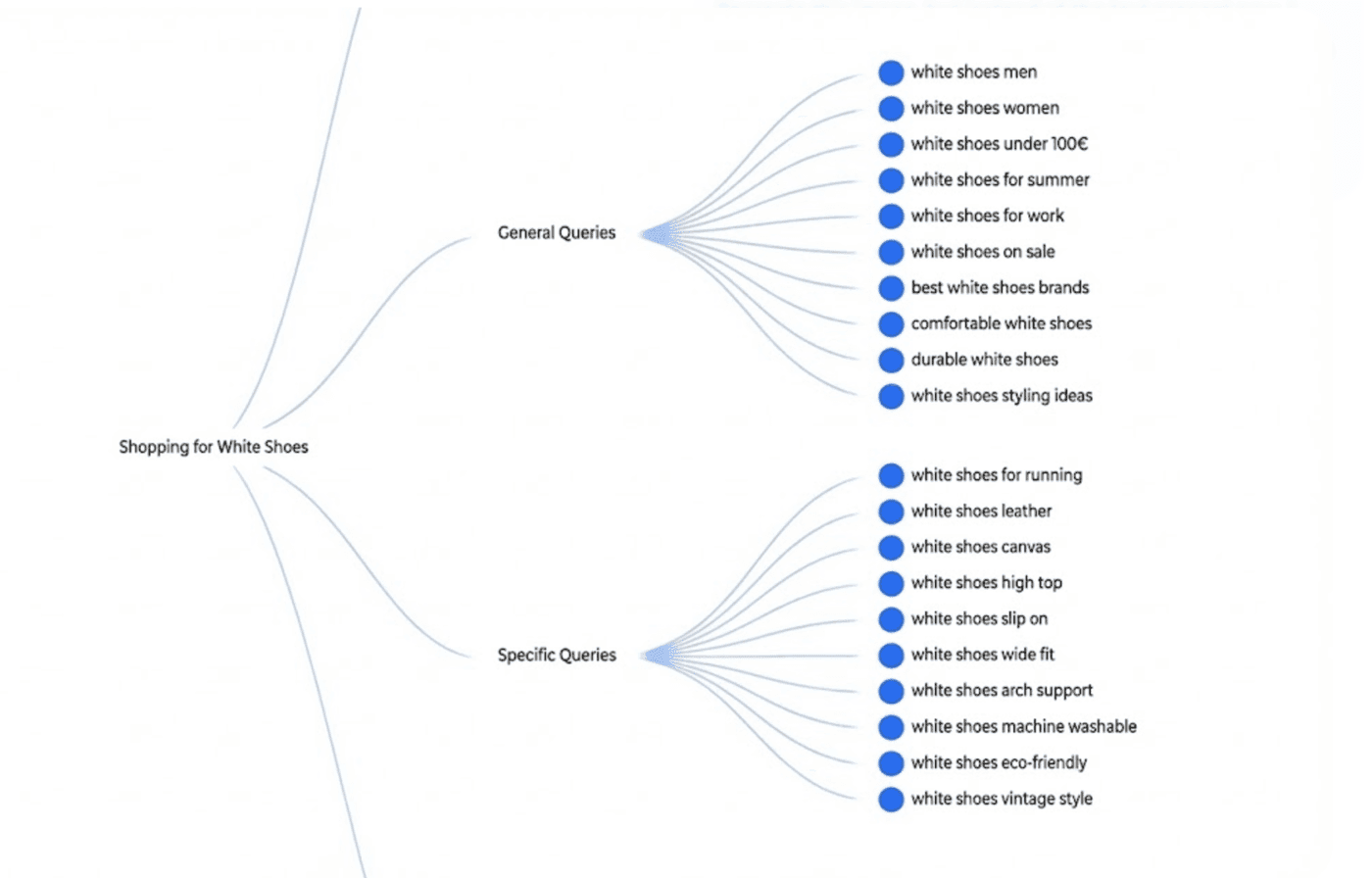
The model breaks the user request into smaller, more specific searches, for example:
"best beginner running shoes under 100 euro"
"white running shoes men comfortable city use"
"durable entry-level running shoes reviews"
"white running shoes men"
"white running shoes minimal design"
"running shoes for city and everyday wear"
3) Retrieval and evaluation: the assistant gathers product information from sources
Depending on the system, this can include web results, merchant feeds, structured product catalogs, marketplaces, and review sources. It's not "one search," it's usually many retrieval steps that collect candidates and relevant evidence.
AI extracts key details about a product page (price, availability, sizing, materials, cushioning, intended usage, pros/cons, review signals, shipping/returns). This is why rich, well-structured product pages (PDPs) matter: the better the information on the page, the easier it is for AI to confidently match a product to the user's constraints and answer follow-up questions.
4) AI synthesizes the best options into a clear output
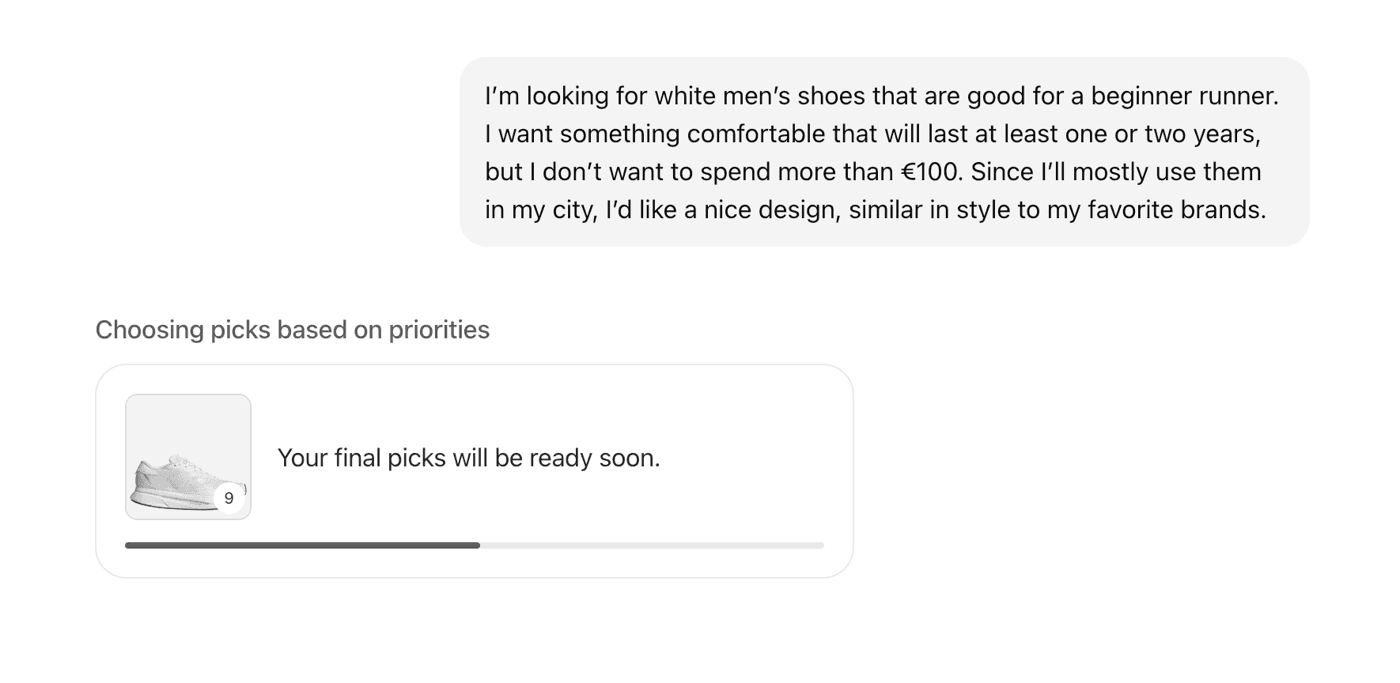
Instead of a list of blue links, AI delivers a concise, synthesized response, often as a shortlist of products, that helps users choose the best option to buy from a set of already high-quality alternatives.
Expected growth of Agentic AI Commerce
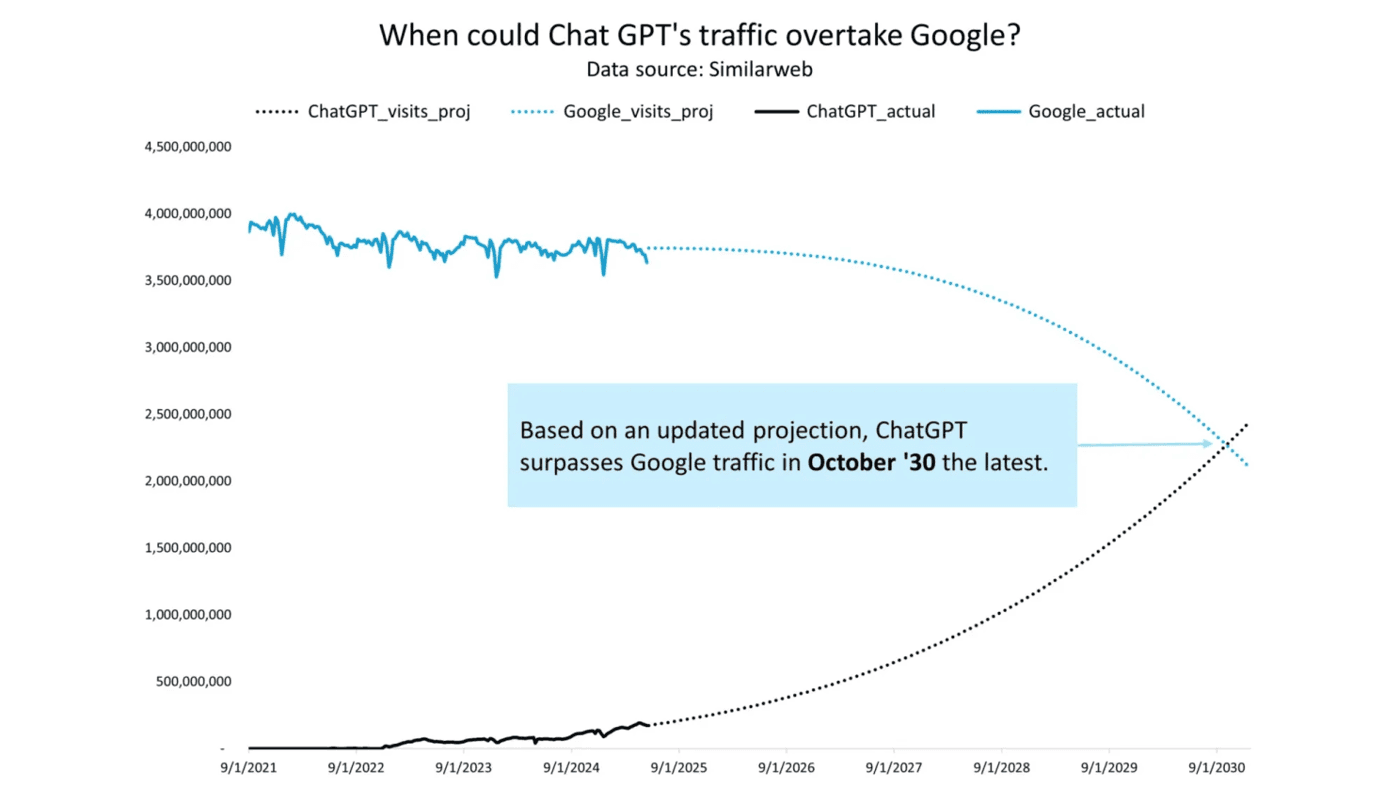
Based on current trends, it is reasonable to expect that AI assistants will capture an increasing share of product discovery over the coming years. As this shift accelerates, online shopping journeys handled by AI interfaces such as ChatGPT or AI Mode will potentially surpass those performed on traditional search engines like Google within the next 4 years.
This broader shift aligns with what many consumers already feel: shopping via traditional search can be tiring.
When people start with traditional Google searches, they often end up comparing options across many sites and channels, marketplaces, brand websites, reviews, YouTube, social content, before they feel confident enough to buy. This back-and-forth evaluation loop is commonly described as the "messy middle."
Agentic AI changes the game because it can orchestrate much of that messy middle on the user's behalf: it can search for products, gather and compare PDPs, filter options against constraints (budget, preferences, context), and return a shortlist of products that are already pre-evaluated and close to the user's needs.
In other words, instead of the user doing the work of discovery and comparison manually, an AI agent does it automatically, and then the user validates the recommendation and completes the purchase.
Business opportunity of Agentic Commerce
The commercial upside of Agentic Commerce will be massive. McKinsey estimates that by 2030 the US B2C retail market alone could see up to $1 trillion in "agentic revenue" from agentic commerce, with global projections of $3 to $5 trillion.
For brands, this implies a structural change: companies have spent decades optimizing consumer journeys for people, where every click and scroll was designed following the principles of CRO (Conversion Rate Optimization).
In Agentic Commerce, the shopper is still the customer, but the day-to-day navigation and micro-decisions shift to AI agents acting on the customer's behalf. Winning AI Shopping will require rethinking the full stack of engagement, not only for humans, but also for the agents that evaluate, compare, and choose products for them.
The importance of the product catalog for Agentic Commerce and AI Shopping
In traditional eCommerce SEO, most optimization efforts have historically focused on blog content, homepages, and category pages. These assets were critical for capturing informational traffic and guiding users through a multi-step discovery funnel. In AI-driven shopping experiences, however, their role is fundamentally different.
This does not mean that blog posts, category pages, or homepages are irrelevant overall. Optimizing these assets still contributes to stronger domain authority, better crawlability, and improved overall rankings, factors that indirectly help product pages perform better and become more visible to AI systems. A strong domain remains an important trust signal.
The key difference is that AI shopping assistants operate with a radically shorter funnel. When an AI is in "shopping mode," it recommends product pages only.
Instead of guiding users through multiple layers of navigation, the AI compresses the eCommerce funnel and directs the user straight to the point of purchase: the product page.
This happens for a simple reason. Every additional step between a user's purchase intent and the actual transaction introduces friction. Each click, page load, or decision reduces the probability that the user will continue and complete the purchase.
In a traditional eCommerce journey, the flow often looks like this:
User searches online → compares different websites → lands on a precise website → browses a category page → opens a product page → purchase.
In an AI-driven shopping experience, that entire sequence can be reduced to a single action:
User asks AI online → AI suggests relevant results → purchase.
With AI Shopping the user is taken directly to the most relevant product page. Because product pages consistently have higher conversion rates than category or informational pages, this shortcut significantly increases the likelihood of conversion.
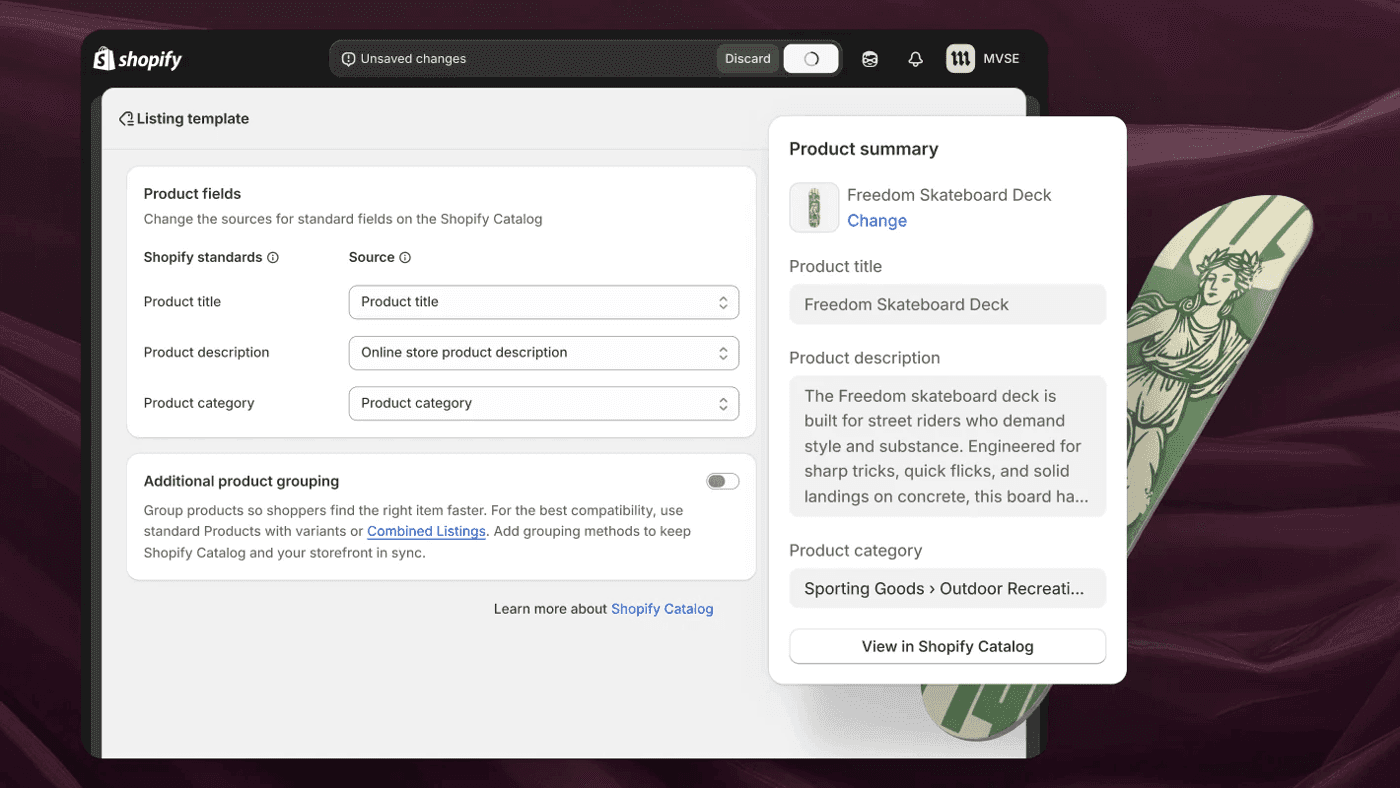
As a result, if the goal is to optimize for AI Shopping and Agentic Commerce, the primary focus must shift toward the product catalog itself. Structured data, rich attributes, accurate specifications, high-quality descriptions, pricing, availability, and trust signals at the product-page level become the most critical assets.
The product catalog is no longer just an operational requirement; it becomes the primary interface through which AI agents discover, evaluate, and recommend products. In this new landscape, the product catalog will become eCommerce's main growth engine.
AI Shopping Framework: How to Get Your Products Recommended by AI
This framework required dozens of hours of development and is the result of our hands-on work with hundreds of eCommerce brands, optimizing their product catalogs and managing over €100M in eCommerce marketing investments.
Below is a preview of the six steps. To see how they apply to your catalog, request a free catalog audit.
Step 1: Adopt a PDP-first strategy
Summary: In Agentic AI Commerce, product pages are no longer the last step of the funnel, they are the first, and often the only, touchpoint. AI shopping assistants recommend individual products, not categories or blogs. This step reframes PDPs as standalone decision engines that must convert even if the user has never seen your brand before.
Step 2: Optimize for product-level SEO
Summary: SEO doesn't disappear with AI shopping, it evolves and becomes even more critical. AI agents rely on search engines to retrieve product results, but they start from a lot of long, intent-rich queries rather than short keywords. This step explains how Product Detail Pages (PDPs) must be optimized to be discoverable by AI, focusing on optimizing for query fan-out, the way AI agents expand and use queries to find and recommend products to users.
Step 3: Make product content semantically understandable
Summary: AI doesn't read product pages like humans, it extracts meaning, attributes, and relationships between entities. This step focuses on moving beyond keywords toward explicit, structured, and semantically rich product information, so AI agents can truly understand what a product is, who it's for, and how it differs from alternatives.
Step 4: Use structured data and merchant feeds to become machine interpretable
Summary: Natural language alone isn't enough. AI shopping systems rely on structured data, product entities, and merchant feeds to retrieve products at scale. This step shows how schema, GTINs, attributes, and feeds (like Google Merchant Center) turn PDPs into clean, trusted entities inside shopping graphs and AI systems.
Step 5: Turn PDPs into full product experiences
Summary: AI favors products that can resolve decisions, not just sell. This step explains why AI-ready product pages must answer objections, clarify trade-offs, and provide depth, transforming PDPs from transactional pages into complete decision surfaces that AI can confidently recommend.
Step 6: Keep product pages fresh and adapt them to seasonality
Summary: In AI commerce, freshness is a trust signal. AI agents avoid recommending products that appear outdated or neglected. This step explains why product pages must be treated as living assets, continuously updated. Users search for the same product differently throughout the year, and brands need to adapt product content to seasonal intent shifts so AI agents can recommend the right product at the right time.
Keep reading
More customer results


Free AI Readiness Audit
Find out what AI agents can't read on your product pages
Send us 3 product URLs. We score them for ChatGPT, Gemini and Google AI Mode, show what is missing and send them back fixed.
- AI Readiness Score for each page
- Missing attributes, keywords and shopper intents
- The optimized pages, ready to publish
Featured in







How we Increased AI traffic by 1,800%: our framework for AI Shopping Optimization
How we increased clicks from AI by 1,800% with our proprietary framework and AndromedAI technology: what AI shopping is, how it works, and the six steps to get products recommended.
AI Shopping Optimization framework that increased AI traffic by 1,800%
Our framework and AndromedAI technology **increased clicks from AI by 1,800%**. AI shopping agents fan out one long, intent-rich request into many sub-queries, then retrieve, evaluate and shortlist products. In shopping mode, AI recommends **product pages only**: the funnel compresses to ask, recommend, purchase. The six-step framework: PDP-first strategy, product-level SEO, semantic content, structured data and feeds, full product experiences, freshness and seasonality.
What is AI Shopping Optimization? | The practice of preparing your product catalog so AI agents like ChatGPT Shopping Research can discover, understand, and recommend your products. Because AI assistants recommend individual product pages rather than categories or blogs, it centers on making each PDP a standalone decision engine, rich in structured data, accurate specs, trust signals, and semantically clear content. How is optimizing for AI shopping different from traditional eCommerce SEO? | Traditional SEO focuses on blogs, homepages, and category pages through a multi-step funnel. AI shopping compresses that funnel and sends users straight to the product page. SEO becomes more product-level, because AI agents expand a single request into many intent-rich sub-queries (query fan-out) and retrieve products against them. Why is the product catalog so important in Agentic Commerce? | The catalog becomes the primary interface through which AI agents discover, evaluate, and recommend products. With McKinsey projecting up to $1 trillion in US agentic revenue by 2030 and $3 to $5 trillion globally, a well-structured catalog becomes eCommerce's main growth engine.
